Courage
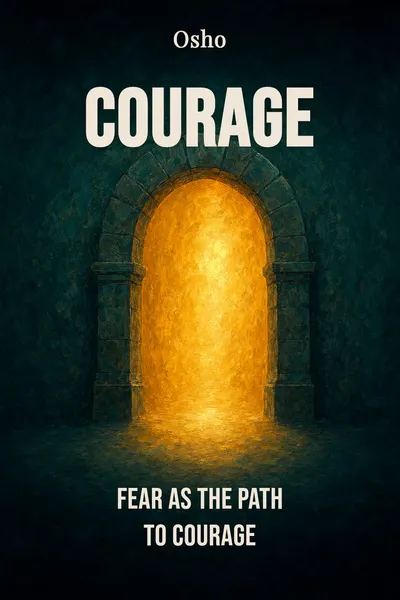
Fear as the path to courage
Description
There is a particular kind of person we tend to call courageous: the one who feels nothing as they walk toward the danger, calm where the rest of us would be shaking. It is a flattering image, and Osho — the Indian mystic born Rajneesh, who spent decades talking to seekers in Pune and Oregon — wants to take it apart from the first page of his book on the subject. The fearless person, in his telling, is not braver than anyone else. They have simply gone numb, or learned to look away. Courage, for Osho, has nothing to do with not feeling afraid.
His definition runs the other way. Courage is the total presence of fear, felt fully, with the willingness to move into it anyway. The trembling does not disappear; we go forward while trembling. That small inversion changes everything that follows, because it means fear stops being the enemy to be defeated and becomes the doorway to be walked through. The whole book is an attempt to map that terrain — where our fears come from, what they are really protecting, and why facing them turns out to be the same gesture as becoming fully alive.
What gives the argument its strange optimism is where Osho points it. The moments we dread most — the uncertainty, the change we didn't choose, the ground shifting under a settled life — are precisely the ones he treats as cause for celebration. Not because suffering is good, but because the familiar has a way of putting us quietly to sleep, and the unknown wakes us up. The question is whether we can learn to meet it as an adventure rather than a threat.
The question we’re asking : If courage isn't the absence of fear, what exactly is it, and why would anyone choose to feel afraid on purpose?What we’ll see : How a mystic reframes fear, security, and the unknown — and asks us to treat the trembling as an invitation rather than a warning.
Table of contents
01 Chapter 1 — Courage is not the absence of fear
The book opens by clearing away the image most of us carry. We imagine the courageous person as someone who has conquered fear, who stands unmoved while others panic. Osho calls this a misunderstanding, and a costly one, because it makes courage look like a trait we either possess or lack. If courage means feeling nothing, then those of us who tremble are simply disqualified, and there is nothing to be done. He refuses that. The fear, he insists, is always there in anyone alive enough to feel it.
His own formulation is almost paradoxical: courage is fear taken fully in. The brave person and the coward feel the same thing. The difference is that the coward lets the fear decide and retreats, while the courageous one feels every bit of it and steps forward regardless. The trembling is not a sign of failure. It is the body acknowledging that something real is at stake. To go ahead while shaking, rather than waiting for the shaking to stop, is the whole of what he means by courage.

02 Chapter 2 — Where the fear actually comes from
Having redefined courage, Osho turns to the fear itself, and here the book becomes a kind of excavation. Most fears, he argues, are not responses to present danger. They are inherited — handed down by parents, schools, religions, the whole apparatus that raises a child to be manageable. We are taught early what to want and what to dread, and by adulthood the warnings feel like our own instincts. A great deal of what we call our personality, in his account, is simply the shape our accumulated fears have pressed us into.
At the root, he locates a single fear that the others orbit: the fear of the unknown. Life is uncertain by nature, and the mind responds by building structures meant to make it predictable — beliefs, routines, identities, attachments. These give the comforting sense that we know who we are and what tomorrow holds. The trouble is that they are defenses against being alive, because to be alive is precisely to be exposed to what hasn't happened yet. The known is safe largely because it is, in a sense, already dead.
03 Chapter 3 — The leap into the unknown
If the deepest fear is of the unknown, then courage and the unknown are bound together, and this is where the book makes its turn toward celebration. Every moment of real growth, Osho argues, requires leaving the familiar — and leaving the familiar always feels like danger. The student who changes direction, the person who ends a comfortable but deadening relationship, the seeker who abandons inherited beliefs: each is being asked to let go of a certainty without knowing what replaces it. That gap, that not-knowing, is the precise spot where most people turn back.
He insists the gap is not to be avoided but enjoyed. Uncertainty, in his framing, is the texture of aliveness; a fully secured life is a contradiction. When the ground shifts — a loss, an upheaval, a change we did not choose — the instinct is to grab for the old handholds. Osho counsels the opposite: treat the disruption as an opening. The familiar had lulled us into a kind of sleep, and the unknown, frightening as it is, is what wakes us up to where we actually are.
04 Chapter 4 — Living dangerously, as a way of being
Step back from the particular fears and a larger picture emerges, and it is here that Osho's real proposal lives. He is not offering a technique for managing anxiety. He is describing an entire stance toward existence, which he sometimes calls living dangerously. The phrase is easy to misread as a taste for risk or thrill-seeking. He means something quieter and more demanding: refusing to organize a life around the avoidance of fear, and instead remaining permanently open to what cannot be controlled.
Underneath this lies a trust that distinguishes his view from ordinary self-help. The courageous person, in his account, is finally someone who trusts existence — who has stopped trying to wall life off and has begun to let it carry them. Where the fearful mind sees a hostile universe to be defended against, Osho sees a current worth surrendering to. Courage, then, is not a muscle we flex against the world; it is a relaxation of the grip, a willingness to be carried by something larger than our plans. The deepest fear and the deepest faith turn out to be facing the same uncertainty, with opposite postures.
05 Conclusion
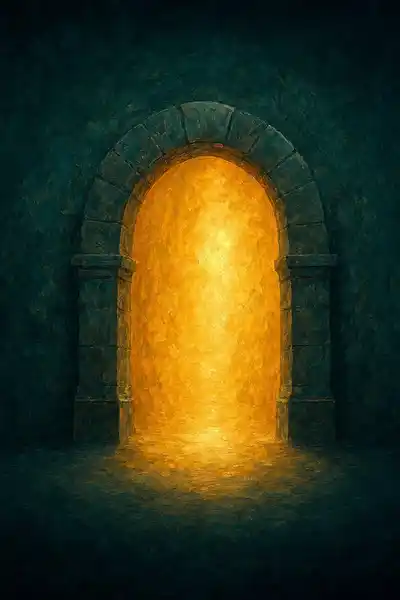
The image we began with — the fearless hero who feels nothing — turns out to be the opposite of what Osho values. The person who has stopped feeling fear has usually stopped feeling much of anything; they have bought their calm at the price of being fully awake. The courageous one, by contrast, trembles and goes forward, and it is the trembling itself that tells them they are near something alive. Fear is not removed from the picture. It is repositioned, from a wall into a door.
Related books