
Copies in seconds
The untold story of chester carlson and the revolutionary xerox machine: a communication milestone
Description
Chester Carlson invented the xerography copying process in 1938 and obtained patents, but had difficulty interesting companies in developing it commercially. In 1944, Carlson partnered with Battelle Memorial Institute, and in 1947 they licensed the technology to small photographic paper company Haloid.
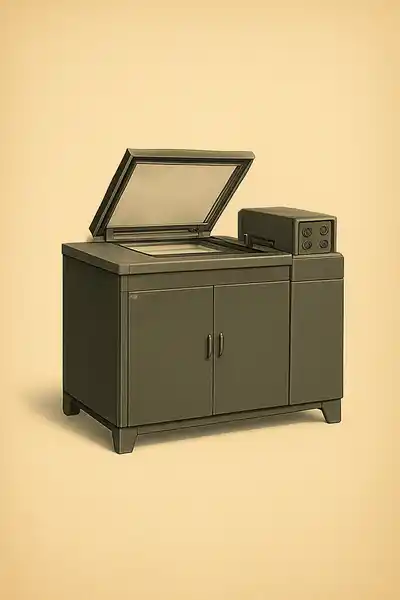
After years of engineering development, in 1960 Haloid launched the Xerox 914, the first automatic plain paper copier. The 914 was an immediate success, leading to rapid growth for Haloid, renamed Xerox Corporation. Xerography revolutionized document copying worldwide, although Carlson did not become wealthy from his invention before his early death in 1968.
Table of contents
01Carlson's invention
Chester Floyd Carlson, the inventor of xerography, was born in Seattle, Washington in 1906. His early life was marked by hardship; his father, a barber, contracted tuberculosis and arthritis, leading the family to move frequently in search of a better climate for his health. During high school, Carlson took on multiple jobs to support his invalid parents, earning $50-60 per month. Despite these challenges, he excelled academically and was inspired to become an inventor after reading about successful figures like Thomas Edison. From the age of 15, Carlson began recording his invention ideas in a diary, including concepts for a rotating billboard and a disposable handkerchief. His fascination with printing began early; at 10, he published his own typed newspaper and later acquired an old printing press, which he used to publish The Amateur Chemists’ Press. However, the laborious printing process, taking a week to publish his magazine, sparked his interest in finding more efficient duplication methods.

02Xerography's origin
Chester Carlson, after his father's death in 1932, dedicated himself to developing a copying machine. Despite losing his job at Bell Labs in 1933 due to the Great Depression, he remained undeterred. He found employment with patent firms and enrolled in night classes at New York Law School, all while continuing his research on printing and duplication. His breakthrough came in 1937 when he read an article by Hungarian physicist Paul Selenyi. The article introduced him to the principle of photoconductivity, which is the increased electrical conductivity of materials when illuminated. Carlson initially thought of using this principle to darken paper with electrical current, but realized the high current would likely set the paper on fire. Selenyi's article led him to consider using high voltage electrostatic charges instead, which involved much lower electrical currents. Selenyi had developed a method of transmitting images using a heated cathode and a rotating drum coated in insulating material. The cathode generated ions that were deposited onto the drum's surface, and the image was made visible by dusting the surface with a fine powder that stuck to the ions.
03Battelle's involvement
After obtaining his patent in 1937, Chester Carlson faced significant challenges in developing a working prototype of his electrophotography process. Despite having a clear vision, he lacked the necessary technical skills, funding, and lab space. In October 1938, he rented a room for his experiments and hired Otto Kornei, an Austrian physicist, as his research assistant. Kornei made significant progress in a short time, creating a crude prototype that demonstrated the basic principles of electrophotography.
However, Carlson struggled to secure financial backing. He approached over 20 major companies, including IBM, GE, and RCA, but without a working prototype, they showed little interest. He even offered IBM exclusive licensing rights for the U.S. and Canada, but they declined. A subsequent attempt to build a machine based on his patent drawings also failed.
04Haloid company's role
In late 1945, Joseph Wilson, the president of Haloid Company, a small photographic paper manufacturer in Rochester, New York, was determined to find a product that could compete outside of Kodak's shadow. He saw potential in electrophotography and secured a non-exclusive license from Battelle Memorial Institute to develop a copying machine based on the technology. Haloid's commitment involved payments to Battelle, starting at $10,000 in 1947 and increasing to $35,000 by 1951, a significant investment given Haloid's modest earnings of $100,000 in 1945. The deal was not seen as a major win by Battelle or Chester Carlson, the inventor of electrophotography, due to Haloid's size.
Initial progress was slow, with no research conducted by Haloid in the first two years, raising concerns that Carlson's key patent might expire before a viable product emerged. However, in 1948, the U.S. Signal Corps, which had previously bought Haloid's equipment during World War II, invested $100,000 in electrophotography. This funding, which eventually accounted for about half of Battelle's development costs, spurred progress. Breakthroughs, such as improving the photoconductive drum with selenium, were made and patented to secure a competitive edge.
05914 copier's introduction
In 1948, Battelle and Haloid unveiled the Xerox technology at the Optical Society of America's annual meeting in Detroit, aiming to demonstrate document copying in under a minute. This required designing "boxes" to house each manual step of the dry photocopying process. The effort, described by Haloid's head researcher John Dessauer as "prodigious," resulted in a crude but successful demonstration, producing a single blurry copy. Despite the modest outcome, Chester Carlson saw it as progress, leading to the release of the first Xerox copier, the Model A, nicknamed the "Ox Box" for its cumbersome operation and over four dozen manual steps required for copying. Initially, the Ox Boxes, wooden and painted silver, were sent to large companies for testing but were returned due to their complexity and poor copy quality.
06Public demonstration
In 1954, IBM approached Haloid Xerox with a proposition to manufacture and market a xerographic office copier, which promised a steady revenue stream. However, IBM's demand for an exclusive license would have barred Haloid Xerox from selling its own copiers, leading the latter to decline the offer in favor of continuing its own technology development. That same year, Haloid Xerox released the Copyflo copier, a machine that cost $130,000, was as large as a mail truck, required reinforced floors and 220-volt power, and could only copy from microfilm onto rolls of continuous paper.
It was designed for organizations with heavy documentation needs, such as the U.S. Navy, and about 500 units were sold. These sales accounted for 40% of Haloid Xerox's revenue from supplies in 1956, demonstrating the commercial viability of xerography. Consequently, Haloid Xerox shifted its focus towards creating an office copier. Battelle eventually sold all its xerography rights to Haloid Xerox for 53,000 shares of its stock and a 3% royalty, with Chester Carlson entitled to 40% of Battelle's xerography revenue, including the stock. The company was renamed to better reflect its focus on copiers, and land was purchased in Webster, New York for potential research and development expansion.
07Office photocopier release
Xerox traces its roots to a small photographic paper company named Haloid. Chester Carlson, a patent attorney, invented electrophotography in the late 1930s, a process that used an electrostatic charge to transfer images onto paper. Despite his efforts, over two dozen companies turned down his invention. It wasn't until 1947 that Haloid partnered with Carlson to develop the technology into a commercial product, leading to the launch of the Xerox 914 copier in 1960. This machine was the first automatic plain-paper copier and, despite its unreliability and frequent need for servicing, it was a hit for its convenience and speed.
To offset the high manufacturing costs of $2,000 per unit, Haloid adopted an innovative pricing model, charging $95 per month and five cents per copy after the first 2,000 free copies. This model proved lucrative as customers typically used between 40,000 to 100,000 copies monthly, far exceeding the estimated 2,000. By 1961, Haloid Xerox's revenues had nearly doubled to $64 million. The success of the 914 was unexpected, and production increased to 100 units per month to keep up with demand. Despite the machine's issues, no competitor could match its speed and convenience, and by 1965, Xerox Corporation's revenues were nearing $400 million. Over 200,000 units of the 914 were manufactured globally, and Fortune magazine hailed it as the most successfully marketed product in American history, considering the return on R&D investment. Carlson, who received millions in royalties, lived modestly and donated much of his wealth before his death in 1968, the same year as Haloid's CEO Joseph Wilson.