Cool Tools
The best tools, curated
Description
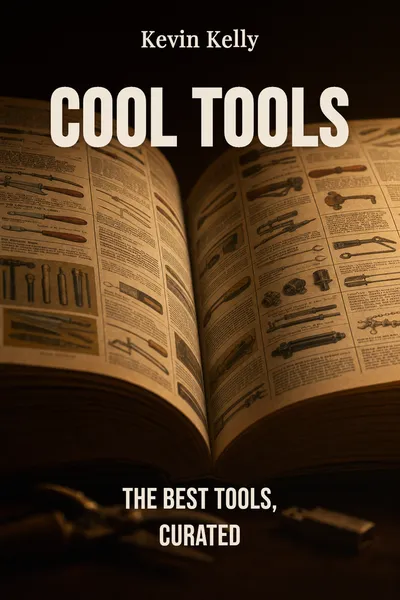
Around 2003, Kevin Kelly — a founding editor of Wired and, before that, a key figure at the Whole Earth Catalog — started sending friends short notes about things he'd found useful. A good pair of pruning shears. A book that actually taught welding. A piece of software that did one job well. He posted these recommendations on a blog he called Cool Tools, and other people started sending in their own. The notes piled up. By 2013 there were thousands of them, and Kelly gathered the best into a single oversized object: a 472-page paper book, the size of an old phone directory, printed in dense color, that he also titled Cool Tools.
The book is strange to hold. It looks less like a product than like a catalog from a hardware store run by extremely curious people. There are hand tools and tractors, sleeping bags and spreadsheets, maps, microscopes, websites, how-to manuals, and a generator that runs on wood. Nothing is sold inside it; Kelly's outfit had nothing to ship. What the pages offer instead is a recommendation — somebody used this thing, for real, and it earned its place. The format deliberately echoes the Whole Earth Catalog that Stewart Brand ran in the late 1960s and early 1970s, the publication that taught a generation it could equip itself to live differently.
The promise is small and enormous at once: that the right tool, the one you didn't know existed, can quietly change what you're able to do. Cool Tools isn't trying to be complete. It's trying to be good — a filter rather than a database, in an era when the problem was no longer finding options but choosing among too many of them.
The question we’re asking : How does a book that recommends pruning shears and software in the same breath end up saying something about how we equip ourselves to act?What we’ll see : How a personal recommendation habit became a curated catalog of the genuinely useful — and what its method reveals about tools themselves.
Table of contents
01 Chapter 1 — A catalog that started as an email
The lineage matters here, because Cool Tools doesn't pretend to be the first of its kind. Kelly had worked on the Whole Earth Catalog, Stewart Brand's project that, between 1968 and 1972, reviewed everything from goat-rearing guides to early personal computers under the banner "access to tools." The Catalog's premise was that ordinary people, given the right information about what existed and where to get it, could take their own lives in hand rather than depend on institutions. Steve Jobs would later call it one of the bibles of his generation, the paperback precursor to a Google search. Kelly absorbed that sensibility completely, then waited a few decades for the web to make a new version possible.
When he started the Cool Tools blog, the mechanism was almost embarrassingly simple. He wrote up things he found genuinely useful and asked readers to do the same. A reviewer had to have actually used the tool — no speculation, no press-release enthusiasm. Over a decade the site accumulated a deep reservoir of these accounts, written by farmers, programmers, parents, nurses, machinists, and hobbyists who knew their corner of the world. Each one read like a tip passed across a workbench rather than a verdict handed down from on high.

02 Chapter 2 — What makes a tool cool
The word "cool" in the title does real work, and it isn't about style. A cool tool, in Kelly's usage, is one that's the best of its kind for a particular job — durable, well-designed, fairly priced, and proven by someone who depended on it. Coolness is a verdict, not an aesthetic. A thirty-dollar item can be cooler than a thousand-dollar one if it does the work better and lasts longer. The judgment is ruthlessly practical, and it doesn't care about brand or fashion.
Kelly defines a tool broadly, and this is part of what gives the book its odd reach. A tool is anything useful: a hand plane, yes, but also a map, a how-to book, a website, a vehicle, a piece of software, a medical device, a method. Knowledge counts as a tool. So does access. If something extends what a person or a small group can accomplish, it qualifies — which is why a paper field guide and a cloud service can sit on facing pages without any sense of contradiction. The category isn't the object; it's the capability the object unlocks.
03 Chapter 3 — The crowd does the curating
The deeper innovation of Cool Tools is its method, not its contents. The contents date — a gadget recommended in 2013 may be obsolete now, and Kelly knew this when he printed a paper book about tools in a world moving online. What doesn't date is the editorial logic: a large, distributed crowd of real users, filtered hard by a small editorial hand, producing recommendations that carry the weight of experience rather than the weight of marketing.
This sits in deliberate contrast to two failures Kelly had watched up close. One is the expert review, which is informed but thin — a critic who tested a thing briefly for an assignment and moved on to the next. The other is the open rating system, the five-star pile of anonymous reviews that the web produced in abundance, which is broad but shallow and easily gamed. Cool Tools tries to take the best of both: the breadth of the crowd, the discernment of an editor who keeps only the accounts that ring true.
04 Chapter 4 — Tools as a way of seeing
Step back from the catalog and a larger conviction comes into view, one Kelly has held since the Whole Earth days: tools are not neutral conveniences sitting in a drawer. They shape what we believe is possible. A person who doesn't know a particular tool exists simply can't imagine the project it would enable. Half of capability, in this view, is knowing what's out there — which is why a catalog of the genuinely useful is more than a shopping aid. It's a way of expanding the reader's sense of what they could attempt.
This is why Cool Tools mixes a wood-burning generator with language-learning software with a good kitchen knife and feels coherent rather than scattered. The unifying thread isn't the category of object; it's the relationship between a person and what they can do. Each entry is really an argument that says: here is a door you didn't know was there. The book treats human capability as something extendable, almost infinitely, by the right additions — and treats ignorance of available tools as the main thing holding people back.
05 Conclusion
The paper Cool Tools is, in one sense, a beautiful anachronism: a heavy printed catalog of objects, published just as the web was making printed catalogs obsolete, by a man who understood that better than almost anyone. Many of its specific recommendations have aged out. But the book was never really a list of products to buy. It was a demonstration of a method — trusted users, hard filtering, lived experience over marketing — and that method has only become more relevant as the volume of options has kept climbing.
Related books