

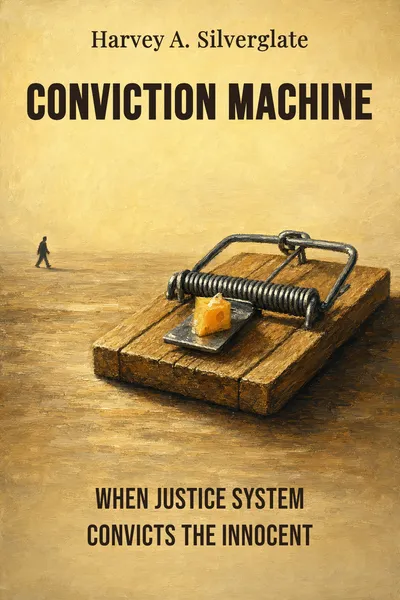
Conviction Machine
When justice system convicts the innocent
Description
Picture the moment a federal prosecutor decides to look at you. Not because a crime was reported, not because a victim came forward, but because your name surfaced in an investigation and someone upstairs wants a scalp. In the book Conviction Machine, the defense attorney Harvey Silverglate and the former federal prosecutor Sidney Powell describe this as the ordinary starting point of a great many federal cases — a target chosen first, a charge found later. That reversal, they argue, is not an aberration. It is close to how the system is built to run.
Silverglate had already made a version of this argument in his 2009 book, whose title alone summed up the thesis: the average American professional, he claimed, unknowingly commits several federal felonies a day, simply because the criminal code has grown so vast and so vaguely worded that almost any conduct can be reframed as a crime. Conviction Machine widens the lens. It traces how a prosecutor, once she has picked a target, can lean on broad statutes, the threat of ruinous charges, and a plea-bargaining system that makes going to trial feel like suicide — until a conviction arrives that may have very little to do with whether anyone actually did anything wrong.
The book is not a defense of the guilty. It is a warning about what happens to the presumption of innocence when the incentives of the people running the machine point almost entirely one way. The two authors come at it from opposite chairs in the courtroom, which is part of what gives the account its edge: one spent his career defending the accused, the other spent hers putting them away, and both arrived at roughly the same alarm.
The question we’re asking : What happens to the innocent when a prosecution system is optimized for convictions rather than for truth?What we’ll see : How a handful of structural features — prosecutorial discretion, elastic statutes, and the pressure to plead — combine into something larger than any of its parts.
Table of contents
01Chapter 1 — The prosecutor holds the deck
The starting point of the book is a shift in power that most people never notice, because it happens before a case has a public face. In the American federal system, Silverglate and Powell argue, the prosecutor is not one player among several. She decides whether to open an investigation, whom to target, what to charge, how many counts to stack, whether to grant immunity, and what deal to offer. Judges rule on what reaches them; grand juries approve nearly everything set in front of them. The prosecutor chooses what reaches both. That accumulation of discretion, exercised largely out of view, is where the authors locate the real center of gravity.
The problem is not that prosecutors are dishonest — the authors are careful about this. It is that the incentives reward aggression and punish restraint. Careers are built on high-profile convictions, not on cases declined. A prosecutor who wins is promoted; a prosecutor who decides the evidence is thin and walks away gets nothing to show for it. When the reward structure points that consistently in one direction, the authors argue, you do not need bad actors to get bad outcomes. You need ordinary ambition applied to a system with almost no counterweight.

02Chapter 2 — Statutes broad enough to catch anyone
If prosecutorial power is the engine, vague law is the fuel. Much of Conviction Machine is a tour through the statutes the authors consider dangerously elastic, and the recurring villain is the language of federal criminal law itself. Terms like fraud, honest services, obstruction, and conspiracy are written so broadly, they argue, that a determined prosecutor can fit an enormous range of ordinary conduct inside them. A statute meant to punish clear wrongdoing becomes a net wide enough to catch behavior no reasonable person would have understood to be criminal.
The authors dwell on the honest-services fraud statute as a case in point — a single sentence that, before the Supreme Court reined it in, had been used to criminalize a startling variety of conduct on the theory that someone had been deprived of another person's honest services. Mail and wire fraud get similar treatment: because almost everything now travels through a phone line or the mail, almost any transaction can be swept in. Conspiracy, meanwhile, allows a prosecutor to charge people for agreements that were never written down and for acts committed by others, provided the jury can be persuaded a common plan existed.
03Chapter 3 — Why almost nobody goes to trial
The image most people carry of criminal justice is the trial: two sides, a jury, a verdict reached in open court. The authors point out how rare that image now is. The overwhelming majority of federal convictions — something in the range of nine in ten — come not from trials but from guilty pleas. The trial, the constitutional centerpiece of the whole apparatus, has become the exception. Understanding how it disappeared is central to the book's argument about how the innocent get convicted.
The mechanism is plea bargaining, and the authors describe it less as a negotiation between equals than as a form of pressure. A prosecutor can stack charges so that a defendant faces the theoretical possibility of decades in prison, then offer a plea to a lesser count carrying a fraction of that time. The gap between the two is the leverage. Faced with the choice between pleading guilty to something and risking financial ruin, years of one's life, and the sheer uncertainty of a jury, even an innocent defendant may rationally conclude that pleading is the safer bet. The system, the authors argue, is engineered to make surrender look like the sensible option.
04Chapter 4 — A machine that runs without a driver
Step back from the individual cases and a larger claim comes into focus, which is where the book's title earns its weight. Silverglate and Powell are not simply cataloguing bad prosecutors or bad statutes. They are describing a system that has, over decades, quietly optimized itself for a single output — convictions — and that now produces that output almost automatically, whether or not the person at the end of it is guilty. No one person designed the machine to work this way. It assembled itself out of ordinary incentives, and it runs without anyone at the wheel choosing its direction.
This is the sense in which the metaphor is meant literally. A machine does not weigh justice against efficiency; it converts inputs into outputs. When a prosecution system measures success by conviction rate, rewards the people who raise it, and gives them elastic statutes and coercive plea leverage to do so, the pursuit of truth quietly stops being the point. Truth becomes, at best, a byproduct — sometimes produced, sometimes not, but never the thing the apparatus is actually tuned to deliver. The authors' worry is that a system indifferent to whether it convicts the innocent will eventually convict them at scale, not out of malice but out of momentum.
05Conclusion
The book ends where it began, with the ordinary citizen who never expected to become a target. Silverglate and Powell's account circles back to the uncomfortable implication of their opening: that the distance between a law-abiding professional and a convicted felon is not a gulf of guilt but a decision made in a prosecutor's office. The presumption of innocence, in their telling, has not been formally repealed. It has been outmaneuvered — by discretion, by vague statutes, by a plea system that rewards surrender, until it survives on paper more than in practice.