

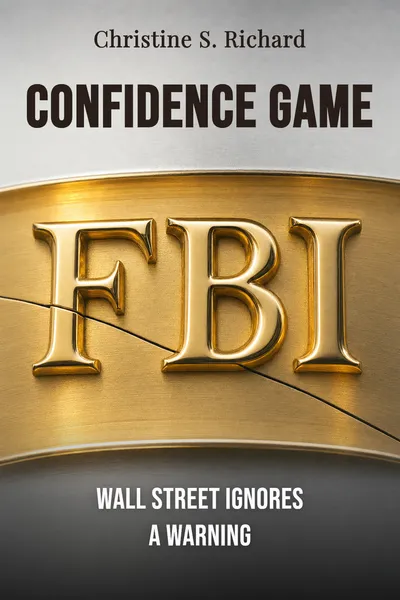
Confidence Game
Wall Street ignores a warning
Description
In late 2002, a young hedge fund manager named Bill Ackman began telling anyone on Wall Street who would listen that one of the safest-looking companies in finance was quietly rotten. The company was MBIA, a bond insurer based in Armonk, New York, that carried the highest possible credit rating — triple-A — and used it to guarantee the debt of towns, states, and, increasingly, exotic mortgage securities. Ackman, running a small firm called Gotham Partners, had bet against MBIA and published a long report arguing the rating was a fiction. The response was swift, and it was not agreement. MBIA complained to regulators. The New York attorney general and the SEC opened investigations — into Ackman, not the insurer.
Christine S. Richard, then a reporter at Dow Jones and Bloomberg, spent years following that fight up close, and her book Confidence Game turns it into a slow-motion account of how a correct warning can be treated as an attack. The mathematics Ackman laid out were not especially complicated. What made the story unnerving was that everyone who mattered — the rating agencies, the regulators, the other analysts — had incentives to keep believing MBIA was fine. Being right early, it turned out, looked almost identical to being reckless.
Then the housing market cracked, the mortgage securities MBIA had guaranteed began to fail, and the triple-A rating that had held for decades came apart. By the time the numbers proved Ackman right, the crisis he had described in miniature had gone systemwide. The interesting part is not that he saw it. It is why no one who could have acted did.
The question we’re asking : Why does a correct, public, thoroughly argued warning go unheeded until the losses it predicted have already happened?What we’ll see : How one investor read the footnotes of a triple-A company, what he found, and what the market's refusal to listen says about the machinery of belief on Wall Street.
Table of contents
01Chapter 1 — The short seller who read the footnotes
Bill Ackman was not a household name in 2002. Gotham Partners was small, and its founder had a reputation for stubbornness rather than genius. What set him apart on the MBIA question was a habit that sounds mundane and turned out to be radical: he actually read the filings. Not the press releases, not the analyst summaries — the footnotes, the guaranteed portfolios, the structures MBIA had insured and the capital it held against them. Richard's account keeps returning to this image of a man buried in documents that were public, available to everyone, and read closely by almost no one.
What Ackman concluded was that MBIA's business rested on a piece of circular logic. The company guaranteed other people's bonds, promising to pay if they defaulted. That guarantee was only worth something because MBIA itself carried a triple-A rating — the highest grade the agencies award. But MBIA earned much of its profit by insuring riskier and riskier debt, including complex mortgage-backed structures, while holding what Ackman argued was far too thin a cushion of capital underneath it. The whole edifice depended on the rating never being questioned, because the moment it was, the guarantees it sold would be worth less, which would justify questioning it further.

02Chapter 2 — How an insurer could be worth more than what it insured
To understand why the warning landed so badly, it helps to see what MBIA actually sold. Bond insurance is a strange product. A city wants to borrow money by issuing bonds, but investors worry about default. MBIA steps in and, for a fee, guarantees the payments. The city's bond now carries MBIA's triple-A rating instead of its own lower one, so it borrows more cheaply. Everyone appears better off. The insurer collects premiums, the city saves on interest, the investor gets a safe bond. For decades this was a quiet, profitable, almost boring business.
The problem Ackman identified was what happened when that model expanded beyond municipalities into structured finance. By the mid-2000s, insurers like MBIA were guaranteeing pools of mortgage debt and the elaborate securities built on top of them — collateralized debt obligations, tranches of tranches, instruments whose risk was genuinely hard to measure. The premiums were larger and the growth was faster. But the same thin capital base now sat beneath obligations that could all sour at once if housing turned, rather than defaulting one isolated town at a time.
03Chapter 3 — The years nobody listened
The most uncomfortable stretch of Confidence Game is the middle, when Ackman is simply right and nothing happens. He kept publishing, kept meeting with regulators, kept pressing the rating agencies to explain how their models justified MBIA's grade. The years passed — 2003, 2004, 2005, 2006 — and MBIA's stock held up, its rating held, its business grew. Being early, in markets, is often indistinguishable from being wrong, and for a long while Ackman bore all the costs of the latter with none of the vindication of the former.
Richard is careful about why the warning bounced off. It wasn't stupidity. Everyone in the chain had a reason to keep the belief intact. The rating agencies were paid by the issuers they rated and had built their franchise on the stability of companies like MBIA. Wall Street banks earned fees packaging the very securities MBIA insured and needed that insurance to sell them. Regulators saw a decades-clean insurer being attacked by a self-interested short seller. And investors holding MBIA-wrapped bonds had no appetite to hear that their safe assets weren't. A warning that threatened everyone's position at once was a warning almost no one could afford to act on.
04Chapter 4 — The market that only trusts confidence
Step back from the personalities and the MBIA story becomes a study in how markets actually decide what is true. In principle, a public company's health is a matter of numbers, and anyone with the numbers should reach the same conclusion. In practice, Richard's account shows a market that runs on something softer and more fragile: shared confidence. MBIA was solvent because everyone agreed to treat it as solvent, and that agreement was load-bearing. Ackman's real offense was not being wrong. It was threatening the confidence that held the structure up.
This is why the analysis alone could never win. Facts don't circulate in a vacuum; they circulate through people with positions to defend. The rating agencies, the banks, the regulators, the bondholders — each had staked something on MBIA's rating, and a fact that would cost all of them at once faces a headwind no amount of footnoting can overcome. The information was available for six years. What was missing was any incentive powerful enough to make someone act on it before the loss became undeniable.
05Conclusion
By 2008, the numbers had settled the argument that six years of reports could not. MBIA's rating was cut, its stock cratered, and Ackman's long, expensive bet against it turned into one of the more spectacular payoffs of the crisis. He had been right about the capital, right about the correlated risk, right about the fragility of a triple-A that everyone had agreed to trust. The investigations into him faded; the company he had warned about spent years litigating and restructuring what remained.