Common Sense on Mutual Funds
Bogle's new playbook for investors
Description
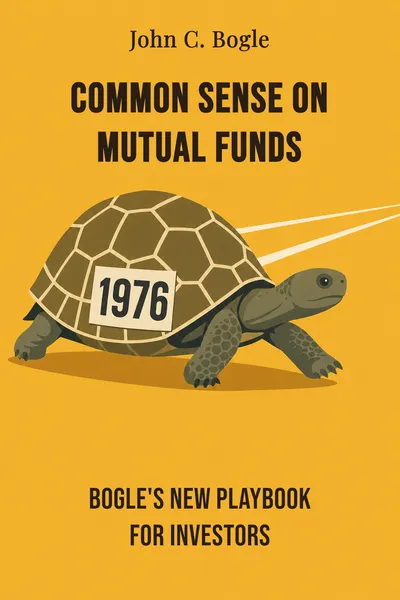
In 1951, a Princeton senior turned in a thesis on the mutual fund industry, an obscure corner of finance that managed a few billion dollars and almost nobody outside Wall Street had heard of. The student was John Bogle, and the thesis argued something modest: funds should be run in the interest of the people who owned them, not the people who managed them. Two decades later he founded Vanguard on exactly that idea, and in 1976 he launched the first index fund available to ordinary investors. The industry mostly laughed. They called it Bogle's Folly.
By 1999, when the first edition of Common Sense on Mutual Funds appeared, nobody was laughing. Indexing had gone from punchline to a serious force, and Bogle had become the closest thing American investing had to a conscience. But he was watching an industry he had helped build drift somewhere he didn't like. Funds were multiplying, fees were creeping, marketing was loud, and the basic deal offered to a saver had quietly gotten worse. So in the updated second edition he came back to do the unglamorous thing he'd always done: the arithmetic.
What follows isn't a stock-picking guide or a set of hot tips. It's closer to a long, patient conversation with someone who has watched this business from the inside for fifty years and has stopped being polite about what he sees. The case is built less on cleverness than on subtraction — on what investors keep after the industry has taken its share. The numbers are not complicated. The reason so few people act on them is the interesting part.
The question we’re asking : In an industry designed to look sophisticated, what actually determines what a long-term investor ends up with?What we’ll see : How a lifetime spent inside the fund business turned its most successful insider into its most stubborn critic — and what he wanted savers to understand before they handed over their money.
Table of contents
01 Chapter 1 — The arithmetic nobody wants to do
Bogle's argument begins with a tautology so simple it sounds like a trick. All investors, taken together, own the entire market. So all investors, taken together, must earn exactly the market's return — before costs. There is no other place for the money to come from. The market gives back what the companies in it produce: dividends and earnings growth. That gross return is a fixed pie, and every investor is eating from it at once.
From there the conclusion is forced. If investors as a group earn the market return before costs, then after costs they must earn less than the market return — by precisely the amount they pay in fees, trading commissions, and taxes. Active management can't change this for the group. For every fund manager who beats the market by a dollar, another must lag by a dollar, because together they are the market. Costs, though, are subtracted from everyone. The whole crowd of professionals is, by definition, average before expenses and below average after them.

02 Chapter 2 — The tyranny of compounding costs
A fee of one or two percent sounds like a rounding error, and that intuition is exactly the trap. Bogle's point is that costs compound the same way returns do, in the same direction, with the same patience — only against you. Over a few years the damage is modest. Over an investing lifetime it becomes the single largest factor separating what an investor earns from what the market handed out.
He works the example carefully because the result is hard to believe until you see it laid out. Suppose the market returns roughly 8 percent a year over several decades. A fund that costs 2 percent a year doesn't take 2 percent of your money. It takes 2 percent of the base every year, and that base would otherwise have been compounding. Run it across forty or fifty years and the difference is not a slice of the final wealth — it can be the majority of it. The fund company, contributing no capital and bearing no risk, ends up with more of the gains than the investor who supplied the money and absorbed the volatility.
03 Chapter 3 — Why funds beat themselves
The natural objection is obvious: fine, the average fund lags, but I'll just buy the good ones. Find the manager with the hot record and ride it. Bogle spends much of the book dismantling exactly this hope, and his weapon is the historical record rather than theory.
He points to reversion to the mean — the stubborn tendency of returns, like most things in markets, to drift back toward average. The fund that crushed it for five years is rarely the fund that crushes it for the next five. Often it is the reverse: the very factors that produced a hot streak, a concentrated bet or a style that happened to be in favor, turn into the drag when conditions change. Track the top-quartile funds of one period into the next and the ranking scrambles almost as if at random. Yesterday's winners are not a reliable map to tomorrow's.
04 Chapter 4 — The index, plain and unfashionable
The constructive answer Bogle offers is almost insultingly simple, which is precisely why it took an industry decades to take it seriously. Own the whole market through a low-cost index fund, hold it broadly, keep your costs near zero, and stop trying to be clever. The index fund doesn't try to beat the market; it tries to be the market, minus almost nothing. By giving up the attempt to win, it captures more of what's there than most of the people who keep trying.
But stepping back, the book is about something larger than which product to buy. It's a quiet argument about who the financial system is built to serve. An industry that profits from activity has every incentive to make investing look hard — to multiply choices, launch new funds, and keep the customer moving — because movement generates fees. Simplicity is the one strategy nobody on Wall Street can sell at a markup, and that, in Bogle's telling, is exactly why it's so hard to hear over the noise.
05 Conclusion
The Princeton thesis and the second edition, separated by nearly fifty years, make the same argument with the patience of someone who never expected the industry to agree. Funds should serve their owners. Costs matter more than anyone wants to admit. The market's return, claimed cheaply and held quietly, beats the long parade of strategies designed to capture it. Bogle had watched the fund business grow rich on the opposite belief, and he came back, older and blunter, to repeat the arithmetic for anyone still willing to finish it.
Related books