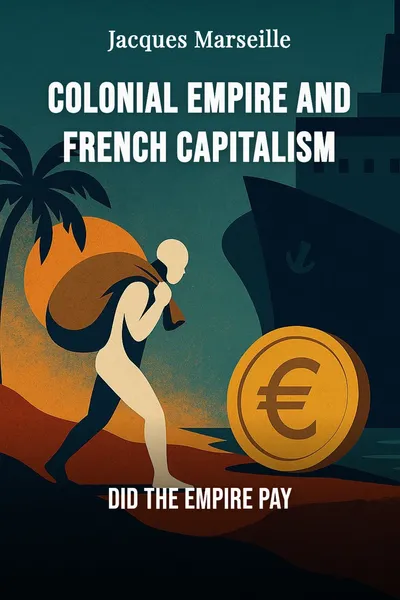
Colonial Empire and French Capitalism
Did the empire pay
Description
In 1984, a French historian named Jacques Marseille published a thick, austere book with an unpromising title: Empire colonial et capitalisme français. It had taken him years of digging through customs records, company balance sheets, trade statistics and the archives of the great colonial firms. What came out of that labor was a single, deceptively simple question that almost nobody had bothered to ask with real numbers in hand. France had spent close to a century telling itself a story about the empire — a story of grandeur, of civilizing mission, of a greater France stretching across three continents. Marseille wanted to know something narrower and far more awkward. Did any of it actually pay?
The assumption, on both sides of the political argument, had always been that it did. The right defended the empire as a source of prosperity and prestige; the anticolonial left attacked it as the brutal engine of French capitalist enrichment — colonies looted so that Paris could grow fat. Both camps agreed on the premise. The colonies made money for the metropole; they only disagreed about whether that was glorious or shameful. Marseille's archives told a stranger story. The two sides, he found, had been arguing about the morality of a profit that, taken as a whole and over the long run, may never have existed in the way everyone imagined.
The book landed quietly and then detonated inside the historical profession. It took a question loaded with ideology and answered it the way an accountant would — patiently, line by line, without raising its voice. The result unsettled the colonial nostalgics and the anticolonial economists at the same time, because it suggested that the empire and French capitalism had, by the end, grown apart rather than together.
The question we’re asking : When you actually tally the costs against the receipts, did the French colonial empire enrich the metropole — or was the whole arrangement a subsidy running the wrong way?What we’ll see : How a historian replaced a moral quarrel with a balance sheet, and what the numbers did to a story France had told itself for a hundred years.
Table of contents
01Chapter 1 — A question nobody had actually added up
The strange thing about the colonial debate before Marseille is how little arithmetic it contained. For decades the discussion ran on conviction. Defenders of the empire pointed to its scale — the maps colored in pink, the ports, the plantations, the sense that France mattered more because it reached farther. Critics on the Marxist left pointed to the extraction: raw materials pulled out cheap, finished goods sold back dear, a captive population made to buy what the metropole produced. Lenin's theory of imperialism hovered over all of it, the idea that advanced capitalism needed colonies as outlets for surplus capital and goods, that empire was not a political accident but an economic necessity.
Marseille's move was to take that necessity seriously enough to test it. If the empire was the lifeblood of French capitalism, then the accounts should show it — rising colonial investment, colonial profits flowing home, French industry leaning ever harder on its protected markets. So he went looking for the ledgers. He assembled trade figures running back to the nineteenth century, the balance sheets of the colonial trading houses and banks, the budgets that Paris poured into administering and defending its overseas territories. He wanted the flows, in both directions, over the long span.

02Chapter 2 — The colonies as a sheltered market
To see who actually benefited, Marseille shifted the camera from the nation to the firm. At that level, the empire was anything but worthless. It functioned as a greenhouse — a warm, protected space where certain French industries could sell what they could not easily sell anywhere else. Behind tariff walls that kept foreign competitors out, the colonies absorbed French textiles, French sugar, French manufactured goods that were often older in design and higher in price than what the open world market offered.
This was the genuine economic engine of the arrangement, and it explains why colonial lobbies fought so hard to keep the empire intact. For a cotton mill in the north of France, a sugar refinery, a shipping line, or one of the great trading houses operating along the African coast, the colonies were a guaranteed clientele. No need to modernize aggressively, no need to win a brutal price war against the British or the Germans. The market was fenced in and reserved. Marseille's point was sharp: this sheltered demand could be a profit for the individual company while being a drag on the economy as a whole, because it rewarded firms precisely for not adapting.
03Chapter 3 — When the arithmetic turned against the empire
The most unsettling part of Marseille's account is what happens to the balance over time. The relationship between empire and French capitalism, he argued, was not static. It had a trajectory, and the trajectory bent downward. In the early decades the colonies could still look like a reasonable bet for the metropole. But as the twentieth century advanced, especially from the 1930s onward, the costs rose and the returns thinned, until the whole arrangement started to look less like an investment and more like a liability the state kept carrying out of habit and pride.
The costs climbed for concrete reasons. Holding an empire grew more expensive as colonial populations grew, as expectations rose, as revolts and then wars demanded armies and money on a scale the old colonial budget had never imagined. The metropole found itself not extracting wealth but injecting it — building infrastructure, funding administrations, eventually financing development plans meant to quiet discontent. Public money flowed outward to keep the structure standing. Meanwhile the most advanced parts of French industry were discovering that the real growth lay elsewhere: in trade with wealthy, modernizing partners, in the European market that was beginning to take shape, in sectors where sheltered colonial demand simply did not matter.
04Chapter 4 — A divorce dressed up as a tragedy
Step back from the ledgers and Marseille's deeper claim comes into view. France experienced decolonization as a wound — the loss of Indochina, the trauma of Algeria, the sense of a great nation shrinking. The emotional story was one of amputation. But the economic story Marseille reconstructs is almost the opposite: a separation that the most modern parts of French capitalism had, in effect, already decided was overdue. The empire and French capitalism had not been fused in a permanent marriage of necessity. They had drifted into a relationship of convenience that was quietly ending on its own economic logic.
This reframes the whole quarrel the book inherited. If the dynamic economy no longer needed the colonies, then the Leninist premise — that advanced capitalism cannot survive without empire — does not hold for the French case, at least not in its late phase. And the nostalgic premise, that losing the empire impoverished France, inverts the real accounting. The years after decolonization were, famously, France's thirty glorious years of growth, achieved by a capitalism that had turned toward Europe and the world market rather than toward its former possessions. The nation let go of the thing it had been told it could not live without, and promptly grew faster.
05Conclusion
Marseille's book ends where it began, at the ledger, but the ledger now reads differently. The empire that France had argued over for a century — gloriously profitable for some, criminally profitable for others — turns out, in the aggregate and over the long run, to have been something harder to celebrate or to indict: a system of concentrated private advantage and diffuse public cost, paying handsomely for a few firms while the nation carried the overhead. The great colonial profit, tallied honestly, dissolves into a transfer the metropole largely financed itself.
Related books