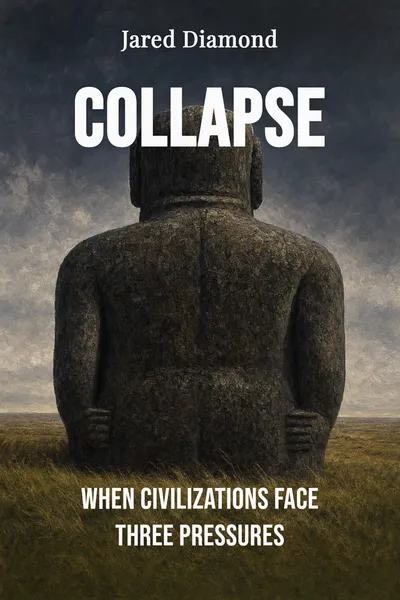
Collapse
When civilizations face three pressures
Description
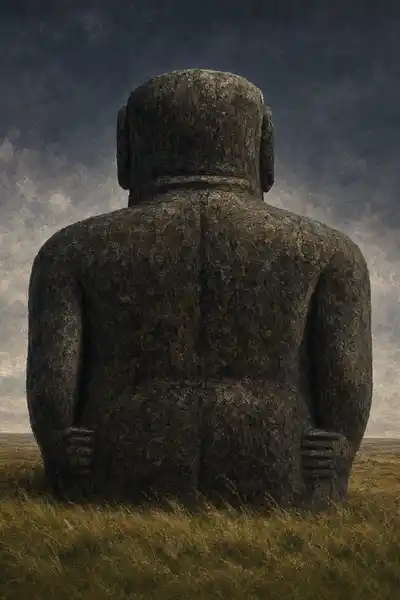
On a remote triangle of volcanic rock in the South Pacific, hundreds of giant stone faces stand with their backs to the sea, staring inland at grass. When Europeans landed on Easter Island in 1722, they found a treeless, wind-scoured place inhabited by a few thousand people — and these enormous statues, some weighing eighty tons, that those people could no longer move and could barely explain. Somebody had carved them, hauled them across miles of open ground, and raised them upright. Then somebody had stopped. The forest that made the hauling possible was gone, and so was almost everything it had supported.
Easter Island is the image Jared Diamond opens with in Collapse, his 2005 sequel to the Pulitzer-winning Guns, Germs and Steel. It is a tidy, terrible parable: an isolated society that cut down its last tree, lost the canoes it needed to fish and the rollers it needed for its monuments, and tipped into hunger, war and a long, slow unmaking. Diamond's wider project is to ask why some human societies fall apart while their neighbors, facing the same pressures, hang on. He looks at the Maya, the Anasazi, the Norse who vanished from Greenland, and at modern Rwanda, China and Montana, hunting for a pattern that connects them all.
What gives the book its edge is the refusal to treat collapse as something that happened to people stupider than we are. Diamond's failed societies were often sophisticated, well-organized and proud of what they had built. They did not see the end coming, or saw it and could not turn. The discomfort the book wants us to feel is the suspicion that we are reading about ourselves in a slightly older costume.
The question we’re asking : Why do some societies survive the pressures of climate, population and conflict while others, facing much the same pressures, come apart?What we’ll see : How a self-taught geographer of disaster traced the anatomy of collapse across centuries and continents — and arrived at an answer that lands closer to home than we might like.
Table of contents
01 Chapter 1 — The statues that watched an island die
Easter Island works as the book's overture because it is a closed system — a Pacific Petri dish. The Polynesians who arrived around 1200 CE found a forested island with palms, seabirds and rich volcanic soil. Over the following centuries they multiplied, organized into competing clans, and poured astonishing energy into carving and erecting the moai, the stone ancestors that signaled a clan's prestige. Moving them required timber for sledges and rope, and timber meant cutting trees. The competition that built the statues was, in Diamond's reading, the same competition that ate the forest.
The collapse he describes is not a single catastrophe but an erosion. As the palms disappeared, so did the canoes for deep-water fishing, the firewood, the windbreaks that kept the soil from blowing away and the habitat for the birds. Crop yields fell. The clans, no longer able to feed their populations or their rivalry with new monuments, turned on each other. Diamond cites traditions of warfare, the toppling of rivals' statues, and even accounts of cannibalism in the island's oral memory. By the time outsiders arrived, the moai had become headstones for a world that had already ended.

02 Chapter 2 — Diamond's five-fingered grip
Having opened with one island, Diamond builds a framework meant to travel. Collapse, he argues, tends to emerge from five sets of factors working together, and the mistake is to look for a single cause. The first is environmental damage a society does to itself — deforestation, soil erosion, salinization, overhunting. The second is climate change, which in his cases is natural rather than human-made: a run of droughts, a colder century, a shift in rainfall that turns a marginal living into an impossible one.
The third factor is hostile neighbors. Societies under strain rarely exist in isolation; a state weakened by famine becomes prey to enemies it once held off. The fourth is the loss of friendly trading partners — the supply lines and allies that propped a society up, which can dry up when the partner has troubles of its own. None of these four alone is usually decisive. A society can absorb a drought, a war or a bad harvest. It struggles when several arrive at once and reinforce each other, drought feeding conflict feeding the failure of trade.
03 Chapter 3 — Greenland and the Norse who farmed the wrong dream
The richest chapter in Collapse is the story of the Norse in Greenland. Around 985 CE, Erik the Red led settlers from Iceland to the island's fjords, where they built a Christian European farming society of churches, cattle and roughly five thousand people at its height. They lasted some four hundred and fifty years. Then, over the fifteenth century, they died out completely, while the Inuit who shared the island endured. Both faced the same cooling climate of the Little Ice Age. One group walked off the stage and one did not, and the difference is Diamond's whole point.
The Norse, he argues, brought a fixed idea of who they were and never let it bend. They were European cattle-and-sheep farmers, Christians who looked to Norway for trade and identity. They cleared fragile turf for pasture in a landscape that recovered far more slowly than the one back home, exhausting the soil. They built churches and imported stained glass and bronze bells when the calories were running thin. Most strikingly, they refused — on the evidence Diamond marshals — to eat the fish that swam in abundance off their coast, and never adopted the Inuit techniques for hunting seals through winter ice or for building kayaks suited to the conditions.
04 Chapter 4 — The societies that chose to last
The step Diamond takes, having buried the Norse, is to insist that collapse is not destiny. For every Easter Island there is a counter-case, a society that faced the same vise of climate, population and resource limits and squeezed its way through. He points to the highlands of New Guinea, where farmers worked the same plots for thousands of years by planting trees and managing the soil. He points to Tokugawa Japan, which faced catastrophic deforestation in the seventeenth century and responded with a top-down forestry regime that reversed it. He points to the tiny Pacific island of Tikopia, whose people made the collective decision to control their population and convert the island into a single sustainable garden.
What separates the survivors, in his account, is not luck or richer land. It is the capacity to perceive a problem before it becomes fatal and to act against entrenched interests and beloved habits — two things that are hard for any society to do at once: long-term thinking, and a willingness to let go of an identity that no longer fits the facts. The Japanese shogunate could impose forest discipline because power was centralized; Tikopia could limit its numbers because it was small enough to reach consensus. Each found a route Diamond calls courageous, because it meant choosing future survival over present comfort or pride.
05 Conclusion
The stone faces of Easter Island still stand, backs to the ocean, watching an island that can no longer explain them. In Diamond's hands they are less a mystery than a warning shaped like art — proof that intelligent, capable people can pour their dwindling resources into the very thing that finishes them, and never name the moment when restraint became impossible. The Maya cities, the silent kivas of Chaco Canyon, the abandoned Norse farms under Greenland turf all carry the same charge. They were not built by fools.
Related books