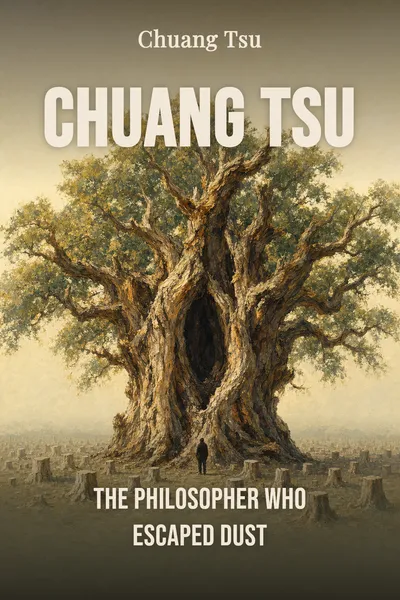
Chuang Tsu
The philosopher who escaped dust
Description
Around the fourth century BC, in the crowded intellectual marketplace of warring-states China, most thinkers were selling something. Confucians offered ritual and hierarchy, the Legalists offered discipline and punishment, the Mohists offered universal love enforced by policy. Rulers listened, hired, dismissed. Into this noisy scene walks a figure named Chuang Tsu — a minor official, by some accounts, who worked briefly in a lacquer garden and then, more or less, walked away. When the king of Chu reportedly sent envoys to make him prime minister, the story goes that Chuang Tsu asked whether they'd rather be a sacred tortoise, honored and dead in a temple, or a live one dragging its tail in the mud. He preferred the mud.
That anecdote may or may not be true — almost nothing about Chuang Tsu can be separated from legend, and the man himself would probably have found the distinction funny. What survives is the text: a collection of stories, dialogues and small explosions of fantasy, of which the first seven, the Inner Chapters, are the part most scholars trust to his own hand. Gia-fu Feng and Jane English translated them as a companion to their celebrated 1972 Tao Te Ching, and the pairing makes sense. If Lao Tsu gave the Tao its quiet aphorisms, Chuang Tsu gave it a voice that laughs.
What he was after was a way out of what the old phrase calls the whang cheng — the illusory dust of the world, the churn of rank and gain and opinion that everyone else was so busy managing. Not by conquering it, and not by fixing it, but by seeing through it entirely.
The question we’re asking : How does a philosopher escape the dust of the world without ever leaving it — and why does his answer still land?What we’ll see : A thinker who declined the game everyone else was playing, and the strange, funny, weightless philosophy he left behind instead.
Table of contents
01 Chapter 1 — A man who left almost no footprint
We know Chuang Tsu the way we know a rumor. The main historical source, written by the Han dynasty historian Sima Qian roughly two centuries after the fact, gives us a name — Chuang Chou — a birthplace in the state of Meng, and a modest post overseeing a lacquer garden. Everything else is anecdote, and the anecdotes were partly written by Chuang Tsu himself, who liked to put words in the mouths of Confucius, of robbers, of talking trees. The line between biography and fiction was never clean, and he seems to have preferred it that way.
This is not a gap the book apologizes for. Where the other schools of the period built careers on being consulted — the whole point of a philosophy, then, was to get a ruler to adopt it — Chuang Tsu treats worldly usefulness as a trap. The tortoise story is the clearest version. Offered the highest office in the land, the figure in the text turns it down not out of humility but out of clear-sighted preference: the honored life is a mounted, lacquered, lifeless thing, and he would rather drag his tail in the mud and stay alive.

02 Chapter 2 — The butterfly that dreamed a man
The most famous passage in the whole book is four sentences long. Chuang Tsu dreams he is a butterfly, fluttering about, happy, with no idea he is Chuang Tsu. Then he wakes, unmistakably himself. And he does not know: was he a man dreaming he was a butterfly, or is he now a butterfly dreaming he is a man? He calls this the transformation of things, and leaves it there. No resolution, no moral. The delight is in refusing to settle it.
The passage is doing something the surrounding culture was not. Confucius wanted to fix names to things — to call a ruler a ruler and a father a father, and to make conduct follow. Chuang Tsu keeps loosening the names back off. His long central chapter, sometimes rendered as "the equality of things," argues that the distinctions we treat as solid — right and wrong, useful and useless, this and that, even self and world — are angles of view, not features of reality. Every debater thinks he is right; from the mountain, the debate is just noise.
03 Chapter 3 — The uselessness that saves the tree
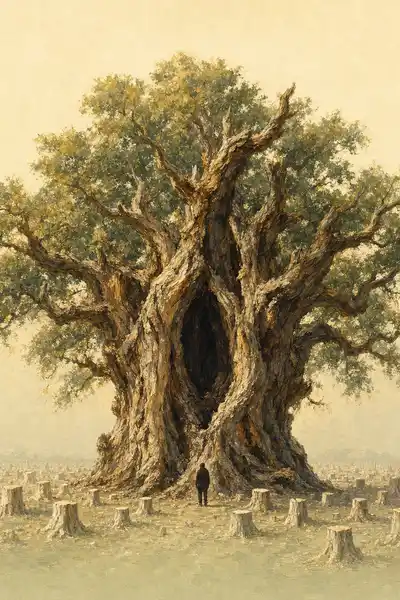
One of the recurring characters in the Inner Chapters is a tree — huge, ancient, gnarled — that a carpenter passes by without a second look. Its wood is knotted and useless; it would rot as a boat, split as a coffin, warp as a beam. And precisely because it is good for nothing, no one has ever cut it down. It grew enormous by being useless. The carpenter's apprentice is puzzled; the tree, in a dream, is not. Its uselessness is the whole basis of its long life.
This is the heart of Chuang Tsu's quarrel with his ambitious contemporaries. The straight, useful tree gets felled young. The talented official gets used up in service. Skill, virtue, reputation — the very things the other schools were cultivating like crops — are, in his reading, the ropes by which the world hauls you into its churn and wears you out. He is not against ability. He is against being defined by your usefulness to someone else's project, which is a slow way of losing your life while appearing to succeed at it.
04 Chapter 4 — The stillness that outlasts the argument
Step back, and what is unusual about Chuang Tsu is that his philosophy is built by subtraction. Nearly every other system on offer in his era, and most since, works by accumulation — more virtue, more discipline, more knowledge, more control. Chuang Tsu goes the other way. He takes things off: fixed categories, the drive to be useful, the need to win, finally even the firm sense of a separate self doing all the wanting. What is left when you keep subtracting is not emptiness in the bleak sense but a kind of unclenched ease, an emptiness that has room in it.
That gesture is why he anticipates so much of what came after. Zen's ego transcendence, the state of emptiness its teachers point at, is recognizably a descendant of the mind that dreamed the butterfly and could not say which way round it went. The refusal to grasp, the suspicion of the tidy answer, the trust that letting go is not losing but arriving — these are Taoist moves that Buddhism, arriving in China centuries later, found a ready-made soil already prepared for them. Chuang Tsu did not build a bridge to Zen. He was, in a sense, standing where the far end would land.
05 Conclusion
The tortoise in the temple and the tortoise in the mud are still the two choices Chuang Tsu leaves us with, and he never pretends the mud is glamorous. It is just alive. Everything in the Inner Chapters bends back toward that preference — the butterfly that will not resolve into man or insect, the useless tree that outlives the useful ones, the cook whose blade never dulls because it never forces. What connects them is not a doctrine but a temperament, a way of meeting the churn of gain and rank and opinion by declining to treat it as the only real thing.
Related books