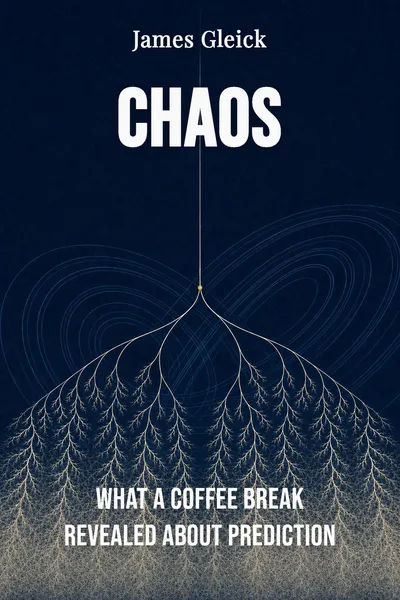
Chaos
What a coffee break revealed about prediction
Description
In the winter of 1961, a meteorologist named Edward Lorenz was running a weather simulation on a Royal McBee computer in his office at MIT. The machine churned through a set of twelve equations, printing out streams of numbers that stood in for wind and temperature. Wanting to re-examine a sequence, Lorenz took a shortcut: instead of starting over, he typed in the numbers from a printout halfway through and let it run. He went down the hall for coffee. When he came back, the weather the machine had produced was nothing like the run before. The two patterns, identical at the start, had diverged until they bore no resemblance to each other at all.
The cause turned out to be almost trivial. The computer stored numbers to six decimal places but printed only three. Lorenz had typed .506 where the machine had been holding .506127. A difference of one part in a thousand — the kind of rounding error every scientist had always assumed would simply wash out — had grown, doubling and redoubling, until it swamped the entire forecast. Long-range weather prediction, Lorenz realized, was not just hard. It was impossible in principle. And the same instability, he suspected, was hiding inside a great many systems that science had been treating as well-behaved.
That coffee break is one of the founding scenes of James Gleick's Chaos, the 1987 book that introduced a generation of readers to a science still being assembled in real time. Gleick's story isn't really about weather, or fractals, or any single equation. It's about a handful of researchers, scattered across fields that barely spoke to each other, who kept stumbling onto the same unsettling fact — that simple rules can produce behavior no amount of computing power can predict — and the slow, contested process by which their loose intuitions hardened into a discipline.
The question we’re asking : How did a stray rounding error, and the scattered people who noticed things like it, turn into a science with a name?What we’ll see : How disorder hiding inside simple equations was discovered, given a mathematics, and gradually recognized across fields that had no language for it yet.
Table of contents
01 Chapter 1 — The detail nobody was supposed to keep
Lorenz's insight had a poetic name before it had a respectable one. He liked to ask whether the flap of a butterfly's wings in Brazil might set off a tornado in Texas — and the phrase "butterfly effect" stuck, partly because the shape his equations traced on a graph happened to look like a butterfly's wings. The technical name was sensitive dependence on initial conditions. The idea was that in certain systems, the tiniest difference in where you start grows exponentially, so that any uncertainty in your measurement, however small, eventually makes the future unknowable. You could know the laws perfectly and still not know what comes next.
This was a quiet scandal. Since Newton, the working faith of physical science had been that nature was, in principle, predictable: give a system precise enough starting conditions and the laws would tell you its future for all time. Pierre-Simon Laplace had made the boast explicit two centuries earlier — an intelligence that knew the position and velocity of every particle could compute the entire history of the universe. Lorenz's twelve equations, modeling nothing more exotic than convection in the atmosphere, broke the boast. Determinism and predictability, it turned out, were not the same thing.

02 Chapter 2 — A coastline has no length
While Lorenz's weather sat ignored, a mathematician at IBM was circling the same territory from a wholly different direction. Benoit Mandelbrot was an outsider by temperament and biography — a Polish-born émigré who had bounced between disciplines and trusted his eye more than formal proof. At IBM's research center he was free to chase patterns wherever he found them, and he kept finding the same one: roughness that looked the same at every scale. Cotton prices, the rise and fall of the Nile, the static crackling on telephone lines — they all had a texture that didn't smooth out when you zoomed in. It just repeated.
Mandelbrot pressed the idea into a famous question: how long is the coastline of Britain? The answer, he showed, depends entirely on the length of your ruler. Measure with a long stick and you skip the inlets; measure with a short one and you trace every bay; measure with one shorter still and you follow every rock. The coastline doesn't converge to a number — it keeps growing as you look closer, because each magnification reveals new detail shaped like the whole. He coined a word for objects like this — fractals, from the Latin for broken — and gave them a strange property: a dimension that wasn't a whole number. A coastline might be 1.25-dimensional, sitting somewhere between a line and a plane.
03 Chapter 3 — Strange attractors and the shape of disorder
The breakthrough that turned scattered findings into something like a science came from a physicist studying the least glamorous subject imaginable. Mitchell Feigenbaum, working at Los Alamos in the mid-1970s, was looking at how orderly systems become turbulent. The model he used was a simple equation describing how a population grows and then crashes back. Crank a single parameter up slowly and the system goes through a sequence of changes: it settles to one steady value, then oscillates between two, then four, then eight, the period doubling faster and faster until it dissolves into apparent randomness.
Feigenbaum did the arithmetic by hand on a pocket calculator and noticed something extraordinary. The intervals between successive doublings shrank by a constant ratio — roughly 4.669. Then he tried entirely different equations, with different shapes and different physics, and the same number came out. The route from order into chaos had a universal measure, independent of the details of the system traveling it. Like the speed of light or the charge of an electron, this was a number that nature seemed to obey across cases that had nothing else in common.
04 Chapter 4 — Why the new science kept slipping between disciplines
Read straight through, the most striking thing about Gleick's history isn't any single discovery — it's how long it took anyone to notice they added up. Lorenz the meteorologist, Mandelbrot the mathematician at a computer company, Feigenbaum the physicist at a weapons lab, a young ecologist named Robert May who found chaos lurking in population models, a Santa Cruz group of graduate students chasing it in dripping faucets: none of them shared a journal, a department, or a vocabulary. Each kept discovering, more or less alone, that the smooth and predictable world of textbook science had been a selective edit. The mess had been there all along; it simply had no home.
That homelessness is the real subject under the equations. Universities organize knowledge into fields, and fields define which problems count as serious. A phenomenon that lives in the seams — too irregular for the physicist's clean models, too quantitative for the biologist, too applied for the pure mathematician — can sit in plain sight for decades because no discipline is responsible for it. Chaos was such a phenomenon. It became a science only when enough people noticed they were all describing the same animal, and when the cheap computer finally let them see the shapes their equations were making.
05 Conclusion
By the time Gleick was writing in the mid-1980s, the rounding error Lorenz had stumbled on twenty years earlier had a name, a mathematics, and a growing roster of converts who no longer had to explain why their work belonged anywhere. The butterfly effect had crossed from a meteorologist's private puzzle into common speech. Mandelbrot's fractals were being used to model coastlines and arteries and stock markets; Feigenbaum's constant had been measured in laboratories; the strange attractor had become an image people recognized without quite knowing what it meant.
Related books