Chaos Monkeys
Inside the tech bubble
Description
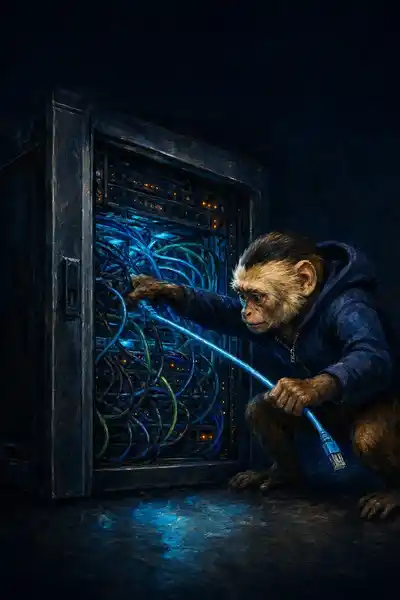
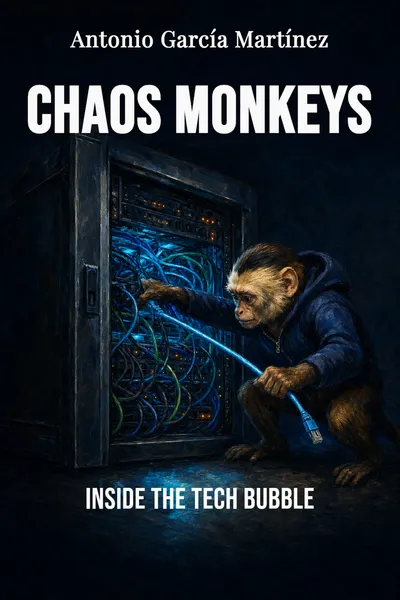
In 2016, a man who had spent the previous decade near the center of the technology industry published a memoir that most of his former colleagues wished he hadn't. Antonio García Martínez had a physics PhD he abandoned, a stint pricing credit derivatives at Goldman Sachs, a small ad-tech startup he co-founded, and a two-year run as a product manager at Facebook during the years the company was figuring out how to actually make money. He put all of it into a book called Chaos Monkeys, named after the software tool Netflix engineers built to deliberately break their own systems — to unleash a little chaos and see what survives.
The metaphor was the whole point. García Martínez saw himself, and the founders and operators around him, as the human version of that tool: agents of disruption loosed into markets and companies to smash things and find out what held. The book arrived reading like a hybrid of Michael Lewis's Liar's Poker and the paranoid social climbing of The Social Network, except written from inside, by someone still covered in the mud. It was gossipy, technical, profane, unflattering to nearly everyone — including its author, who came off as the least reliable and most self-aware narrator in the room.
What makes the book more than a settling of scores is what it lets us see. Behind the mythology of world-changing missions and hoodie-wearing visionaries, García Martínez describes an economy built on advertising data, acqui-hires, dilution clauses, and the cold arithmetic of who gets rich and who gets used. He was there when Facebook turned targeting into a business. He wrote it all down while the details were fresh and the wounds were open.
The question we’re asking : What does someone who was actually inside the machine — pricing the deals, shipping the ad products, watching the term sheets — see that the founder mythology is built to hide?What we’ll see : A firsthand tour through the incentives, the money, and the disposability that run underneath the industry's story about itself.
Table of contents
01Chapter 1 — From physics PhD to Goldman quant to nobody in particular
García Martínez opens with a résumé that reads like a slow drift away from certainty. He was a graduate student in physics at Berkeley, on the path toward the kind of academic career that had once looked inevitable, when he did the math on his actual prospects and walked away. Physics, it turned out, produced more brilliant people than the world had jobs for, and the ones who stayed were competing for scraps. He left the lab for finance, which in the mid-2000s was where quantitative people went to get paid for the same skills.
At Goldman Sachs he worked on the credit side, building models to price the exotic instruments that would, a couple of years later, help detonate the global economy. He writes about that world with the eye of someone who watched smart people construct machinery they didn't fully control, and who noticed how thoroughly everyone's incentives pointed toward not asking too many questions. When the crisis hit, the whole edifice looked less like a science than like a very well-dressed casino.

02Chapter 2 — AdGrok, and the art of getting acqui-hired
Frustrated at Adchemy, García Martínez and two engineers quit to start their own company, AdGrok, a tool to help small advertisers manage their Google campaigns. This is where the book becomes a field guide to how the startup game is actually played, stripped of the inspirational gloss. They got into Y Combinator, Paul Graham's accelerator, which he describes less as a school than as a rite of passage that hands founders a network, a stamp of legitimacy, and a crash course in raising money from people richer than they are.
The founding itself was messy in exactly the way the mythology never mentions. Adchemy, their former employer, threatened litigation over intellectual property, and García Martínez walks through the legal brinkmanship with relish — the posturing, the leverage, the way a threat of a lawsuit is really a negotiation about who has the nerve to keep going. Startups, he keeps insisting, are not built by geniuses executing a vision. They are built by people improvising through conflict, cash-strapped and terrified, making it up as the runway shrinks.
03Chapter 3 — Inside Facebook when the money problem got real
García Martínez arrived at Facebook in 2011, before the IPO, as a product manager on the ads team. The company had a billion users and a business model that Wall Street did not yet trust. Everyone knew Facebook could capture attention; the open question, worth tens of billions of dollars, was whether it could turn that attention into advertising revenue at the scale the valuation demanded. He was assigned, more or less, to help answer it.
The heart of the book is his account of the internal war over how to do that. Facebook sat on an extraordinary asset — detailed, self-declared data about who people were, what they liked, and who they knew — but connecting that data to advertisers' own information about their customers was legally and technically fraught, and politically radioactive inside the company. García Martínez worked on the projects that eventually became the plumbing for targeted advertising: the systems that let a business match its customer list against Facebook users and follow them across the web. He describes the engineering, but also the turf battles, the executives, the meetings where careers were made and unmade over which product would ship.
04Chapter 4 — The house always wins, and the players know it
Step back from the gossip and Chaos Monkeys is really an argument about what kind of machine Silicon Valley actually is. The title tells us: the chaos monkey deliberately breaks things to find out what survives, and García Martínez insists the whole industry runs on a version of that logic. Founders are loosed into markets to smash and disrupt; most fail, a few produce something, and the churn itself — the failed startups, the acqui-hires, the burned-out employees — is not waste but the mechanism by which the system finds what works. The disorder is the product.
In that reading, the disposability of people is a feature. The stock options that vest slowly enough to keep you compliant, the acqui-hire that buys your talent and discards your dream, the reorg that reassigns your life's work — these are not failures of a benevolent industry. They are how the machine keeps capital and talent flowing to wherever the returns are highest. García Martínez does not moralize about this so much as describe it with the flat clarity of someone who played the game and understood the rules. He got used; he also used others; the book refuses to pretend he was only ever a victim.
05Conclusion
García Martínez left Facebook, went to Twitter briefly as an adviser, and eventually retreated to a boat off the coast of Washington, writing the book that would make him unwelcome at most of the addresses on his old résumé. Chaos Monkeys is what a smart, compromised participant produces when he decides that the honest version of the story is more valuable than continued access to the club. He names names, spares no one, and least of all himself — which is precisely what gives the account its strange authority.
Related books