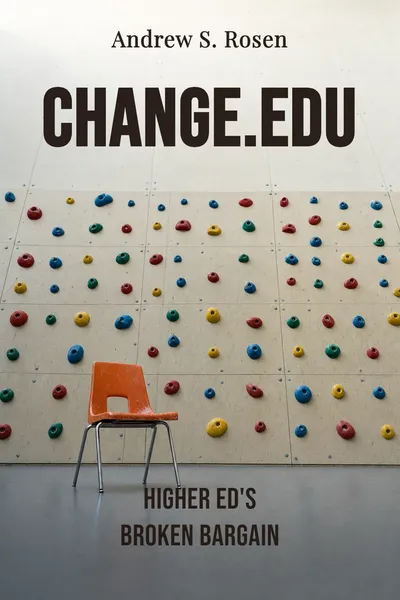
Change.edu
Higher ed's broken bargain
Description
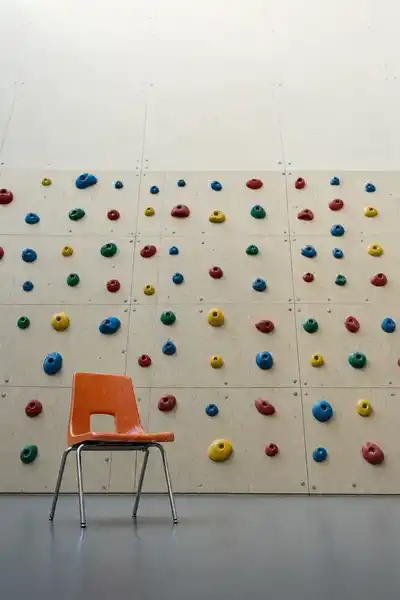
Take the standard campus tour at almost any American public university and you will notice what the guide is trained to show. The rock-climbing wall. The lazy river. The residence hall with a smoothie bar and a room the size of a hotel suite. The stadium expansion, the new recreation complex, the wellness center. Andrew Rosen, who spent years running one of the country's largest for-profit education companies, took a lot of these tours, and what struck him was the vocabulary. The pitch was about lifestyle, amenities, the experience. It was rarely, if ever, about what a student would actually learn, or whether they would graduate, or what it would cost when they were done.
A few miles away, in the same state, the picture inverts. A community college turns away thousands of applicants because it cannot fund enough sections of introductory algebra. A single mother who wants to become a nurse sits on a waiting list. A laid-off factory worker who needs a credential to get back into the labor market finds the door quietly closed. The money in American higher education, Rosen argues, has been flowing toward the students who need it least and away from the ones who need it most — and almost nobody planned it that way.
In Change.edu, Rosen sets out to explain how a system that was supposed to be about access, quality, affordability, and accountability came to reward something closer to the opposite. He is not a neutral observer, and he knows it. But his account of where the money goes, and who gets left standing at the door, lands whether or not one shares his conclusions about the fix.
The question we’re asking : How did a system meant to open doors end up spending the most on the students who need it least?What we’ll see : How the money actually moves through American higher education, who it was designed to serve, and what a country loses when its schools stop treating teaching as the job.
Table of contents
01Chapter 1 — The country club at the end of the tour
Rosen's opening move is to follow the money on a modern campus, and the trail rarely leads to a classroom. Over the past few decades, American universities have poured extraordinary sums into things a prospective student can see and touch on a Saturday visit. Residence halls have gone from cinder-block dormitories to apartment-style suites. Recreation centers now rival commercial gyms. Dining halls compete on cuisine. Athletic facilities, especially football stadiums, absorb budgets that would make a mid-sized business blush. The logic is competitive: eighteen-year-olds choosing between schools respond to what they can feel, so schools spend on feel.
The problem is that this arms race runs on borrowed time and other people's money. Amenities do not teach anyone anything, yet they drive up the sticker price that everyone — including the students who never use the lazy river — ends up paying for. Rosen points to the steady climb in tuition, far outpacing inflation and household income, and asks the uncomfortable question of what exactly all that extra money bought. Much of it, he argues, bought comfort and prestige rather than learning. The customer being courted is not the struggling adult who needs a skill; it is the affluent teenager choosing an experience.

02Chapter 2 — Who the system was built to serve
To see how the money got skewed, Rosen looks at who the system was designed around. The image most Americans carry of college — the leafy residential campus, four years away from home, football Saturdays — describes a shrinking slice of who actually needs higher education now. The traditional full-time eighteen-year-old living in a dorm is no longer the typical student. A large and growing share are older, working, raising children, commuting, and trying to fit study around a job. Yet the prestige, the funding, and the cultural attention still cluster around the traditional model.
This mismatch has real consequences for access. Selective public universities compete for high-achieving, often wealthier students, because those students lift rankings and bring resources. Community colleges and open-access institutions, which enroll the bulk of first-generation and low-income students, operate on a fraction of the per-student funding. When state budgets tighten, it is these under-glamorous schools — the ones doing the heaviest lifting on access — that get cut first. The students with the fewest options attend the institutions with the least money.
03Chapter 3 — When teaching became the thing you fund last
If amenities are where universities spend to attract students, teaching is often where they economize. Rosen walks through the internal reward system of the modern research university and finds that instruction sits surprisingly low on it. Faculty at prestigious institutions are hired, promoted, and celebrated primarily for research and publication, not for how well they teach undergraduates. A professor who wins a major grant or publishes in a leading journal advances; one who devotes those hours to teaching does not. The incentives point away from the classroom.
The consequence is a quiet substitution. Much of the actual instruction, especially in the large introductory courses that most students take, is delivered by graduate assistants and poorly paid adjuncts, while tenured faculty reduce their teaching loads to protect research time. Rosen is careful not to dismiss research — some of it is vital, and universities are among the world's great engines of discovery. His point is about proportion and honesty. Institutions that market themselves as places of teaching quietly organize themselves around something else, and students, paying more than ever, frequently get less attention than the brochure implied.
04Chapter 4 — The talent economy the country keeps missing
Step back from the campus tour and the balance sheet, and Rosen's larger claim comes into focus: a national education system exists, ultimately, to supply the country with the skilled people it needs. That is the job. And by that measure, the American arrangement has drifted badly. The economy increasingly rewards education and credentials, the demand for trained workers keeps rising, and yet the institutions best positioned to meet that demand — the ones that serve working adults at scale — are the least funded and the least respected.
The stakes are not just individual. Rosen frames higher education as economic infrastructure, as consequential to national competitiveness as roads or research labs. When a country lets its most advantaged young people compete for luxury campuses while its working adults sit on waiting lists, it is not merely being unfair; it is starving its own labor market of talent. Other nations expanding access aggressively are, in his account, out-investing the United States in exactly the capacity that determines future growth. The lazy river, in that light, is not a harmless indulgence — it is money that could have trained a nurse.
05Conclusion
Rosen ends where the campus tour began, but the meaning has shifted. The climbing wall and the widening stadium are no longer just quirks of an affluent institution competing for teenagers; they are the visible sign of a bargain that quietly changed its terms. A system founded to widen access has learned to profit from exclusivity, to fund comfort ahead of instruction, and to escape the simple test of whether its students learned anything at all. The working adult on the community-college waiting list is not an unlucky exception. She is the person the current arrangement was, in effect, built to keep waiting.
Related books