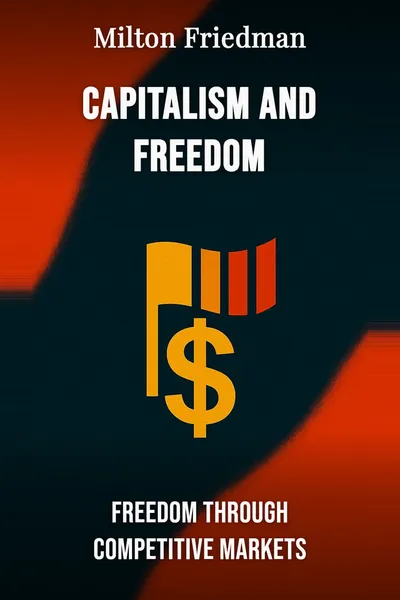
Capitalism and Freedom
Freedom through competitive markets
Description
In 1962, a University of Chicago economist named Milton Friedman published a slim book based on lectures he had given a few years earlier at a summer conference in Indiana. The political climate was not friendly to it. The New Deal consensus held, John Kenneth Galbraith was the celebrated economist of the day, and the prevailing assumption among educated people was that an active, expanding government was simply what a modern society did. No major newspaper reviewed the book. And yet Capitalism and Freedom went on to sell well over half a million copies in English, get translated into eighteen languages, and outlast nearly every bestseller that crowded it off the shelves that year.
The argument Friedman made was unfashionable to the point of seeming naive. He claimed that economic freedom and political freedom were not separate goods you could trade against each other, but two faces of the same thing — and that the competitive market, far from being a threat to liberty, was its most reliable guardian. Where most thinkers of his era saw the market as a problem the state existed to correct, Friedman saw the state as the standing danger and the market as the thing that kept power from pooling in one place.
That inversion is the whole book. It is not a defense of business, and Friedman is careful — sometimes brutally so — to say that the friends of capitalism and the friends of big corporations are often enemies. It is a defense of a particular arrangement of power, argued case by case, from money to schools to the color of a job applicant's skin.
The question we’re asking : How do we keep the things government does well without letting it quietly become the thing that takes our freedom?What we’ll see : How Friedman tied economic and political liberty into a single knot, and followed that knot into the most concrete corners of ordinary life.
Table of contents
01 Chapter 1 — The two freedoms that turn out to be one
Friedman opens by going after a distinction almost everyone in 1962 took for granted: that there was economic freedom on one side, political freedom on the other, and that a society might sensibly sacrifice some of the first to secure more of the second. The democratic socialist of the period believed exactly this — that you could nationalize industry, plan the economy, and still hold free elections and a free press. Friedman thought this was not just wrong but close to impossible, and most of the book is an attempt to show why.
His claim is that economic arrangements are themselves a form of freedom, and also the precondition for the political kind. The freedom to choose your job, spend your money as you like, start a business, or simply quit one employer for another — these are not lesser liberties hiding beneath the noble ones. They are liberties. And a person who depends entirely on the state for a paycheck, a permit, or a printing press is not in a strong position to criticize that state.

02 Chapter 2 — The state as referee, not player
If the market guards freedom, what is government for? Friedman is no anarchist, and he spends real effort defining the legitimate jobs of the state rather than wishing it away. The market needs rules, and rules need an enforcer. Someone has to define property, adjudicate disputes, enforce contracts, and provide the framework of law within which voluntary exchange can happen at all. The image he reaches for is government as a referee — setting and enforcing the rules of the game, not stepping onto the field to decide who wins.
He grants a few genuine exceptions where markets fail and the state has a real role. There are what economists call neighborhood effects, where one person's action imposes costs on others who never agreed to bear them — pollution being the classic case — and a market price cannot capture that on its own. There are technical monopolies, where competition is impractical. And there are the people who cannot be responsible for themselves, like children or the severely incapacitated, for whom the case for protection is paternal rather than economic. Friedman accepts each of these, though grudgingly, and warns that every one of them is an open door that interests will push wider than the principle allows.
03 Chapter 3 — The list of things government should stop doing
The most memorable part of the book is the most concrete: a running list of programs Friedman thinks fail their own stated goals and should be scrapped or rethought. He is not gesturing at a vague smaller state. He names things. Farm price supports, tariffs, rent control, minimum-wage laws, the licensing of doctors and barbers, public housing, the regulation of broadcasting, conscription in peacetime, the national parks as federal property — all of it gets the same cold examination, and most of it fails.
His reasoning is consistent. Take occupational licensing, which sounds like consumer protection. Friedman argues it mostly protects existing practitioners from competition, raising prices and shrinking the supply of doctors while doing little for actual quality. Take the minimum wage, sold as help for the poor: by making low-skilled labor more expensive than it produces, he argues, it prices the least employable workers out of jobs entirely, hurting precisely the people it claims to lift. The pattern repeats — a policy named for its good intentions, judged by its results, found to deliver the opposite.
04 Chapter 4 — Why the friend of freedom keeps losing the argument
Step back from the particular fights and a strange thing comes into view. Friedman won much of the intellectual contest — flexible exchange rates arrived, the volunteer army replaced the draft, vouchers and cash transfers became respectable, his ideas reshaped how economists and central bankers think. Yet the thing he was fighting, the steadily expanding state, kept expanding through it all. The book grows in influence while losing on the ground. Friedman himself noticed this and tried to explain it in later editions, and the explanation is the most useful thing in the whole project.
His answer is that freedom is structurally outmatched in the political arena. The cost of any single intervention is spread thinly across millions who barely notice it, while the benefit is concentrated on a few who feel it intensely and organize to defend it. The tariff helps one industry visibly and taxes every consumer invisibly. The license protects a known guild and excludes unknown newcomers who never get to complain because they never get in. Each measure is small; each beneficiary is motivated; each victim is diffuse. So the ratchet only turns one way.
05 Conclusion
The book that no major paper bothered to review in 1962 has now sold past half a million copies in English and traveled into eighteen languages, and it did so without ever softening its central claim. Friedman never separated economic freedom from political freedom, never treated the market as a regrettable necessity to be corrected, and never pretended that good intentions were the same as good results. He held that the competitive market was both a freedom in itself and the soil in which the other freedoms grow, and he was willing to follow that conviction into territory — schools, money, the draft, the licensing of barbers — where most philosophers never bother to go.
Related books