Capital in the Twenty-First Century
Two centuries of wealth data
Description
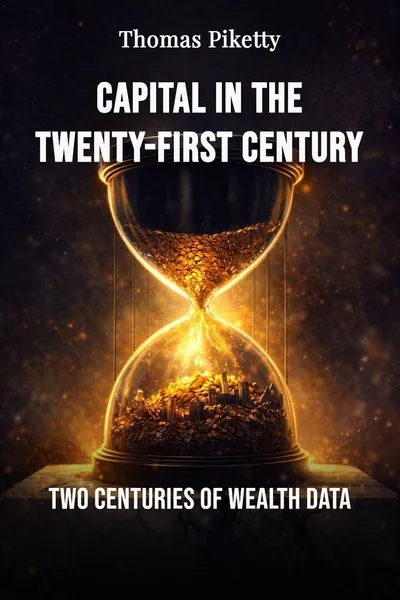
In 2013, a French economist named Thomas Piketty published a nine-hundred-page book with a title borrowed, half in homage and half in provocation, from Karl Marx. Capital in the Twenty-First Century was dense, footnoted, and built on decades of archival work — the kind of book that usually sells a few thousand copies to specialists and disappears. Instead it became a global bestseller. The English translation, out in 2014, spent weeks at the top of the Amazon charts, sold well over a million copies, and turned a soft-spoken professor into an unlikely public figure. People who would never open an economics textbook were suddenly arguing about a single formula.
What Piketty had done was different from what economists usually do. Rather than build a model and defend it, he and a network of collaborators had spent years digging through tax records, estate filings, and national accounts stretching back to the eighteenth century. France had unusually good data, thanks to a revolution that started measuring who owned what. Britain, the United States, and a handful of other countries filled in the rest. The result was the longest continuous picture of wealth and income ever assembled — two centuries of who had how much, and how that changed.
And the picture told a story that ran against a comfortable postwar assumption. For decades, economists had treated the relative equality of the mid-twentieth century as the normal condition of a mature market economy. Piketty's data suggested the opposite: that equality was the exception, produced by war and depression, and that the deeper tendency of capitalism pulls the other way. The question was why — and whether anything could be done about it.
The question we’re asking : What do two centuries of wealth records actually show about how capitalism distributes what it produces?What we’ll see : How a mountain of tax data revealed a quiet mechanism pushing wealth to concentrate, and what Piketty argues we could do about it.
Table of contents
01Chapter 1 — A book of ledgers, not of opinions
The first thing to understand about Capital in the Twenty-First Century is that its authority comes from measurement, not argument. Piketty is skeptical of economics as it is often practiced — the field's fondness for elegant equations detached from any historical fact. His method is closer to that of a historian who happens to count. Over roughly fifteen years, working with collaborators including Anthony Atkinson and Emmanuel Saez, he assembled data from more than twenty countries, some of it reaching back to the early 1700s.
The raw material was tax returns and inheritance records. When a state taxes income, it produces a paper trail of who earns what; when it taxes estates at death, it records who owns what. France, which introduced an income tax in 1914 and had kept meticulous estate records since the Revolution, offered an especially long and clean series. Britain and the United States, with their own long histories of fiscal record-keeping, allowed comparison. Piled together, these sources let Piketty track not just income but wealth — the stock of accumulated property, land, buildings, shares, and savings that most inequality studies ignore because it is so much harder to measure.

02Chapter 2 — When capital outruns growth
The engine of the argument is a comparison between two rates. The first is r, the average annual return on capital — what wealth earns for those who own it, whether as rent, dividends, interest, or capital gains. The second is g, the growth rate of the economy as a whole — how fast national income expands from year to year. Piketty's central claim is disarmingly simple: across most of recorded economic history, r has been greater than g.
The numbers he assembles put the return on capital at roughly four to five percent a year over the long run, remarkably stable across centuries and forms of property. Economic growth, by contrast, was close to zero for most of human history and only reached the one-and-a-half to two percent range in the industrial era — and even the high-growth decades after 1945 were, he argues, a temporary rebound from the destruction of two world wars. When r exceeds g, wealth accumulates faster than the economy grows. Money already piled up compounds more quickly than new money can be earned through work.
03Chapter 3 — The rich get richer, mathematically
The r-greater-than-g inequality drives two related tendencies, and Piketty is careful to separate them. The first concerns the overall weight of capital in the economy. As wealth compounds faster than income, the total stock of private capital swells relative to annual national output. In Europe before 1914, private wealth ran to six or seven times national income; it fell to two or three times in the mid-twentieth century, and by the 2010s it had climbed back toward five or six. Capital, in other words, was reclaiming the dominant place in economic life it had held before the wars.
The second tendency concerns who holds that capital. Because large fortunes earn higher and more stable returns than small ones — bigger portfolios can take more risk, pay for better management, and reach investments closed to ordinary savers — wealth does not just grow, it concentrates. Piketty points to university endowments as an unusually clean illustration: the largest, like Harvard's, earned markedly higher returns over recent decades than smaller ones, purely as a function of scale. Extended across a whole society, this means the very top pulls away not only from the poor but from the merely affluent.
04Chapter 4 — A tax nobody wants to collect
What lifts Capital in the Twenty-First Century out of pure diagnosis is Piketty's insistence that the trend is not fate. If inequality is structural rather than natural — produced by the specific rules governing property, taxation, and inheritance — then different rules can produce a different outcome. The book is, at bottom, a claim that distribution is a political choice dressed up as an economic law, and that we forget this at our peril.
His proposed remedy is deliberately ambitious: a progressive global tax on wealth itself, not just on income. A modest annual levy on large fortunes, rising with their size and coordinated across countries, would slow the compounding that lets capital outrun growth. Crucially, it would also require the wealthy to declare what they hold, producing the financial transparency that today's tax havens deliberately prevent. Piketty freely admits the idea is, in his own word, utopian — no world government exists to enforce it — but he offers it as a benchmark against which more partial measures can be judged.
05Conclusion
The formula at the heart of the book — r greater than g — reads like a footnote and lands like a thesis. Two centuries of ledgers, gathered from estate files and tax returns that were never meant to be read together, converge on a single unglamorous point: left to itself, accumulated wealth grows faster than the economy that surrounds it, and so it concentrates. The relative equality that shaped our sense of what capitalism is turns out to have been bought at the price of world wars and depression, then extended by taxes we have since abandoned.
Related books