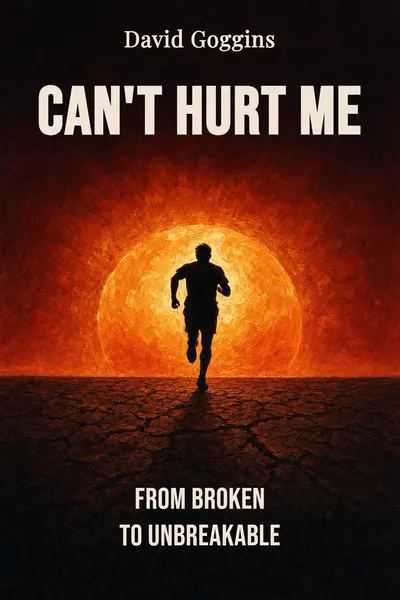
Can't Hurt Me
From broken to unbreakable
Description
In 1999, a twenty-four-year-old named David Goggins was working nights spraying for cockroaches in restaurants around Indianapolis, weighing close to 300 pounds, eating boxes of doughnuts on the drive home. One evening he caught the tail end of a Discovery Channel program about Navy SEAL training — men shivering in surf, carrying logs, breaking down on camera. Something in him went quiet and certain. He started calling recruiters the next morning. Most of them hung up once they heard his weight. He had failed the test to become an Air Force pararescueman years earlier, partly because of a learning difficulty he'd hidden his whole life, partly because he'd quit on himself. Now he wanted back in.
What followed reads less like a fitness story than a controlled demolition. To qualify for SEAL training he had to lose roughly 106 pounds in under three months, a number most people would call impossible and most doctors would call dangerous. He did it. Then he went through the SEALs' Hell Week three separate times, due to injuries and pneumonia, refusing to ring the bell that would have let him stop. By the time he was done collecting hard schools — Ranger, Air Force tactical air controller — he had become, as far as anyone can verify, the only person to complete all three. Then he started running 100-mile races on a whim.
The man who wrote Can't Hurt Me in 2018 is not interested in being admired. He's interested in something stranger: convincing the reader that the misery of his childhood and the misery he later chose for himself are made of the same material, and that material can be worked. The book sold millions of copies on word of mouth, which is its own kind of evidence.
The question we’re asking : How does someone manufacture toughness from a childhood designed to break him — and is the method transferable, or just the testimony of one unusually stubborn man?What we’ll see : We follow Goggins from the violence of his early years through the mental tools he built to survive it, into the physiology of pushing past where the body wants to quit, and finally toward what his life says about discipline as something made rather than given.
Table of contents
01 Chapter 1 — The boy who learned to hide the bruises
Goggins is unsparing about where he started, because the whole argument of the book depends on it. As a small child in Buffalo, he and his brother were put to work in the family's roller-skating rink, running it through the night while their father, Trunnis, ran the operation with a cruelty Goggins describes in flat, exact detail. There were beatings — of the children, of their mother — that left marks they covered with long sleeves and rehearsed explanations. He learned young that pain was a private thing you managed alone, and that the adults around you might be the source of it.
When his mother finally took the boys and left, they landed in Brazil, Indiana, with almost nothing. Poverty was one problem. Being one of the few Black families in a small, white, sometimes openly hostile town was another. Goggins recounts finding racist graffiti on a car, hearing slurs, absorbing the steady message that he didn't belong. The trauma showed up in his body: stress-related skin conditions, a stutter, and a reading problem severe enough that he was, by his own account, functionally faking his way through school, memorizing rather than reading, terrified of being found out.

02 Chapter 2 — The accountability mirror and the callusing of the mind
The first tool Goggins built has no equipment and costs nothing, which is part of why it travels. He calls it the accountability mirror. The idea is brutally literal: you stand in front of an actual mirror, you tell yourself the actual truth about where you are — overweight, undisciplined, lying to yourself — and then you write your real goals on sticky notes and post them on the glass. Not the comforting version. The version you'd be ashamed to say out loud. The mirror, in his telling, becomes the one place lying stops working.
Underneath the gimmick sits a serious claim about self-knowledge. Most of us, Goggins argues, run on a story about ourselves that's been quietly edited to feel survivable. We blame the childhood, the boss, the bad luck — and a lot of it may even be accurate — but the editing keeps us comfortable and stuck. The mirror is a way of refusing the edit. It's less about motivation than about ending a particular kind of self-deception, the kind that lets you off the hook every morning.
03 Chapter 3 — The 40% rule and the second wind nobody reaches for
The most quoted idea in the book is what Goggins calls the 40% rule: when your mind tells you that you're done, you're actually only about 40% spent. The number isn't a laboratory finding, and he doesn't pretend it is — it's a working figure drawn from his own experience of going far past the point where every signal said stop. The brain, he argues, is a deeply conservative governor. It throws up the white flag early to protect a body it assumes is more fragile than it is, and most people obey the first flag without question.
He learned this in the worst possible classroom. During his races and during military selection, he found that the moment of total collapse was almost never total. Behind it, if he kept moving, there was usually more — a reserve the body hides and the mind guards. The story he returns to is a 24-hour event he entered with essentially no ultra-running base, on a dare to himself, where his body broke down so badly he was urinating blood and the small bones in his feet were fracturing, and he kept going long past any reasonable line.
04 Chapter 4 — Suffering as a chosen tool
Step back from the records and the running, and the deeper move Goggins makes is about the nature of discipline itself. The common assumption is that disciplined people were lucky — given stable homes, good genes, the right encouragement — and that toughness is something you either inherited or you didn't. Goggins's entire life is a counterargument. He inherited the opposite: chaos, fear, a body and brain that had quit on him. What he built afterward, he insists, he manufactured, and the raw material was voluntary suffering.
That reframing is what makes the book land so hard in the particular moment it arrived. We live surrounded by an architecture of comfort designed to remove friction — one-tap delivery, endless scroll, climate control, the gentle nudge to rest whenever something gets hard. Most of the messaging around well-being treats discomfort as a problem to be solved. Goggins inverts it completely. For him, comfort is the enemy and discomfort is the gym. The harder thing is not a detour around growth; it is the only road there.
05 Conclusion
The man who couldn't get a recruiter to take his call ended up the only person to finish SEAL training, Army Ranger school, and Air Force tactical air controller training, and then kept going into ultramarathons and a pull-up world record he set partly to prove a point. Outside magazine called him one of the fittest men in America. But the through-line of Can't Hurt Me isn't the highlight reel. It's the insistence that the broken kid in Brazil, Indiana, and the man pushing past mile 70 on fractured feet are the same person using the same engine — pain, refused permission to dictate the outcome.
Related books