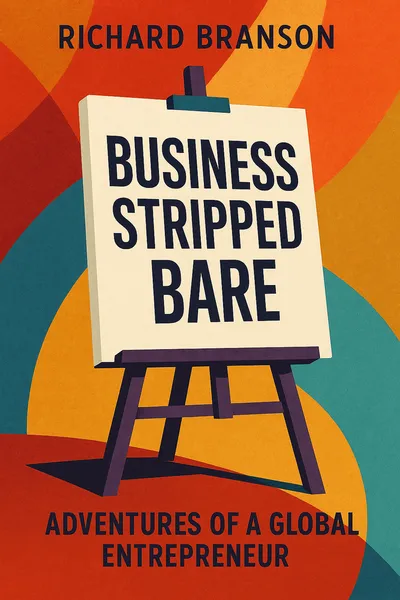
Business stripped bare
Creativity, ethics, and meaning
Description
Business is fundamentally about creativity, with no room for backtracking. It demands inventing solutions to problems rather than undoing what's already done. Success hinges on seven key elements, and the application of ethical principles.
The larger the enterprise, the more complex the ethical dilemmas. Success isn't about wealth accumulation, but about creating something meaningful and positively impacting others' lives. As Richard Branson says, it's not about following a guidebook, but about learning from experience and trusting your instincts. Every business, like every painting, has its own unique rules and dynamics.
Table of contents
01 1-team building - identify talented individuals and empower them with autonomy
Richard Branson once said, "Business has to give people enriching, rewarding lives, or it’s simply not worth doing". This sentiment is particularly true when starting a new company or expanding an existing one. The key to success lies in finding people who can think for themselves and giving them the creative freedom to make and execute good decisions. These individuals are not only energetic and enthusiastic, but they also possess distinguishing characteristics such as attentiveness, a willingness to go the extra mile, and a love for what they do. Once you find these individuals, it's crucial to place them in an environment where they can thrive. This often means avoiding restrictive atmospheres and instead fostering a small team or business setting. Virgin, for instance, has found that a team of about 100 people is ideal. If more people are needed, the company is split in two, allowing each to grow independently. This approach may not be feasible for large-scale enterprises, but it does offer significant advantages for most businesses.

02 2-brand development - ensure to fulfill all your commitments
The conventional wisdom in business suggests sticking to what you know, as companies often fail when trying to transfer their brands to new markets. However, Virgin stands as a notable exception to this rule. Between 2000 and 2003, Virgin established three startups in three different countries and two different industries, each becoming billion-dollar enterprises. Over the last thirty-five years, Virgin has created more billion-dollar companies in more industries than any other company, with the Virgin brand being the common factor. The Virgin brand guarantees high-quality products that won't dent your bank balance and promises more fun than expected. Richard Branson, the founder of Virgin, emphasizes that the brand has become a 'way-of-life' brand by focusing on the customer and their experience.
Virgin's brand was borngradually as Branson discovered his personal driving force: to find new ways to give people a good time in unexpected places. Virgin has always been known for its irreverent sense of humor, which works well because people like to feel like they are in on the joke. For instance, when Virgin Atlantic's redesigned salt and pepper pots started disappearing, Branson stamped the bottom of each pot with the words "Pinched from Virgin Atlantic", treating them as a fun and cheeky promotion. Virgin has been disarmingly honest about its ups and downs, openly celebrating setbacks and mistakes, which provides the brand with real-world credibility.
03 3-effective communication - articulate clearly and focus on the minutiae
Virgin's success is attributed to its focus on delivering what the brand promises, which boils down to two key factors: effective communication and attention to detail. Communication is crucial, with the CEO ideally updating staff weekly on developments. This can be achieved by keeping a notebook to jot down important points. Managers and owners should also experience their products first-hand to understand their customers better. This involves stepping out from behind the desk, sampling products, and noting what works and what doesn't. Addressing shortcomings promptly is essential. It's surprising how many businesses overlook the importance of good communication and attention to detail in their operations. To excel in delivering value, one must be proactive in these areas.
04 4-embrace failures - confront uncomfortable truths and persistently progress
In the realm of business, the only certainty is that everyone will make mistakes, including you. When you hire people, you're essentially investing in their potential errors from the start. The optimal strategy is to employ individuals who are intelligent enough to learn from their mistakes, and to adopt the same approach yourself. Virgin, for instance, has had its fair share of notable blunders. In 1969, Richard Branson was caught exploiting a loophole in government regulations related to sales tax on records. He falsely claimed that records were for export and thus not subject to sales tax, when in reality, they were merely being transported across the English Channel and then returned to the UK. Eventually, Customs agreed not to prosecute as long as Virgin Records repaid three times the unpaid tax. In 2007, a Virgin Trains-operated train derailed at over 100 mph, injuring 24 people and killing one passenger.
05 5-foster innovation - address obstacles by implementing enhancements
Richard Branson, the founder of Virgin Group, emphasizes the importance of innovation in business, especially in a rapidly changing market. He believes that the key to navigating through a crisis is through constant experimentation and adaptation. In the 21st century, businesses must be creative and responsive to keep moving forward. This is particularly true for smaller companies, which can adapt more quickly than larger enterprises.
Despite the challenges, innovation is crucial for all businesses, regardless of their size. Virgin Group, for instance, has always prided itself on its innovative customer services. For example, during the early planning stages of Virgin America, the management team sought to differentiate itself from other airlines by enhancing the customer experience. They designed a cabin that was more liberating, with each seat equipped with an individual in-flight entertainment screen and an inbuilt keyboard, allowing passengers to chat with each other, order food, and plug in their own devices at their convenience. To further enhance the flight experience, the planes were fitted with a new lighting system to create an impression of space and freedom.
06 6-exhibit strong leadership - inspire everyone to adopt an entrepreneurial
True leadership, as Richard Branson suggests, requires the ability to discern between real and apparent danger, a skill applicable in various fields from business to extreme sports. Understanding the challenges your enterprise faces and confronting them is crucial, as is resisting the urge to overreact at the first sign of trouble. Effective leadership in business boils down to two essentials: knowing whether you're a manager or an entrepreneur and playing to your strengths, and understanding everything about your business, especially in its early stages. Entrepreneurs thrive in the uncertainty of start-ups, while great managers are the glue that holds an enterprise together, implementing systems that ensure smooth and profitable operations. It's important to know which role suits your talents and temperament best and excel in it.
07 7-corporate social responsibility - achieve profitability while contributing
Despite the billions of dollars invested in development aid and emergency relief over the years, we still witness over 16,000 people dying daily from preventable diseases like Aids and TB. Half the world's population lives on less than $2 per day, and one billion people lack access to drinking water. These persistent problems are not due to a lack of effort or commitment from the social and environmental sectors. However, without the influence of market forces and businesses, we end up with a market of good intentions. Richard Branson believes in the concept of enlightened self-interest, where it's possible to turn a profit while making the world a better place. He asserts that capitalism, when generously and humanely defined, can create solutions to the world's problems.
Related books