Business Model Generation
Reinventing business from the ground up
Description
Sometime around 2008, a Swiss researcher named Alexander Osterwalder and his former doctoral advisor, Yves Pigneur, did something unusual for two academics writing a business book. Instead of finishing it behind closed doors, they invited 470 practitioners from forty-five countries to co-write it with them, charging each a fee to join an online community and shape the manuscript as it went. The result, published in 2010, looked nothing like a normal management text. It was designed like a magazine, full of sketches, sticky notes and hand-drawn diagrams. It was called Business Model Generation, and it sold over a million copies in close to thirty languages.
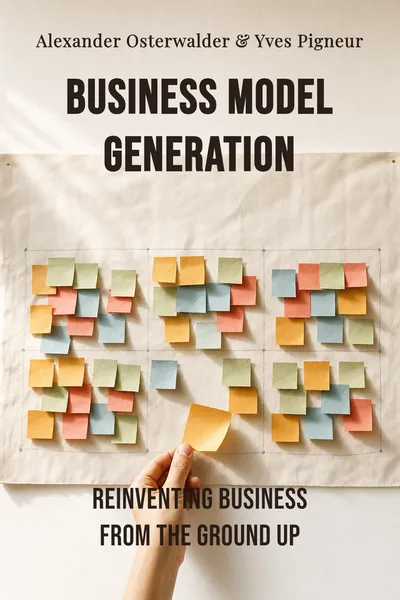
What made it land was not a new theory of competition or a clever growth formula. It was a picture. At the center of the book sits a single diagram, nine connected boxes on one page, that the authors named the Business Model Canvas. The promise was disarmingly simple: any business, from a corner bakery to a multinational, could be described on that one sheet, and once it was visible to everyone in the room, it could be questioned, pulled apart and rebuilt. The canvas turned something most people carry around as a vague intuition into something you could point at, argue about and redraw together.
That shift — from a thing felt to a thing drawn — is the quiet engine of the whole book. Osterwalder and Pigneur were not promising a shortcut to a better company. They were handing over a shared vocabulary and a working surface, the way an architect hands over blueprints, so that the messy question of how an organization actually creates and captures value could finally be discussed out loud.
The question we’re asking : Why does drawing a business on a single shared page change how a company can be reinvented?What we’ll see : How two researchers turned the slippery notion of a business model into a visible, editable object — and what they expect us to do with it.
Table of contents
01 Chapter 1 — A single shared language for how a business works
The book opens with a complaint dressed up as an observation. Everyone uses the phrase business model, and almost nobody means the same thing by it. Executives invoke it in strategy meetings, journalists reach for it to explain a startup, investors weigh it before writing a check — and yet ask three people in the same company to define theirs, and you get three different answers that never quite connect. Osterwalder and Pigneur argue that this fuzziness is not harmless. It quietly blocks the conversation, because people cannot redesign something they cannot describe.
Their definition is deliberately plain. A business model is the rationale of how an organization creates, delivers and captures value. Three verbs, and that is on purpose. Most discussions stall on only one of them — usually how a company makes money — and miss that value has to be created and actually delivered to someone before any of it can be captured. The authors want all three in view at once, because a model that captures value brilliantly while creating very little for anyone is exactly the kind of thing that looks healthy until it suddenly is not.

02 Chapter 2 — Nine boxes that hold an entire company
The Business Model Canvas breaks any organization into nine building blocks, arranged on one page so the eye can travel across them. On the right sits everything facing the customer; on the left, everything that makes delivery possible; and along the bottom, the money that runs both ways. The genius is less in any single box than in seeing them together, with the lines of dependency between them made visible.
At the heart is the value proposition — the bundle of products and services that solves a problem or satisfies a need for a specific group. To its right are the customer segments a business chooses to serve, the channels through which it reaches them, and the customer relationships it maintains, from self-service to dedicated account managers. These four blocks answer the question of who the business is for and how it shows up in their lives. They are the part most companies think they understand and, the authors suggest, most often get wrong by guessing rather than checking.
03 Chapter 3 — Patterns, sketches, and the work of stress-testing
A blank canvas is not much use on its own, so the second half of the book stocks the toolbox. Osterwalder and Pigneur catalog recurring business-model patterns — shapes that show up again and again across very different industries. There is the unbundled model, which separates customer-relationship businesses from infrastructure businesses from product-innovation businesses, since each runs on a different logic. There is the long-tail model, selling many niche items in small quantities. There are multi-sided platforms that create value by connecting distinct groups, the free model where one segment subsidizes another, and open models that draw on outside partners for innovation. These are not recipes to copy; they are reference shapes, the way a chess player recognizes openings.
04 Chapter 4 — Why a model is something you redraw, not defend
Step back from the nine boxes and the sticky notes, and a deeper claim comes into focus. Osterwalder and Pigneur are not really selling a diagram. They are arguing that a business model should be treated as a hypothesis — a current best guess about how value gets created and captured — rather than a fixed asset to be protected. That distinction changes almost everything about how a company relates to its own success.
An asset is something you defend. A hypothesis is something you test, and expect to revise. The whole apparatus of the book — the cheap prototypes, the willingness to draw several versions and discard them, the deliberate hunt for where a model breaks — only makes sense if the model is provisional by nature. The canvas is designed to be erased. Its lightness is the message: if rebuilding your model feels like a small act rather than a crisis, you will do it sooner, while you still have room to maneuver.
05 Conclusion
The book that 470 strangers helped write turned out to be a tool you can teach in an afternoon. That was always the point. By the time the canvas reaches its reader, the nine boxes feel obvious — which is the highest compliment a thinking tool can earn, and also the easiest way to forget how much careful work went into agreeing on the language first. The whole arc, from a fuzzy phrase nobody could define to a company sketched on a single sheet, was built to make reinvention feel like something you do, not something that happens to you.
Related books