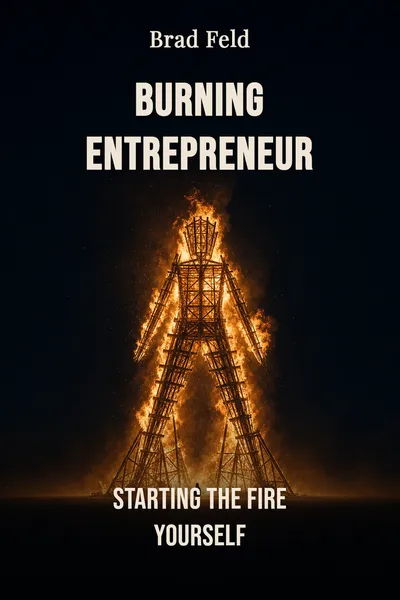
Burning Entrepreneur
Starting the fire yourself
Description
Every August, tens of thousands of people drive into the Black Rock Desert in Nevada to build a temporary city, live in it for a week, and then burn a giant wooden figure before leaving no trace behind. Burning Man is not a music festival and not quite a party. It is a ritual of radical self-expression, where what you make of yourself in the dust is the whole point. Brad Feld, a venture capitalist who helped build Foundry Group and co-founded the startup accelerator Techstars, has been a regular. And somewhere along the way he noticed that the people he funds back home are chasing the same thing on a different playa.
That parallel gives his book its title. The burning entrepreneur is someone who treats building a company not as a way to get rich but as the ultimate act of self-expression — the fire you light yourself, knowing it might consume you. Feld has spent decades watching founders catch that flame, and watching plenty of them get badly burned. He has written and invested through several boom-and-bust cycles, and his blog, Feld Thoughts, has been one of the more candid voices in tech precisely because he refuses to pretend the work is clean or the odds are good.
What makes his guide unusual is that it reads less like a playbook and more like a long conversation with someone who has seen the whole arc — the raising, the running, the unraveling — and decided to tell you the truth about all three. He is not selling the dream. He is describing what the dream actually costs, and why some people keep paying it anyway.
The question we’re asking : What does Feld actually mean when he treats building a company as self-expression rather than a financial bet, and what does that change about how you start, fund, and survive it?What we’ll see : How an insider who has funded hundreds of companies describes the fire, the money, the wiring it takes to keep going, and the kind of person it slowly makes of you.
Table of contents
01 Chapter 1 — The man who turned the desert into a method
Brad Feld came up through the first internet wave. He sold his first company, Feld Technologies, in the early 1990s, then moved into investing, made and lost money through the dot-com crash, and eventually co-founded Foundry Group in Boulder, Colorado, in 2007. Along the way he helped launch Techstars, the accelerator model that gives small cohorts of founders mentorship, a little capital, and a brutal deadline. He has backed hundreds of companies. He has also sat on the boards where many of them quietly died. That double vision — funder and witness — is what gives his writing its weight.
The Burning Man connection isn't a marketing flourish. Feld is genuinely shaped by it. The festival runs on ten principles, and the one that matters most to him is radical self-reliance paired with radical self-expression. You bring what you need, you build what you want to build, and nobody is coming to rescue you. The desert doesn't grade you. It just reflects back whatever you put into it. Feld saw the same logic in the founders worth backing: they weren't optimizing a spreadsheet, they were making something that expressed who they were.

02 Chapter 2 — Money is a relationship, not a transaction
When Feld writes about raising money, the first thing he does is strip away the fantasy that funding is a finish line. Closing a round feels like winning, but it is really just signing up for a relationship that can last a decade, with someone who now owns part of your company and a seat at your table. He has been on both sides of that table enough times to know that founders routinely misjudge it — chasing the highest valuation, the biggest name, the fastest yes, when what they should be evaluating is whether they can stand to work with this person when things go wrong. And things go wrong.
He is unusually frank about how the venture machine actually operates. Term sheets are dense with provisions that don't matter much in good times and matter enormously in bad ones — liquidation preferences, board control, anti-dilution clauses. Feld co-wrote a separate book essentially decoding these terms, and the same instinct runs through here: a founder who doesn't understand the mechanics of the deal is negotiating blind. The point isn't to win the negotiation. It's to enter the relationship with your eyes open and your interests aligned, because misalignment compounds.
03 Chapter 3 — The company runs on the founder's wiring
Where Feld diverges most sharply from the standard startup literature is his refusal to separate the company from the person running it. A founder's anxieties, blind spots, and emotional weather don't stay private — they ripple through the whole organization. He has watched leaders project their own panic onto a team that was actually doing fine, and watched others stay so relentlessly upbeat that nobody dared tell them the building was on fire. The company, in his telling, runs on the founder's internal wiring whether the founder admits it or not.
This is also where Feld gets personal, and where the book earns its candor. He has been open about living with depression, about the periods when the relentless intensity of the work pulled him under. Coming from a prominent investor in a culture that prizes invulnerability, that admission does real work. It gives other founders permission to acknowledge that the grind is not a character test they're failing — it's a known hazard of the job. He insists on the unglamorous infrastructure of staying functional: real boundaries, time away from the screen, people you can be honest with, and the discipline to actually use them.
04 Chapter 4 — The founder who never finishes building
Step back from the term sheets and the hiring advice, and Feld's whole project is an argument about what entrepreneurship is for. The conventional frame is instrumental: you build a company to produce a return, and the company is the means to the money. Feld inverts it. The money is real, but it is the byproduct. The point is the building itself — the act of taking something that exists only in your head and making it real enough that other people can use it, work inside it, and stake their own lives on it. That is the self-expression the Burning Man parallel was always pointing at.
This is why his advice keeps circling back to the person rather than the plan. If the company is the medium through which you express who you are, then your limits become its limits, and working on yourself is not self-indulgence — it's product development. The depression he names, the boundaries he insists on, the partners he tells you to choose carefully: all of it is in service of keeping the maker intact long enough to finish making. A burned-out founder produces a burned-out company, and no business model survives that.
05 Conclusion
The figure burns, the desert city comes down, and the people who built it drive home already thinking about next year. Feld's founders move the same way. The company that consumed them gets sold or shuttered or outgrown, and a surprising number of them start over, because the fire was never really about the outcome. It was about the making — the chance to externalize a vision and live inside it for a while, whatever it costs. That is the thread running from the playa to the cap table, and Feld follows it without sentimentality.
Related books