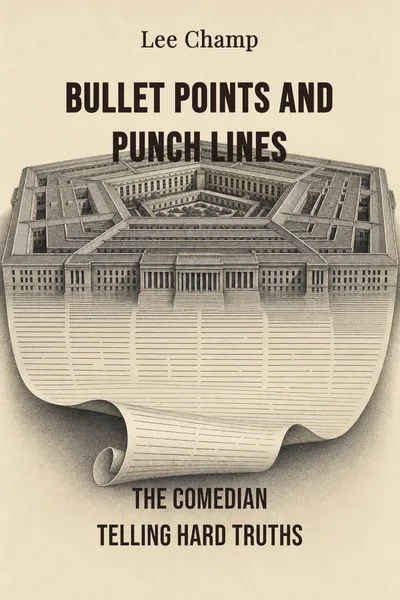
Bullet Points and Punch Lines
The comedian telling hard truths
Description
Lee Camp built a career out of a strange premise: that the most accurate way to describe the state of the United States might be to stand on a stage and make people laugh about it. A stand-up comedian and television host, Camp spent years hosting a weekly news-comedy show, dissecting American power the way Jon Stewart once did and Hunter S. Thompson before him — except angrier, and less interested in being invited back. "Bullet Points and Punch Lines," his book, gathers that project into one place: the case that the country is in decline, that its elite is wrecking the world to stay on top, and that ordinary Americans are buried under debt and bad jobs while being told to vote for one of two parties that answer to the same donors.
It is not, on paper, funny material. An empire stretching itself thin abroad. Wars sold as humanitarian missions. A Pentagon that, at one point, could not account for trillions of dollars in its own books. A media that calls repetition of official talking points "journalism." Stacked up like that, it reads as a grim ledger. Camp's wager is that the ledger is so absurd, so far past the threshold of believability, that only comedy can carry it. Say it straight and people tune out or call you paranoid. Say it as a joke and the absurdity does the arguing for you.
That wager is the engine of the book, and it raises a question worth sitting with. We tend to assume comedians simplify — that the laugh comes at the cost of the truth. Camp's claim runs the other way. The official sources, in his telling, are the ones simplifying and distorting; the comedian is the one insisting on the inconvenient detail. So we end up in a country where the guy telling jokes sounds more reliable than the anchor reading the news.
The question we’re asking : How does a comedian end up sounding more credible than the institutions paid to inform us?What we’ll see : How Camp turns decline, debt and missing trillions into material — and why the laugh is doing serious work.
Table of contents
01Chapter 1 — The comedian who took the assignment nobody wanted
Camp came up through stand-up, the unglamorous circuit of clubs and open mics, before drifting toward political material at a time when most comics were keeping their distance from it. The lineage he places himself in is specific. Hunter S. Thompson, who decided in the 1960s and 70s that the only honest way to cover American politics was to abandon the pretense of detachment and write from inside the fever. Jon Stewart, who turned a fake news show into one of the more trusted sources of real news for a generation that had stopped believing the actual networks. Camp positions himself as the next link in that chain, and "Bullet Points and Punch Lines" is partly an argument for why the chain exists at all.
The argument is this: when the official channels stop describing reality, the description doesn't disappear. It migrates. It moves to whoever is willing to say the thing out loud, and in modern America that has reliably been the comedians, because comedy is one of the few formats where you are allowed to point at the obvious and treat it as obvious. A reporter who says a war was sold on a lie risks his access and his career. A comedian who says it gets a laugh, because everyone in the room already suspected as much and was waiting for permission to admit it.

02Chapter 2 — Twenty-one trillion dollars and other things you weren't told
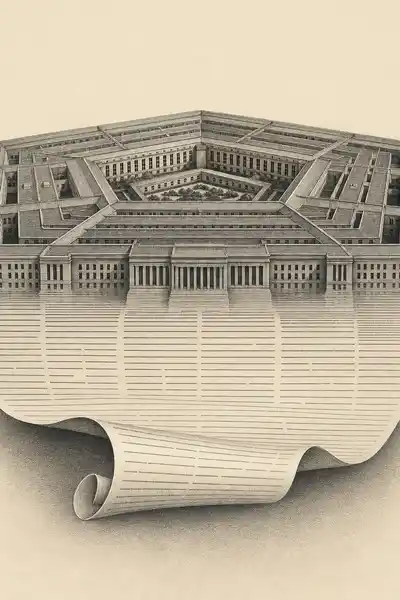
The set piece at the center of Camp's case is the Pentagon. He returns repeatedly to a figure that sounds invented: roughly $21 trillion in what auditors called unsupported adjustments in the Department of Defense's books over a span of years, accounting entries that could not be traced or explained. The number comes from work by economist Mark Skidmore and researcher Catherine Austin Fitts, drawing on the department's own inspector-general reports. Camp's point is not that someone literally stole twenty-one trillion dollars and put it in a bag. It is subtler and worse: the books are so opaque that the question cannot even be answered, and almost no one in the media treated this as a story.
That gap — between the size of the scandal and the size of the coverage — is the real subject. Camp keeps measuring one against the other. An accounting black hole larger than the entire national debt produces a few scattered articles and then silence. Meanwhile the same outlets devote weeks to a politician's gaffe or a celebrity's divorce. For Camp this is the tell. The stories that threaten power's basic legitimacy get the lightest touch, and the stories that threaten nobody get wall-to-wall treatment. The pattern is the message.
03Chapter 3 — Two parties, one Wall Street
The most pointed thread in the book is the one aimed at the people who think they're already fighting back. Camp's quarrel is not mainly with the Americans who tune out, exhausted by debt and overwork. It is with the ones who have the energy to get angry — and are then handed a choice between two parties that, in his reading, agree on the things that matter most. Both, he argues, are committed to war abroad and to Wall Street at home. The fights between them are real enough on the surface, but they happen inside a consensus neither party will break, because the money funding both sides has no interest in breaking it.
This is where Camp parts company with conventional political comedy, which tends to pick a team and roast the other. He roasts both, and the symmetry is the argument. If the deepest problems — the wars, the bailouts, the upward flow of wealth — survive intact regardless of which party wins, then the contest itself functions as a release valve. People pour their anger into an election, the election resolves, the machine continues. The ritual of choosing absorbs the energy that might otherwise threaten the arrangement. Camp's word for this is closer to theater than to democracy.
04Chapter 4 — When the joke is the only thing that lands
Step back from the specific scandals and the deeper claim in "Bullet Points and Punch Lines" comes into focus: a society can reach a point where its truth-telling institutions have so thoroughly abandoned the job that the work falls to whoever is structurally free to do it. In Camp's America, that turns out to be the comedian — not because comedians are wiser, but because comedy is one of the last formats with permission to say the obvious thing and call it obvious. The court jester could mock the king precisely because he was the jester. Camp's claim is that the press traded that license away, and the comics picked it up off the floor.
This is why the book keeps insisting that the present-day story of the country can perhaps only be told by a comedian — that delivered any other way, no one would believe it. The line sounds like a flourish, but it carries real weight. Belief is the scarce resource here. After enough years of wars sold on falsehoods and scandals that vanish without consequence, the audience has learned to distrust the serious voice and the serious format. The anchor's gravity reads as performance. The joke, oddly, reads as sincerity, because the comic isn't pretending to be neutral and has no access to protect.
05Conclusion
Lee Camp set out to describe a country in decline — an elite reaching for the whole globe, ordinary people pinned under debt and dead-end work, and a political contest rigged so that even the angry are steered back toward the people who built the trap. The achievement of "Bullet Points and Punch Lines" is that it makes this bearable to read, and even sharp and entertaining, without sanding off a single hard edge. The jokes are not a way of softening the diagnosis. They are the delivery system that gets it past our defenses.
Related books