
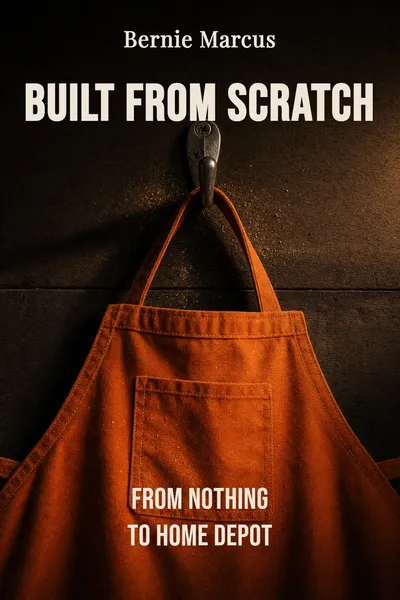
Built from Scratch
From nothing to Home Depot
Description
In the spring of 1978, Bernie Marcus was called into a meeting at Handy Dan, the home-improvement chain where he ran the whole operation, and was fired. He was in his late forties, he had a family, and the dismissal came wrapped in a power struggle he was convinced was engineered from above. It was, by his own account, the worst day of his professional life. Along with him went Arthur Blank, his finance man, and a small handful of loyalists. On paper, a man that age losing a top job in retail has few good moves left. In the memoir he would write two decades later, Marcus calls that firing the best thing that ever happened to him — the shove he needed to build something of his own.
What he built, with Blank and a few others, was The Home Depot: a giant orange warehouse where a homeowner could buy a two-by-four, a toilet, a can of paint, and a fifteen-minute lesson on how to install any of them, all under one roof at prices the neighborhood hardware store couldn't touch. The first stores opened in Atlanta in 1979. Four decades on, the company is one of the largest retailers on earth. But Built from Scratch, the book Marcus wrote with Blank in 1999, isn't really a company history. It's an argument about how a man goes from being humiliated at fifty to building an empire — and what he thinks made the difference.
That's the interesting tension in it. Marcus is a pharmacist's kid from a Newark tenement who ended up a billionaire, and he wants us to believe the through-line runs from the tenement to the warehouse without a break. The book is warm, blunt, occasionally self-serving, and completely convinced that the way you treat customers and employees is not a soft thing but the whole game.
The question we’re asking : How does a man fired at fifty turn a bad day into one of the biggest retail companies in the world — and how does he want that story remembered?What we’ll see : A memoir that reads a firing, a warehouse, and a philosophy of service as one continuous line, and asks what it costs to build something that lasts.
Table of contents
01Chapter 1 — The fired man who had nowhere left to fall
Marcus opens where it hurts. Before the orange aprons and the ribbon-cuttings, there is a boy in a Newark tenement, the youngest of four children of Russian-Jewish immigrants, sharing a cold-water flat and watching his mother — crippled by arthritis — refuse to let hardship narrow her view of the world. He wanted to be a doctor. He couldn't afford the bribe a medical school quietly demanded, so he went into pharmacy instead, and then drifted, almost by accident, into retail. The pattern he sets up early is that the plan rarely survives contact with reality, and the person who improvises well wins.
By the 1970s he was running Handy Dan, a Southern California home-improvement chain, and running it well. He was good at the floor, good at people, restless with anyone who put process ahead of the customer. That restlessness put him on a collision course with the parent company's leadership, and in 1978 the collision came. Marcus tells the firing as an ambush — a manufactured dispute, a boardroom he thought was friendly turning cold. He doesn't pretend he took it gracefully. He describes the fear, the wounded pride, the nights of doubting whether a man his age starts over.

02Chapter 2 — The warehouse nobody had built yet
The concept was almost embarrassingly simple, which is why Marcus keeps insisting nobody had truly done it. Take an enormous space, fill it to the rafters with everything a homeowner or contractor could need, price it below anyone else, and hire people who actually know how to use the merchandise. Depth of selection, rock-bottom prices, and expert help had never lived under one roof before. Hardware stores had the knowledge but not the range or the price. The early discount barns had the price but treated a customer question like an interruption.
The launch was rougher than the concept was elegant. The first Home Depot stores opened in Atlanta in 1979, and Marcus is honest that they nearly didn't make it. The buildings were cavernous, half-empty at first, and the founders resorted to stacking empty boxes on the top shelves to make the aisles look fully stocked. Money was frighteningly tight. On one early promotional day they handed cash to children to give to their parents in the parking lot, just to get people through the doors. For a stretch, Marcus admits, they were closer to collapse than to conquest.
03Chapter 3 — Whatever it takes to keep the customer
If Built from Scratch has a single commandment, it's that the customer is not always right — but the customer is always the reason you exist. Marcus tells the story of a man who returned a set of tires to Home Depot. The company has never sold tires. The associate refunded him anyway. Marcus loves this story precisely because it sounds insane: the point isn't the tires, it's that a business willing to lose a small argument wins a customer for life, and that customer tells the story for you. The return policy, in his hands, is a marketing strategy disguised as generosity.
The same logic runs down through how he treated employees. Marcus disliked the word "employee" and pushed "associate," and he backed the language with stock ownership, so that people stacking lumber had a real stake in the company's rise. He'd walk the floor, sleeves up, and if he found a manager who'd been rude to an associate or a customer, the manager heard about it directly. His theory was almost circular and he knew it: treat associates well, they treat customers well, customers come back, everybody's stock goes up. Culture wasn't a poster in the break room; it was the actual mechanism of profit.
04Chapter 4 — Why the story keeps getting told
Step back from the aprons and the tire refund, and Built from Scratch belongs to a very particular American genre: the founder's memoir that reads a business as a moral education. These books all make the same quiet promise — that the fortune wasn't luck or timing or capital, but character, and that character is something a reader might borrow. Marcus is unusually good at the form because his through-line is so clean. The Newark tenement teaches resilience, the firing teaches that setbacks are launchpads, the warehouse teaches that service beats price, and the fortune arrives as the natural reward. Cause and effect, tidy as an aisle.
It's worth noting what that tidiness leaves out. Marcus had timing — a booming Sun Belt full of new homeowners in the 1980s. He had Langone's access to money and Sol Price's proven playbook. He had the sheer good fortune that a firing he didn't choose landed exactly when the market was ready for what he'd been imagining. None of this makes his account false; it makes it a story, shaped after the fact so that every hardship points toward the win. That's what the entrepreneurial memoir does. It converts a messy sequence of decisions and breaks into a lesson.
05Conclusion
The book ends more or less where it began, with a man marveling that the worst day of his career turned out to be the door to everything after it. Marcus never pretends the firing didn't wound him; he simply insists that pain and possibility arrived in the same envelope, and that his one real skill was refusing to read only the first line. From a Newark tenement to a warehouse in Atlanta to a company spanning a continent, the memoir holds its shape: build for the customer, share the winnings, and treat the culture as the product itself.
Related books