

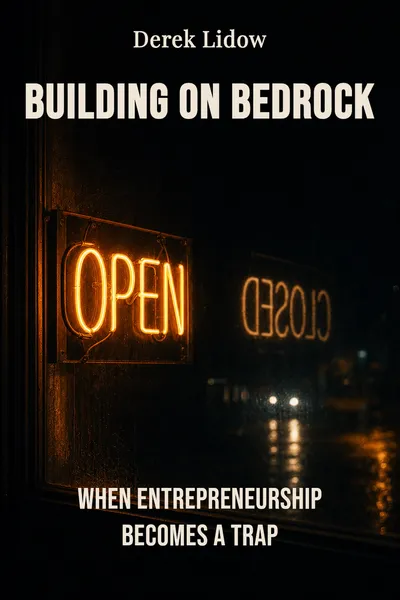
Building on Bedrock
When entrepreneurship becomes a trap
Description
Derek Lidow spent thirty years running companies before he started teaching entrepreneurship at Princeton, and one story kept nagging at him. His grandfather, Eric Lidow, fled Europe in the 1930s, landed in Los Angeles with almost nothing, and built International Rectifier into a semiconductor giant. It is the kind of family legend that gets told at reunions, the founder-hero arriving with an idea and a suitcase. But when Lidow looked closely at the numbers of who actually starts businesses and how those businesses end, the legend stopped matching reality. Most new firms are not tech unicorns run by visionaries. They are dry cleaners, landscaping outfits, consultancies, restaurants. And most of the people running them are not chasing disruption at all.
That gap between the story and the data is the spine of Lidow's book Building on Bedrock. He wanted to know what entrepreneurs really do, not what the TED stage says they do, and whether the version of the dream we keep buying holds up under scrutiny. What he found is that the word "entrepreneur" hides at least two very different animals, that the skills the myth celebrates are often the wrong ones, and that the same cultural pressure pushing people to strike out on their own rarely warns them what the daily life actually feels like.
Lidow is not out to kill anyone's ambition. He runs a nonprofit that helps founders, and he clearly loves the work. But he keeps returning to a harder question, the one his students never quite want to hear. Some people flourish building something from nothing. Others discover, too late and at enormous personal cost, that they have signed up for a life they were never suited to.
The question we’re asking : How can we tell whether starting a business will be a dream come true or a nightmare we cannot wake up from?What we’ll see : How the entrepreneurial myth diverges from the daily reality, and what that gap costs the people who ignore it.
Table of contents
01Chapter 1 — The myth we keep repeating
The dominant image of the entrepreneur is a composite drawn from a handful of famous names. Steve Jobs, Elon Musk, the garage-to-billions arc. In this picture the founder is a visionary who sees a future nobody else can, takes wild risks everyone else is too timid to take, and reshapes an industry through sheer force of insight. Lidow's argument is that this picture is not just incomplete, it is statistically bizarre. It describes maybe a fraction of a percent of the people who start businesses, and it describes them badly even then.
When Lidow works through who actually launches companies in the United States, the numbers tell a quieter story. The overwhelming majority of new businesses are small, local, and unglamorous. Roughly two-thirds are started not to change the world but to give the founder a job, more autonomy, or a way to make a living on their own terms. These are the people Lidow eventually calls antpreneurs, a term he coins for those who start a business mainly to be their own boss rather than to build something that grows. They are not failed founders. They are simply a different kind of person doing a different kind of thing.

02Chapter 2 — What founders actually do all day
To cut through the mythology, Lidow does something unusual: he studies the concrete behaviors of successful founders instead of their pronouncements. What he finds is that the daily work looks nothing like the vision-and-risk story. Building a business, in his account, is mostly the relentless, unglamorous management of relationships. Founders spend their days selling, hiring, firing, negotiating, calming down customers, chasing invoices, and holding together a fragile web of people who all want different things.
From this observation he pulls out four skills that reliably separate the founders who make it from those who crash. The first is the ability to sell, in the broad sense of persuading people to commit before there is much reason to. The second is a comfort with basic finance, knowing where the money is and where it is going. The third is a genuine capacity for building trusting relationships, because a founder cannot do everything alone and must get others to stake their own futures on the venture. The fourth is self-awareness, the willingness to see one's own limits and hire around them.
03Chapter 3 — The trap dressed as a dream
Here is where Lidow's account turns from taxonomy to warning. The trap is not failure in the ordinary sense. Businesses fail all the time and people recover. The trap is the slow-motion nightmare of the person who has built something that owns them. They cannot sell it, cannot leave it, cannot make it thrive, and cannot afford to walk away. They wake up every morning inside a machine they created and now serve.
This happens most often, Lidow observes, when someone starts a business for the wrong reason or with the wrong self-knowledge. The antpreneur who genuinely wanted autonomy but got talked into growth ends up managing employees they never wanted and can't stand. The person who mistook a hobby for a business discovers that turning the thing they loved into a livelihood killed the love. The founder who could not sell, or could not trust anyone, spends years papering over the missing skill until the gap swallows them. The dream and the trap are not opposites. They are the same venture seen from two different personalities.
04Chapter 4 — Why the culture keeps selling it
Step back from Lidow's founders and antpreneurs and a larger pattern comes into view. What our work culture sells is not a job with specific costs and required skills. It sells an identity. To be an entrepreneur has become a way of signaling ambition, freedom, and moral seriousness about one's own life. The problem Lidow keeps circling is that identity and occupation get fused, so that a practical career choice gets loaded with the weight of who we think we are.
That fusion is what turns a manageable question into a trap. If entrepreneurship is just a job that suits some people and not others, then deciding it is not for us is no more shameful than deciding we are not surgeons. But if it has become the highest expression of a work-driven culture, then declining it feels like admitting we lack drive, courage, or vision. Lidow's antpreneur, perfectly content running a small business for its own sake, gets quietly ranked below the founder chasing scale, even when the antpreneur is happier and more solvent.
05Conclusion
Lidow started with his grandfather's story, the immigrant who arrived with an idea and built a semiconductor company, and Building on Bedrock is in part an attempt to understand why that story is told so much more often than it happens. The answer is that the legend is useful. It inspires, it recruits, it flatters the ambition of anyone who hears it. What the legend leaves out is everything that decides the outcome: the specific skills, the daily grind of managing people and money, and the question of whether this particular life fits this particular person.