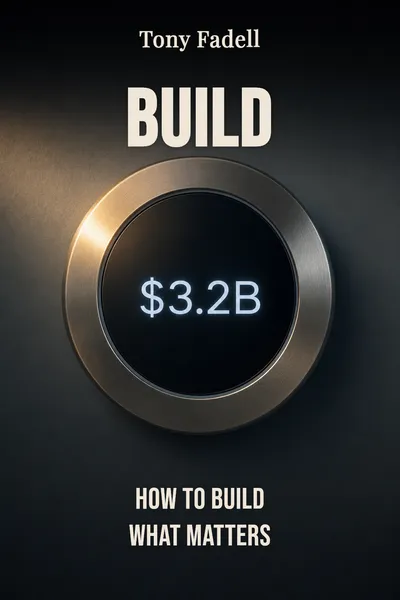
Build
How to build what matters
Description
In the late 1990s, a young engineer named Tony Fadell was shopping a portable music player around Silicon Valley and getting turned down almost everywhere. He had already lived through one spectacular failure — a company called General Magic that tried to build the smartphone roughly fifteen years too early and folded — and he carried that scar into every pitch. Apple, then still recovering, took the meeting. The result, shipped in 2001, was the iPod. A few years later Fadell would leave, start Nest, build a thermostat people actually loved, and sell it to Google for about $3.2 billion in 2014.
That résumé is the kind of thing that gets someone a keynote slot and a memoir ghostwriter. What makes Build, the book Fadell published in 2022, worth opening is that it refuses the memoir. It is closer to the notes a demanding mentor scribbles in the margins of your career — blunt, specific, occasionally irritated, organized around the mistakes he watched himself and everyone around him make. He calls it an advice encyclopedia, which undersells it.
The temptation with a book like this is to reduce it to a method: find a pain point, prototype fast, ship, scale. All of that is in there. But Fadell keeps circling back to something less tidy — the idea that building anything that matters is inseparable from becoming a certain kind of person, one who has failed publicly, learned to sell, and figured out when to walk away. That is the thread worth pulling.
The question we’re asking : What does it actually take to build something that lasts, and why is it so rarely a matter of having the idea?What we’ll see : How one engineer's path from a famous failure to the iPod turned into a manual for building things — and building the people who build them.
Table of contents
01 Chapter 1 — The apprenticeship that came before the iPod
Fadell opens Build not with the iPod but with the years that made it possible, and he is emphatic about the order. Before he built anything anyone remembers, he spent his twenties at General Magic, a company stuffed with the engineers who had built the Macintosh, attempting to invent the handheld connected device. The vision was extraordinary. The execution assumed a world that did not yet exist — no reliable wireless networks, no market, no reason for anyone to want the thing. It failed almost completely. Fadell describes watching brilliant people build for themselves rather than for a customer who was actually out there.
That failure is his first real lesson, and he insists it is the useful kind. You learn nearly nothing from success, he argues, because success hides which of your choices were smart and which were merely lucky. Failure itemizes your mistakes for you. General Magic taught him that a great idea is worthless if it arrives before the market, the technology, or the customer is ready to meet it — timing is not a detail, it is the whole game.

02 Chapter 2 — Build the thing, then build the thing that builds the thing
The heart of Fadell's practical advice is deceptively ordinary: start from a real problem a real person has, not from a technology you find exciting. He returns constantly to the pain point — the small daily friction that a customer feels but has stopped noticing because they assume it is just how the world works. The Nest thermostat exists because Fadell, building a house, was baffled that the box on the wall controlling his home's biggest energy expense was ugly, confusing, and dumb. Nobody had asked why. He did.
From there the method is iteration, and he is precise about what that means. A prototype is not a demo you show off; it is a question you ask reality. You build the cheapest possible version that can teach you something, put it in front of people, and watch where they get confused or give up. Then you do it again. Fadell warns against the seductive trap of polishing an idea in your head — the version that lives in your imagination is always perfect, which is exactly why it teaches you nothing.
03 Chapter 3 — Selling isn't the dirty part of the work
One of the more bracing sections of Build takes on a snobbery common among engineers and designers: the idea that selling is beneath the real work, a necessary evil handled by people in nicer clothes. Fadell rejects this flatly. Everything, he argues, is selling — a job interview, a design review, a pitch to investors, the moment you convince a colleague to change a decision. Pretending otherwise does not make you pure; it just makes you bad at it.
His reframe is that good selling is not manipulation but empathy pointed outward. It means understanding what the person across from you actually cares about, what they fear, what they need to hear to say yes — and then telling the truth in those terms. The best products, he notes, effectively sell themselves only because someone did the harder work of making the reason to buy obvious. Marketing that has to compensate for a confusing product is a bandage on a wound the team should have healed earlier.
04 Chapter 4 — What a career actually looks like from the inside
Step back from the thermostats and the music players and Build reveals what it is really about: the shape of a working life. Fadell is far less interested in the iPod as an artifact than in the arc that produced it, and the argument he keeps making — sometimes between the lines, sometimes head-on — is that you do not build great products, you become the kind of person capable of building them, and that becoming is slow, unglamorous, and mostly invisible from outside.
This is why he spends so much of the book on things that are not product design at all: how to choose a first job for what it teaches rather than what it pays, how to know when you have learned everything a role can offer and should leave, how to survive being managed badly and how to avoid becoming a bad manager yourself. Fadell's own path is a sequence of departures — General Magic collapsing, leaving Apple at the height of his standing, selling Nest and eventually leaving Google. He treats knowing when to go as a core professional skill, not a failure of loyalty.
05 Conclusion
The engineer who could not give away his music player in 1999 ended up defining two decades of consumer hardware, and Build is his attempt to explain how — while resisting the story that it was ever inevitable. The through-line from General Magic to the iPod to Nest is not genius striking twice. It is one person accumulating scars, mentors, and a stubborn habit of asking why the box on the wall was so dumb, and then doing the slow work of answering.
Related books