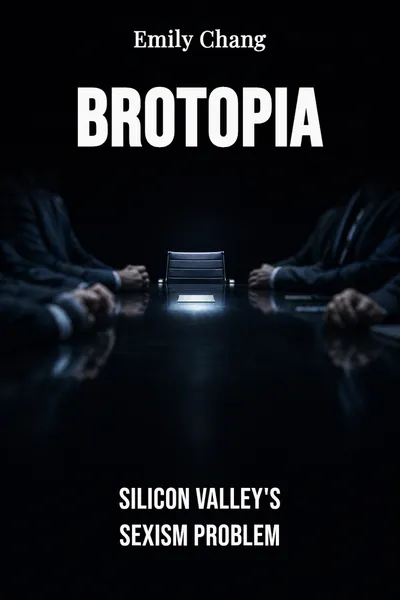
Brotopia
Silicon Valley's sexism problem
Description
In the 1960s, when computing was still being staffed, the people punching cards and writing early code were as likely to be women as men. Programming was clerical, low-status, the kind of detail work a serious man left to a secretary. Grace Hopper had built one of the first compilers. The women of the ENIAC project had wired the first general-purpose computer. For a stretch, the field looked like it might tilt female. Then it didn't. By the time the personal computer arrived and the money got big, the room had quietly emptied of women — and stayed that way.
Emily Chang, a Bloomberg journalist who spent years interviewing the people who run the tech industry, set out in Brotopia to explain that reversal. Her starting figure is blunt: women earned roughly 37 percent of computer-science degrees in 1984, and barely 18 percent three decades later. The industry got richer, more powerful, more central to everyday life — and less female the whole way. That is not the trajectory of an accident. Chang's book is an attempt to name the specific mechanisms that produced it, mechanism by mechanism, from a personality test to a venture pitch to a private party.
What makes the book uncomfortable is that it refuses the comforting story — the one where a few bad men get caught and the system corrects itself. Chang's Silicon Valley is a place where the bias is built into the pipes: the way engineers were hired, the way money was raised, the way after-hours socializing blurred into business. The men running it mostly believe they built a meritocracy. Chang sets out to show, calmly and with receipts, that they did not.
The question we’re asking : How did the most modern industry on earth end up with a culture this old-fashioned about women?What we’ll see : How a tech world that started open to women hardened into a club, and what it cost the people kept outside the door.
Table of contents
01 Chapter 1 — The men who weren't supposed to win
Chang's account starts with a question most founders never ask: why does the stereotypical programmer look the way he does? The answer she traces is not technical but historical, and it runs through a single influential decision in the 1960s. As demand for programmers exploded, two psychologists hired by a major computer firm, William Cannon and Dallis Perry, built a personality profile to identify who would make a good one. They surveyed about 1,400 programmers, most of them men, and concluded that good ones shared a trait: they disliked people.
That profile spread. For years, companies screened candidates for an antisocial, detail-obsessed personality, on the theory that the best coders were loners who would rather talk to a machine than a colleague. Chang's point is that this was never a finding about who can code. It was a finding about who already coded — overwhelmingly men — recycled as a prediction about who should. The hiring filter encoded the existing population and then reproduced it. A field that had no inherent reason to skew male acquired a recruiting machine that quietly did the skewing.

02 Chapter 2 — A hiring test that filtered women out
When the money arrived, the narrowing hardened into a system. Chang devotes a long stretch of the book to how startups actually hire, because that is where she locates the engine of homogeneity. The favored method became the referral — you hire your friends, and your friends' friends. It is fast, it is cheap, and it feels like a sign of trust. It is also, Chang notes, a near-perfect machine for reproducing whoever is already there. A founding team of four men from the same Stanford fraternity will, left to its own networks, build a company of men who look and think like those four.
Then there is the interview itself. Chang describes the rise of the culture-fit test, the question of whether a candidate would be fun to grab a beer with after work, sold as a way to protect team chemistry. In practice, she argues, fit became a respectable word for sameness. A woman, an older candidate, anyone outside the founders' social world could be screened out for a vague feeling that they wouldn't mesh — a judgment that never had to be justified because it never had to be named.
03 Chapter 3 — The money that never reaches the women
If hiring decides who builds, funding decides who gets to start. Here Chang turns to venture capital, the small set of firms that decide which founders receive the millions that turn an idea into a company. The numbers she assembles are stark: women-led startups have for years received a sliver of total venture dollars — in the low single digits when the founder is a woman alone, and the firms handing out the money are themselves overwhelmingly run by men. The deciders and the funded come from the same pond.
Chang's interest is in how the bias operates in the room, not just in the spreadsheet. She draws on research showing that investors, pitched identical business plans, tend to back the one delivered in a male voice. She describes the pattern-matching that venture capitalists openly admit to: they fund founders who remind them of the founders who made them rich before, and those founders were young men in hoodies, so the next ones are too. A woman pitching the same company is asked different questions — about risk and what could go wrong, where a man is asked about growth and how big it could get.
04 Chapter 4 — The parties nobody talks about on the record
The chapter that drew the most attention when Brotopia appeared was the one Chang spent inside Silicon Valley's private party scene — the invitation-only gatherings, sometimes with drugs, sometimes with a sexual charge, where powerful investors and founders mixed after hours. Her reporting on these scenes was vivid enough to make headlines, but her argument is not really about scandal. It is about where business actually happens, and who is allowed to be there when it does.
Her point is that in an industry built on networks, the line between socializing and dealmaking barely exists. Relationships forged at a party become the introductions that become the funding that becomes the company. For the men, this is frictionless: the party is fun and useful at once. For a woman, every invitation is a calculation. Decline, and she misses the room where the deals get seeded. Attend, and she risks being read as available, or finds that a professional relationship has been quietly recoded as something else. There is, Chang argues, no clean move.
05 Conclusion
Chang ends where the numbers began — with an industry that started open to women, closed itself off, and has spent recent years discovering that the closure was never natural. Brotopia is unsparing about the mechanisms, but it is not fatalistic. The personality test was a choice. The referral hiring was a choice. The pattern-matching in the funding meetings is a habit, and habits can be unlearned. Each wall she describes was built, which means each could in principle be taken down by people willing to stop pretending the current shape of the room is simply the shape of talent.
Related books