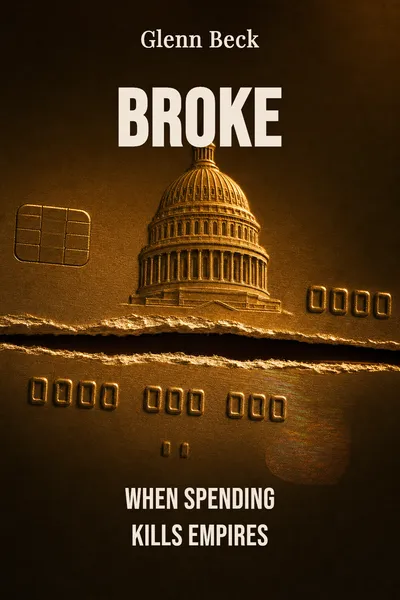
Broke
When spending kills empires
Description
In 2010, the year Glenn Beck published Broke, the gross federal debt of the United States crossed roughly $13.5 trillion — a number so large it had stopped meaning anything to most of the people carrying it. Beck's wager in the book is that this is exactly the problem. A figure that big doesn't frighten anyone; it just floats above the country like weather. He opens not with a chart but with a feeling most of us recognize: the low hum of owing something we can't quite picture, the sense that the bill is real even when the amount is abstract. His argument is that a household knows when it's broke, and a nation has learned not to.
Beck was, by 2010, one of the loudest voices on American cable, and Broke is unmistakably a polemic — written fast, argued hot, aimed at a general reader worried about where the country was heading. But underneath the heat there's a specific claim worth taking seriously on its own terms: that the United States has spent decades borrowing against a future it kept assuming would be richer, and that entitlements, wars, and bailouts have combined into a machine no party has been willing to switch off. He reaches back through American history to argue this isn't new — that the fight over public debt is as old as the republic itself.
What makes the book more than a rant, at least in its ambition, is where it lands. Beck isn't finally interested in accounting. He's interested in what a country believes about itself when it decides that spending tomorrow's money today is simply how things are done. The debt, for him, is a symptom. The disease is a story a people have told themselves for so long they no longer hear it.
The question we’re asking : Why does a nation keep borrowing long after a household in the same position would have stopped?What we’ll see : How Beck traces American debt from the founders' quarrels to the modern entitlement machine, and turns a spreadsheet into an argument about national character.
Table of contents
01Chapter 1 — A country that forgot how much it owed
Beck begins with the scale, because the scale is the whole trick. By 2010 the federal government was running annual deficits well over a trillion dollars, and the accumulated debt had climbed past thirteen trillion. He argues that these figures had crossed a threshold beyond human intuition. A family understands what it means to owe more than it earns; the feeling is physical. A government that owes multiples of what it collects in a year has floated free of that feeling entirely, and Beck thinks the disconnection is the point, not an accident.
The comparison he keeps returning to is the household. If a family spent like Washington — covering ordinary bills with new credit cards, promising retirement money it hadn't saved, treating emergencies as reasons to borrow more — everyone would recognize the trajectory. Beck's frustration is that when the same behavior is scaled to the size of a nation, it gets renamed. Deficit spending becomes stimulus, unfunded promises become entitlements, and the moral vocabulary that would apply to a household quietly disappears.

02Chapter 2 — The founders argued about debt from day one
Having set the alarm, Beck spends much of the book insisting that none of this is new. The quarrel over public debt, he argues, was present at the creation. When the young United States emerged from the Revolution, it carried heavy war debts, and the question of what to do about them split the founding generation almost immediately. Alexander Hamilton, as the first Treasury secretary, wanted the federal government to assume the states' debts and honor them fully, building national credit and a strong central financial hand.
Thomas Jefferson, in Beck's rendering, is the counterweight — deeply suspicious of a permanent national debt, worried that it would bind future generations to the decisions of the present and concentrate power in a distant capital. Beck is plainly drawn to the Jeffersonian anxiety, quoting the founders' warnings about mortgaging posterity. The point of the history lesson is to argue that fiscal restraint isn't a fringe modern obsession but a founding American instinct, one the country has drifted away from rather than never had.
03Chapter 3 — The math nobody wants to run
The heart of Beck's practical argument is that the discretionary spending everyone fights about in public — foreign aid, this program, that agency — is nearly beside the point. The real weight sits in what he calls the untouchable middle of the budget: Social Security, Medicare, Medicaid, and the interest on the debt itself. These are the commitments that grow automatically, driven by demographics and health costs rather than annual votes, and Beck argues that no serious conversation about the debt can avoid them.
His case rests on a demographic squeeze he considers close to arithmetic destiny. When Social Security began, many workers supported each retiree; by the time Beck was writing, that ratio had collapsed toward a handful, and it was still falling as the boomers left the workforce. Medicare faced the same pressure amplified by medical inflation. The programs, he argues, were structured as transfers from current workers to current beneficiaries, which works while the young vastly outnumber the old and buckles when they don't.
04Chapter 4 — A story a nation tells itself
For all its charts and warnings, Broke is finally not a book about accounting, and this is where Beck steps back from the ledger. His deepest claim is that a nation's finances are a mirror of its character — that how a people handle money reveals what they actually believe about the future, about their children, and about the difference between what they want and what they can afford. The debt, in this reading, is less a fiscal condition than a confession.
The story Beck thinks America has been telling itself is a seductive one: that this country is exceptional enough to escape the arithmetic that binds ordinary households and ordinary nations. That growth will always come, that creditors will always lend, that the reckoning belongs to someone downstream. He treats this not as economics but as a kind of national self-flattery — the conviction that the rules don't apply here, dressed up as optimism. And he argues that every empire that told itself that story eventually met the same creditor.
05Conclusion
Beck ends more or less where he began: with the gap between a number too large to feel and a debt entirely real. The book's method is to keep dragging the abstraction back into the household — to insist that the words we use for national finance, stimulus and entitlement and deficit, are polite translations of things a family would recognize as spending money it doesn't have and promising money it hasn't saved. Whether or not one shares his politics, the discomfort he's after is specific: the suspicion that a system which never has to refuse itself anything has not conquered scarcity, only postponed the meeting.
Related books