Brick by brick
From brink to boom
Description
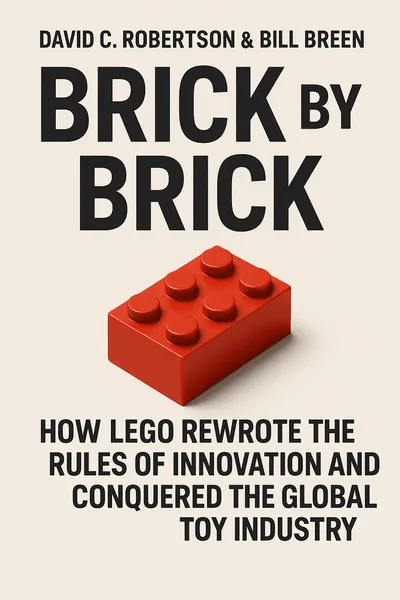
LEGO, a globally recognized brand, produces over thirty-six billion pieces annually. Despite its success, many are unaware of the company's history. Founded in 1932 in Billund, Denmark, LEGO experienced consistent growth but faced a financial crisis in 2003. The company's adherence to popular innovation theories nearly led to its downfall. However, a new management team reevaluated these theories, leading to a remarkable recovery.
By 2011, LEGO's profits soared, outpacing even Apple during a recession. This turnaround is a testament to the power of adaptive innovation and learning within an organization. David Robertson and Bill Breen reflect on LEGO's journey, highlighting the joy and creativity it brings to the world.
Table of contents
01 The innovation principles and lego s downfall
The advent of video games and high-tech gadgets in the global toy market at the close of the 20th century posed a significant challenge for LEGO. Despite its history of innovation, the company found itself playing catch-up. In an attempt to regain its footing, LEGO implemented an ambitious growth strategy based on seven renowned innovation theories from the business world. However, these theories, which had proven successful for other companies, nearly led to LEGO's downfall. The company, founded by Kirk Christiansen in a small carpenter's workshop in Billund, Denmark in 1934, had weathered numerous hardships, including the Great Depression, World War II, and a devastating factory fire in 1942. Despite these challenges, Christiansen's tenacity and commitment to his employees led to the rebuilding of the company and the establishment of its mission to "inspire and develop the builders of tomorrow".
In 1946, LEGO became the first Danish toy manufacturer to acquire a plastic injection molding machine, a significant investment that cost more than double the previous year's profits. It took a decade of experimentation for LEGO to perfect its trademark brick, a process largely consumed by figuring out the stud-and-tube coupling system that allows the bricks to connect with a satisfying click. This innovation allowed children to build whatever they wanted, making LEGO an endlessly expandable toy. As Christiansen worked to build the LEGO Group, he adhered to a set of founding principles that emphasized the importance of values, relentless experimentation, a focus on the big picture, and authenticity. By the 1960s, LEGO had expanded its market to Western Europe, the United States, Asia, Australia, and South America. However, by the 1990s, despite its expansion, LEGO's sales began to plateau due to the emergence of new technologies like VCRs, video games, cable TV, and computers.

02 Harnessing the seven principles of innovation and revitalizing lego
Facing the threat of bankruptcy, the LEGO Group brought in a new management team that reimagined traditional innovation strategies, molding them into a management philosophy that fit LEGO's needs. Instead of the clichéd 'thinking outside the box', LEGO found a way to foster consistent innovation within the confines of a conventional organization.
Cultivating an innovative culture
When Kjeld Christiansen nominally returned to the CEO role in 2023, it was widely understood that Jorgen Knudstorp was the CEO-in-waiting, a change that became official six months later. When asked about his strategy for the LEGO Group, Knudstorp eschewed grand strategies, stating, "Right now, our mission is just to survive. To cut costs, sell businesses, and restore our competitiveness." He emphasized a shift from visionary, child-development focus to a more operational and execution-oriented approach. One of his initial moves was to rebuild relationships with retailer partners like Walmart and Toys "R" Us, who controlled the distribution channel. This approach was communicated to the LEGO sales force with a clear message: support the retailers or face termination.
Knudstorp also targeted LEGO's innovation efforts, which had become so diverse that the company struggled to manage them effectively. He directed LEGO to identify profitable areas and concentrate resources there, while discarding the rest. He stated, "The world's most innovative companies are also the most disciplined. You have to have great control over all the basics; only then can you start to be truly innovative." He also utilized the underused Design Lab, decreeing that it had to approve any new innovations to prevent departments from working at cross purposes. New products had to project a thirteen-and-a-half percent return on sales to be developed. Knudstorp also established a war room at corporate headquarters to track the company's supply chain, measure quality, and maintain key performance indicators. He emphasized results above all else, even selling LEGO's plush head offices and moving everyone into an industrial building that also housed the packing plant
Prioritizing customer needs
In the summer of 2005, LEGO, under the leadership of Knudstorp, began to acknowledge and engage with its adult fan base, recognizing their significant spending power and potential as a marketing resource. This marked a shift from LEGO's traditional focus on children. Knudstorp and Christiansen attended BrickFest, a fan-organized event, marking the first time LEGO's leadership had interacted with adult fans. The company also launched three new initiatives to actively connect with customers: a new line of crowdsourced toys, an Ambassador program for customer feedback, and a Kids Inner Circle for testing new toy ideas. These moves were considered radical as LEGO had previously been resistant to outside ideas.
By the end of 2006, Knudstorp and his team began to focus on creating a long-term growth strategy for LEGO, moving away from the crisis management mode. This strategy included building a defensible core of products, rebalancing the company's financial structure, and innovating to improve LEGO's core business. Knudstorp also wanted LEGO to reconnect with its founding principle of striving for excellence, updating it to "Even the best is not good enough". In addition to crowdsourcing and customer collaboration, LEGO would explore business model innovation, including trialing complementary products, pioneering new distribution channels, and restructuring internal and external partnerships. This approach aimed to position LEGO for profitability and the discovery of new growth drivers.
Embracing openness and crowd wisdom
In the early 2000s, LEGO faced a significant financial crisis, reporting a loss of $292 million in 2004. However, by the end of 2005, the company had managed to turn things around, showing a pretax profit of $117 million and a 12 percent increase in sales. This turnaround was largely due to the company's focus on innovation and the development of new products. LEGO's CEO, Jørgen Vig Knudstorp, recognized that the company's future growth would be driven by its ability to innovate and bring new and better products to the market. Rather than simply updating existing products, Knudstorp aimed to create new markets. The success of the Star Wars and Harry Potter product lines demonstrated that children were drawn to rich storylines and compelling characters. Knudstorp assembled a team to develop a new LEGO toy called the Bionicle, which had originally been launched in 2001. The Bionicle toy line, featuring six mechanized gladiators battling savage beasts on a tropical island, expanded beyond toy sales into movies, books, licensed apparel, and fan-created websites. The success of the Bionicle range provided a blueprint for how LEGO could develop and bring other innovations to market in the future.
Related books