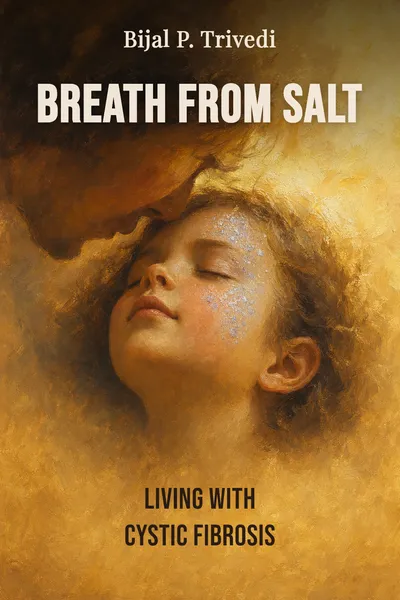
Breath from Salt
Living with cystic fibrosis
Description
There is an old line, quoted so often it has hardened into folklore, that European mothers once feared the child who tasted of salt when kissed. Bewitched soon, the saying went, and soon to die. For centuries nobody knew what the salt meant, only that it traveled with an early death. In 1938, a pathologist in New York named Dorothy Andersen finally gave the pattern a name — cystic fibrosis of the pancreas — after examining the bodies of children who had wasted away, their lungs choked with thick mucus, their digestive organs scarred. A diagnosis, at last. It came with no treatment and a life expectancy measured in months.
Bijal Trivedi's Breath from Salt follows what happened next: how a disease that killed nearly every child it touched became, within a single lifetime, something a person could live with into their forties, fifties, and beyond. The arc runs from that first salty kiss to a class of drugs that reaches into the defective machinery of the cell and switches it back on. It is one of the genuine triumphs of modern medicine, and Trivedi tells it without letting the triumph flatten the people inside it.
What makes the book more than a victory lap is its refusal to end on the applause. The same story that produced a near-miracle also produced a $300,000-a-year price tag, a drug that works beautifully for some mutations and not at all for others, and a set of families whose fundraising made the science possible in the first place. The salt, it turns out, was only ever the beginning.
The question we’re asking : How did a disease that once killed children in infancy become one that people live with for decades — and what did that transformation leave unresolved?What we’ll see : The naming of a killer, the molecule at its root, the families who bankrolled the science, and the uncomfortable arithmetic of who a breakthrough actually reaches.
Table of contents
01Chapter 1 — A word for children who tasted of salt
Before cystic fibrosis had a name, it had a taste. Trivedi opens with the salt because it is where the disease first announced itself to anyone paying attention: a child's skin, a kiss, a warning passed down through generations who had no idea what they were describing. The medical story proper begins in 1938, when Dorothy Andersen, working at Babies Hospital in New York, autopsied a series of infants and identified a consistent pattern of scarring across the pancreas and lungs. She published, she named the condition, and she gave families the small mercy of knowing what had taken their children — even if she could do nothing about it.
For the next two decades, a CF diagnosis was close to a death sentence in the first year of life. The thick mucus that defines the disease clogged the airways, invited relentless lung infections, and blocked the pancreatic ducts so that food passed through undigested. Children starved while eating. The breakthrough in detection came almost by accident during a New York heat wave in 1948, when the physician Paul di Sant'Agnese noticed that children with CF were arriving dehydrated in disproportionate numbers. They were losing salt through their sweat at abnormal rates. That observation became the sweat test, still the standard diagnostic tool, and it confirmed what the old folklore had sensed: the salt was the signature.

02Chapter 2 — The molecule everyone forgot to look for
The turn in the story is genetic, and Trivedi tells it as a hunt. Through the 1980s, the race to locate the cystic fibrosis gene became one of the defining contests of early human genetics. The prize was a single stretch of DNA out of three billion base pairs, and the tools of the day were crude. Two labs pushed to the front: Lap-Chee Tsui and Francis Collins, working on the North American side, closing in through a painstaking technique of walking and jumping along the chromosome. In 1989 they found it, on chromosome 7 — a gene for a protein they called CFTR, the cystic fibrosis transmembrane conductance regulator.
The name is a mouthful, but the function is elegant once decoded. CFTR is a channel that sits in the membrane of cells and moves chloride — a component of salt — in and out. When it works, it keeps the mucus lining the airways and ducts thin and mobile. When the gene is broken, the channel is missing or misshapen, salt balance goes wrong, and the mucus turns to glue. Suddenly the salt from the old folklore, the dehydration in the heat wave, the clogged lungs and pancreas all resolved into a single mechanical fault. The most common mutation, called F508del, deletes just three letters of genetic code and leaves the protein unable to fold and reach the surface.
03Chapter 3 — The families who funded their own cure
One of the most striking threads in Breath from Salt is that the science did not simply flow from government grants and university labs. It was pushed, and often paid for, by the families of patients. The Cystic Fibrosis Foundation, founded in the 1950s by parents, made a decision that Trivedi treats as pivotal: rather than wait for the pharmaceutical industry to find CF profitable enough to bother with, it would fund drug development directly. This model, sometimes called venture philanthropy, meant a patient charity acting like an investor, putting money into a biotech company in exchange for a stake in whatever emerged.
The company was Aurora Biosciences, later folded into Vertex Pharmaceuticals. The foundation's investment eventually ran into the hundreds of millions of dollars, an extraordinary bet for a nonprofit built on bake sales and grieving parents. The gamble was that if you could not fix the broken gene, you might fix the broken protein — coax the misshapen CFTR channel into working, or help it reach the cell surface where it belonged. Trivedi personalizes this through the patients and parents who lived the wait, some of whom died before the drugs arrived, others who timed their survival almost to the release date.
04Chapter 4 — Who a breakthrough leaves behind
The triple therapy costs on the order of $300,000 per patient per year, and it is not a course of treatment but a lifelong prescription. Trivedi steps back here to ask what a scientific triumph is worth if it arrives attached to a price that health systems strain to pay and many patients elsewhere cannot access at all. Cystic fibrosis becomes, in her telling, an early and sharp test case for the entire promise of precision medicine — drugs designed for the exact molecular fault in a given body. The precision is real. So is the cost, and so is the question of who the precision serves.
The unevenness runs deeper than money. Because the drugs are mutation-specific, they were developed first for the most common mutations, which are most prevalent in populations of European descent. Patients with rarer mutations, and patients from communities where CF was historically underdiagnosed, can find themselves outside the reach of a therapy the headlines call a cure. Trivedi notes that CF was long thought of as a white disease, a misconception that delayed diagnosis for others and shaped which mutations got studied and targeted first. A breakthrough built on the common case quietly redraws the line between who is treated and who keeps waiting.
05Conclusion
Breath from Salt closes the loop it opened with that folkloric kiss. The salt on a child's skin, once a superstition and then a diagnostic clue, turned out to mark a single faulty channel in the cell — and following that clue across eighty years produced one of medicine's most complete stories, from a fatal childhood illness to a manageable adult one. Trivedi lets the wonder of that stand. Children who were once sent home to die now grow up, hold jobs, raise families, and outlive the predictions their parents were handed.
Related books