

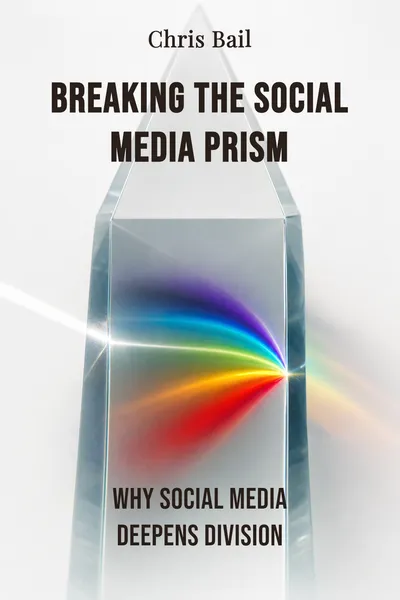
Breaking the Social Media Prism
Why social media deepens division
Description
In 2018, a team of researchers led by the sociologist Chris Bail ran an experiment that should have made the country a little less divided. They recruited more than a thousand Americans who used Twitter regularly, split them by party, and paid them to follow a bot for a month. The bot did one thing: it retweeted messages from the other side. Republicans saw a steady stream of liberal voices; Democrats saw conservative ones. The theory behind it was the one we all half-believe — that we're divided because we live in bubbles, and that exposure to the other side would soften us. If people just heard each other out, the walls would come down.
They did not come down. When Bail's team measured attitudes after the month, most participants hadn't budged, and a good number had moved further away. Republicans who'd spent thirty days reading liberals became markedly more conservative. Democrats drifted a little more liberal. The medicine everyone prescribes for polarization — more contact, more exposure — had, in this careful test, made the patient worse. That result is the seed of Bail's book, and it forces a harder question than the one we usually ask.
Because if hearing the other side pushes us apart, then the story we tell about echo chambers is incomplete at best. Something about the platform itself is doing work we didn't account for. Bail spent years chasing that something — through surveys, bot armies, and long interviews with the people whose feeds he'd rearranged — and what he found looks less like a wall between two tribes and more like a lens that bends everyone's image of everyone else.
The question we’re asking : If exposure to opposing views deepens division rather than easing it, what is social media actually doing to us?What we’ll see : How a sociologist traded the comfortable echo-chamber story for a stranger, better-evidenced one — and what it means for the feeds we scroll every day.
Table of contents
01Chapter 1 — The bot that failed to change anyone's mind
The echo-chamber theory is so tidy that it barely feels like a theory anymore. We assume that algorithms and follows sort us into sealed rooms where we only ever hear our own opinions echoed back, that this hardens us, and that the cure is fresh air from the other side. Politicians repeat it, journalists build features around it, and the platforms themselves nod along, because it locates the problem somewhere fixable. Bail set out to test it directly rather than assume it, which is rarer than it should be.
The design was deliberately clean. His team found active Twitter users, confirmed their partisanship, and offered eleven dollars to follow a study bot for a month — enough to keep them following even after the novelty wore off. The bots retweeted twenty-four messages a day from elected officials, organizations, and pundits of the opposing party. This wasn't fringe material; it was the ordinary voice of the other side, delivered in volume, straight into feeds that normally filtered it out. To make sure people were paying attention, participants had to answer weekly questions about the bot's content.

02Chapter 2 — The prism, not the echo chamber
Bail's alternative image is a prism. A prism takes light and bends it, splitting a clean beam into a distorted spread. Social media, he argues, does the same to our sense of ourselves and each other. We don't log on to gather information and update our views; we log on, whether we admit it or not, to work out who we are and to be seen being it. The platform then refracts that performance, and what everyone sees on the other end is a warped version of the whole.
This runs against the flattering idea that we are rational citizens weighing evidence. Drawing on the tradition of thinkers like Erving Goffman, who described everyday life as a kind of ongoing performance of self, Bail treats a tweet less as a claim to be judged true or false and more as a costume. We post to signal belonging, to earn a nod from our side, to feel a little more solid in an identity that offline life leaves vague. The content is almost secondary to the affirmation it fishes for.
03Chapter 3 — Extremists thrive, moderates go quiet
Follow the prism's logic and you can predict who flourishes and who disappears. Extremists thrive because the platform is built for them. Bail's research traced the online lives of people at the political fringes and found that social media gave them something offline life rarely did: status, an audience, a sense of purpose. A person marginal in their own town could become a minor celebrity to thousands who shared their grievance. The feedback of likes and shares and outraged replies is a drug tuned precisely to their needs, and they organize their days around getting the next hit.
Moderates experience the same platform as a hostile place, and they respond by leaving the field. Not by deleting their accounts, usually, but by going silent on anything political. Bail found that people in the middle looked at the reception waiting for a nuanced take — the pile-ons, the bad-faith readings, the demand to pick a team — and rationally decided it wasn't worth it. They kept scrolling and stopped speaking. The result is a visible political conversation composed almost entirely of the people least interested in agreement.
04Chapter 4 — Redesigning the mirror we look into
Once the problem is named as a prism rather than a wall, the standard fixes look misplaced. Fact-checks, media-literacy campaigns, and calls to burst our bubbles all assume the trouble is bad information reaching passive minds. But if we're on these platforms to perform identity and win status, better facts don't touch the machinery. Bail's diagnosis reframes what we can reasonably ask of the whole enterprise: the fight isn't over what's true, it's over how the mirror is built and how we behave in front of it.
That leads him toward remedies that are architectural and personal rather than informational. On the design side, his team experimented with tools that let people see their own extremity, or that raised the visibility of moderate, cross-cutting voices instead of the most inflammatory ones. Small changes to what a platform rewards, he argues, could change who feels safe speaking. The point is not to police speech but to stop engineering a system that structurally advantages the least reasonable participants and silences the rest.
05Conclusion
The experiment that started it all was meant to prove that contact heals, and it proved something colder: that on these platforms, contact with the other side often meets not the other side but its refracted extreme, and hardens us against it. Bail's prism explains the failure. We arrive to perform who we are, the platform amplifies the loudest performers, and each camp ends up battling a caricature while the reasonable middle slips away into silence. The division we lament is, in large part, manufactured by the shape of the lens.