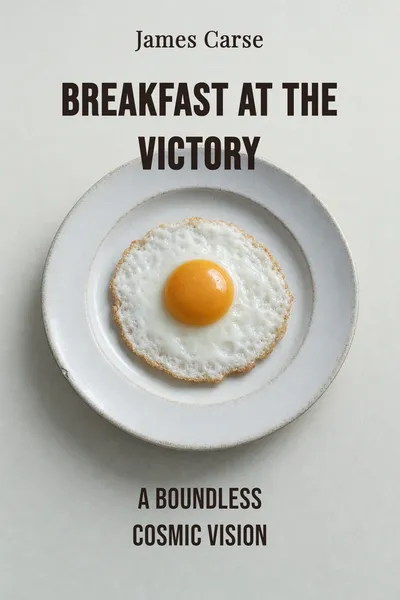
Breakfast at the Victory
A boundless cosmic vision
Description
There is a diner on the Upper West Side of Manhattan called the Victory, a narrow place with a counter, a grill, and coffee that never quite gets hot enough. James Carse, a religious scholar who taught at New York University for thirty years, used to have breakfast there. Nothing much happened. He ate eggs, watched the cook, listened to the regulars, and left. And out of these completely unremarkable mornings he wrote a small book, published in 1994, that treats a plate of eggs the way another writer might treat a cathedral.
Carse was best known for an earlier book, Finite and Infinite Games, a slim, aphoristic thing that had quietly become a cult text among people who like their philosophy stripped to the bone. Breakfast at the Victory is stranger and warmer. It calls itself "the mysticism of ordinary experience," and it means that literally. Not a mysticism of mountaintops and monasteries, but one that lives in laundromats, in a game of chess, in a kite that will not fly, in the exact moment coffee is poured.
The claim underneath all of it is easy to state and hard to hold: that the boundless — the thing religions point at with their heavy words — is not somewhere else. It is right here, in the most familiar corners of a life, waiting for us to stop naming everything long enough to notice. Carse spends the book showing what that noticing feels like, and what it costs.
The question we’re asking : What does it mean to find the boundless not in retreat from ordinary life, but at the counter of a diner in the middle of it?What we’ll see : How a scholar of religion turns eggs, silence, and a failed kite into a mysticism that refuses to leave the everyday behind.
Table of contents
01 Chapter 1 — A greasy spoon on the Upper West Side
The Victory is not a metaphor Carse invented; it was a real diner, and he insists on its realness. The book opens there because the whole argument depends on the place being unspecial. If enlightenment could only be found on a Himalayan ledge, it would be a luxury good, available to the few with the time and airfare. Carse wants the opposite. He wants the reader to understand that whatever the great traditions were pointing at is reachable from a vinyl stool, over a cup of coffee that has gone lukewarm, with a fork in your hand.
The structure of the book mirrors this. It is a series of short chapters, each built around a small scene — a walk, a conversation, an object, a habit. Carse never announces a thesis and then defends it in the academic manner. He describes something, sits with it, and lets the description open outward until the ordinary thing has quietly become enormous. The method is closer to the parable than to the essay, which suits a man who spent his career reading mystics rather than analytic philosophers.

02 Chapter 2 — The self we keep dissolving
One of Carse's recurring moves is to loosen the grip of the word I. We tend to treat the self as a solid thing, a fixed point from which we look out at everything else. Carse doubts this. He returns again and again to experiences in which the boundary between the looker and the looked-at goes soft — listening to music until there is no longer a separate person hearing it, or watching another human being closely enough that the usual wall between two people thins to nothing.
He tells these stories without turning them into doctrine. There is a scene of playing chess with a stranger in the park, where the game stops being a contest between two selves and becomes a single shared unfolding that neither player quite owns. There is another of standing beside someone dying, where the ordinary distinction between my life and yours briefly loses its authority. Carse does not say the self is an illusion, in the tidy way some spiritual writing does. He says something gentler and harder: that the self is real but not fixed, and that it can widen.
03 Chapter 3 — Silence has more room in it than speech
Carse spends a good deal of the book on silence, and he draws a distinction that runs through everything else. There is the silence that is merely the absence of noise, the quiet of an empty room. And there is a fuller silence, one that is not empty at all but crowded with presence — the silence between two people who understand each other, the silence of real attention, the silence that opens after a genuine question rather than closing after an answer.
He is suspicious of answers. A scholar of religion, he had spent decades among traditions that offer explanations for everything, and he came away convinced that the explanations were often the problem. An answer ends the inquiry; it seals the door. The traditions he loved best, he suggests, were the ones that used their doctrines not as conclusions but as ways of keeping the question alive. The mystic is not someone who knows more than the rest of us. The mystic is someone willing to stay in the not-knowing without rushing to fill it.
04 Chapter 4 — What Carse means by boundless
It would be easy to read all of this as a retreat — a scholar tired of the world, taking refuge in eggs and silence. But that reading misses the whole thrust of the book. Carse's boundless is not a place apart from ordinary life. It is ordinary life, seen without the border we habitually draw around each thing. The stars he describes being swallowed in a heartbeat are not out in space; they are what shows up when the diner, the stranger, the coffee stop being small, labeled, finished objects and become instead openings onto something that has no edge.
This is the sense in which his mysticism is genuinely unusual. Most mystical writing asks you to leave: to go inward, upward, elsewhere. Carse asks you to stay, and to loosen your grip on where you already are. The great void that contains us all, in his phrasing, is not a destination reached by turning away from the counter at the Victory. It is what the counter opens onto when you stop treating it as merely a counter. Presence, not absence, is his whole subject.
05 Conclusion
James Carse died in 2020, at eighty-seven, having spent his working life reading the people who tried to say the unsayable and then, in this small book, trying it himself over breakfast. Breakfast at the Victory never became the cult object that Finite and Infinite Games did, and perhaps that suits it. It is not a book of ideas to be argued about but a book of attention to be practiced, and it keeps sending the reader back to the least promising rooms of their own life to see whether anything opens there.
Related books