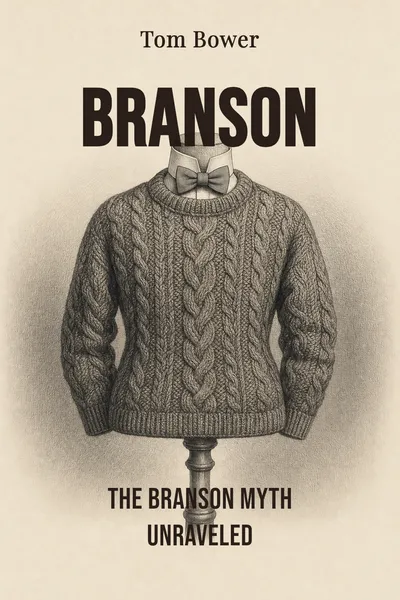
Branson
The Branson myth unraveled
Description
In January 1991, during the first Gulf War, a Boeing 747 painted in Virgin colours landed in Baghdad to collect hostages and refugees. On board, in front of the cameras, was Richard Branson. The image travelled the world: the jumper-wearing entrepreneur who flew into a war zone while other businessmen counted their losses from a safe distance. It was the kind of picture that had, by then, become his signature — Branson in a hot-air balloon, Branson dangling from a crane, Branson grinning through some feat that no rival chief executive would have dreamed of attempting. The public loved it, and the loyalty has barely faded since.
Tom Bower, a British investigative biographer known for taking apart the reputations of the powerful, spent years on a different account of the same man. His book Branson, drawing on firsthand testimony from more than 250 people who dealt with the tycoon directly, sets out to separate the figure that Virgin's publicists had spent decades constructing from the one his former partners, employees and adversaries describe. The two versions rarely match. Where the official story tells of a fearless outsider bloodying the nose of corporate giants, Bower finds a shrewder, harder operator whose charm was a working tool rather than a personality trait.
What Bower is really chasing is not a scandal but a mechanism: how one man turned himself into the most recognisable brand in British business, and how that brand came to be believed more readily than the ledgers behind it. Branson had done something that few founders ever manage. He had made himself more famous than any of his companies, and made his own face the product that everything else was sold beneath.
The question we’re asking : How did Richard Branson become more trusted than the businesses he actually ran?What we’ll see : How Bower's 250 witnesses describe the distance between the beloved public figure and the operator behind Virgin.
Table of contents
01 Chapter 1 — The man on the balloon, the man behind it
The Branson the public met was almost always in motion — crossing the Atlantic by powerboat in 1986, attempting it by balloon a year later, later circling toward the Pacific in a capsule that nearly killed him more than once. These were genuine physical risks, and Bower does not pretend otherwise. What he questions is the meaning attached to them. Each stunt arrived, conveniently, alongside a Virgin launch or a struggling division that needed attention. The daredevil and the marketer, in Bower's account, were never separate people.
The persona was carefully calibrated: no tie, a woolly jumper, a boyish grin, a habit of turning up late and apologising with charm rather than explanation. It read as authenticity, and authenticity was the whole point. In a country suspicious of slick businessmen, Branson looked like the anti-businessman — the pirate taking on the establishment on behalf of ordinary consumers. Bower's witnesses describe how deliberately that impression was cultivated, down to the studied disorganisation and the practised self-deprecation.

02 Chapter 2 — How Virgin actually made its money
The Virgin story most people know is one of scrappy insurgency: a record shop, then a label, then an airline that took on British Airways and won. Bower tells a more tangled version. The record business was real and, for a time, lucrative — Virgin Records signed the Sex Pistols, Mike Oldfield, Culture Club and others, and it was the eventual sale of that label to EMI in 1992, for around one billion dollars, that funded much of what followed. Branson reportedly wept as he signed it away. It was also the moment that revealed how the empire really worked: cash generated in one venture propping up the ambitions of another.
Virgin, Bower argues, was never a single company in any conventional sense. It was a loose constellation of separately owned businesses, many registered offshore, linked chiefly by the brand name and by Branson's personal stake. Profits and losses could be moved, presented and obscured across this structure in ways that made the group's true health difficult for outsiders to read. The image of a unified, thriving empire was, in part, an accounting effect — and a deliberate one.
03 Chapter 3 — The image machine
If there is a hero in Bower's account, it is public relations. From early on, Branson understood that a story printed for free was worth more than an advertisement paid for, and that a photograph of him doing something absurd would run everywhere. He made himself endlessly available, endlessly quotable, and endlessly willing — posing nude, wearing a wedding dress to launch Virgin Brides, hanging off buildings. Editors got a guaranteed picture. Branson got a guaranteed brand.
Bower details the machinery that kept the image clean. Unflattering stories were fought hard, through lawyers and through the personal charm that made journalists reluctant to turn on so likeable a subject. Battles Branson lost were reframed as battles bravely fought. The famous 'dirty tricks' litigation against British Airways in the early 1990s — which Virgin won, extracting a public apology and damages — became the founding legend of the plucky underdog, and it was a genuine victory. But Bower notes how effectively even genuine victories were converted into a permanent narrative of persecuted virtue.
04 Chapter 4 — The cost of being everybody's favorite tycoon
Step back from the individual episodes and Branson becomes a study in something larger: what happens when a personal brand outgrows the business beneath it. Bower's deeper subject is not whether Branson was a good or bad man but why the public was so willing to believe the flattering version, and so slow to check it against the accounts. The answer says as much about us as about him.
We like our capitalists to have a story. A faceless conglomerate that quietly compounds profits inspires nothing; a barefoot adventurer taking on the giants inspires loyalty, forgiveness, even affection. Branson supplied the narrative that made wealth feel likeable. He gave the impersonal machinery of commerce a human face, a sense of humour and an underdog's grievance — and in exchange, the public extended a trust that the underlying businesses had not necessarily earned on their own merits.
05 Conclusion
The plane that landed in Baghdad in 1991 was real, the hostages were real, and Branson was genuinely on board. Bower's point is never that the images were faked. It is that each one was doing more work than it appeared to — carrying a launch, deflecting a story, converting a stunt into affection that could be spent later. Told with all the witnesses in the room, the life looks less like a series of happy accidents and more like a sustained, disciplined act of self-construction by a man who understood the media age before most of his rivals did.
Related books