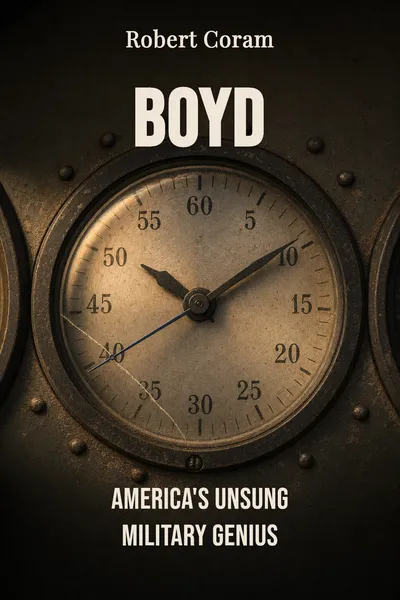
Boyd
America's unsung military genius
Description
At Nellis Air Force Base in the Nevada desert, sometime in the late 1950s, fighter pilots passing through the Fighter Weapons School heard about a standing bet. A young instructor named John Boyd would take any challenger up, let them start on his tail — the killing position, the one every pilot dreams of — and from that disadvantage he would reverse the fight and put them in his gunsight in under forty seconds. If he failed, he owed forty dollars. He held the bet for years. The story goes that nobody ever collected. The men who flew against him called him Forty-Second Boyd, and it was not affectionate at first.
That reputation would have been enough for most careers. But the pilot who could beat anyone in the air turned out to be far stranger and more consequential than a hot stick with a gift for the merge. Boyd barely rose in rank, feuded with generals, worked in near-anonymity, and left almost nothing published under his own name. And yet the aircraft America flew for the next half-century, the way its Marines fought in the Gulf, and a phrase now recited in boardrooms all trace back to a man most Americans have never heard of.
Robert Coram's biography sets out to correct that. It tells the life of a difficult, obsessive, often impossible man, and argues that the difficulty and the achievement were the same thing. Boyd left the Air Force poorer than he entered it and prouder of the people he changed than of anything he built. To make sense of why, we have to follow him from the cockpit to the drawing board to a set of ideas that outran the machines he designed.
The question we’re asking : How did a mid-ranking fighter pilot who published almost nothing end up shaping American airpower and military thinking for fifty years?What we’ll see : How a duelist in the sky became an engineer of jets and, in the end, a theorist of how anyone beats anyone.
Table of contents
01Chapter 1 — Forty seconds, guaranteed
John Boyd flew F-86 Sabres in Korea near the end of that war, arriving too late to log a kill, which he minded for the rest of his life. What he took from Korea instead was a puzzle. American pilots were shooting down Soviet-built MiG-15s at a lopsided rate, even though the MiG could out-climb and out-turn the Sabre on paper. Boyd wanted to know why the worse machine, by the specs, kept winning. The answer he circled toward — better cockpit visibility, faster controls, pilots who could shift from one move to the next quicker than the enemy — would occupy him for decades.
By the mid-1950s he had landed at the Fighter Weapons School at Nellis, the Air Force's graduate school for air combat, first as a student and soon as its most feared instructor. He was loud, profane, and physically enormous in his intensity — a man who jabbed a lit cigar toward a colonel's tie to make a point. But behind the theatrics was rigor. Boyd did not just win dogfights; he could explain, maneuver by maneuver, exactly why he had won, and then teach it.

02Chapter 2 — The man who gave away his ideas
Boyd's second act took place not in a cockpit but at a desk, and it nearly ended his career several times over. In the 1960s the Air Force sent him to Georgia Tech to study engineering, and there he began to formalize an idea that had been nagging him since Korea: that a fighter's performance could be captured as a trade-off between energy and maneuver, and calculated. He would need vast amounts of computer time to prove it — time he was not authorized to use.
So he stole it. Working with a civilian mathematician named Thomas Christie, Boyd arranged, through improvised and unofficial means, to run his calculations on Air Force computers that were meant for other work. Out of it came Energy-Maneuverability theory, a way of charting exactly how much a given aircraft could turn, climb, and accelerate at any speed and altitude — and, devastatingly, of comparing your jet to the enemy's on the same chart. For the first time, the vague question of which fighter was "better" had a numerical answer.
03Chapter 3 — Energy, and how a jet earns its keep
Energy-Maneuverability was not an academic exercise for long. In the mid-1960s the Air Force was designing a new fighter, and the early concept was drifting toward a heavy, complex, fast-but-clumsy machine loaded with expensive systems. Boyd, pulled into the effort in the Pentagon, used his charts to argue for something leaner: an aircraft optimized to win the actual fight, able to turn and change energy states faster than its opponent, rather than one built to impress on a spec sheet. The result, after ferocious internal battles, was the F-15 Eagle.
But Boyd came to think even the F-15 had grown too big and too costly. With his reformers — chief among them the analyst Pierre Sprey — he pushed a more radical idea: a small, light, cheap, brutally agile day fighter, stripped of the heavy radar and gadgetry that drove up weight and price. The establishment resisted; a lightweight fighter threatened budgets and the assumption that more expensive always meant more capable. The fight was bitter and personal. Out of it came the F-16 Fighting Falcon, which became one of the most widely produced and exported fighters in the world.
04Chapter 4 — How to get inside another man's head
Boyd's largest idea arrived after he retired, and it had nothing specifically to do with airplanes. Sitting with his old question — why did the worse machine keep winning in Korea? — he generalized it. The Sabre pilot won, he decided, not by being faster in a straight line but by cycling through his choices faster: seeing the situation, making sense of it, deciding, acting, and then doing it all again before the enemy had finished his own cycle. Boyd called this sequence observe, orient, decide, act. It became known as the OODA loop.
The claim underneath it is deceptively simple and quite radical. Conflict, Boyd argued, is not won by superior force so much as by superior tempo. Whoever can move through the decision cycle quicker gets inside the opponent's, so that by the time the slower side reacts, the situation has already changed and their response is aimed at a fight that no longer exists. The enemy becomes confused, then overwhelmed, then paralyzed — not because they were outgunned, but because they were out-thought in time. Boyd built this out in a marathon briefing, "Patterns of Conflict," that could run for hours and that he delivered obsessively, for free, to anyone who would sit still.
05Conclusion
John Boyd died in 1997, a retired colonel most of the country had never heard of. He was buried at Arlington, and among the wreaths was one from the Marine Corps, whose doctrine he had helped rewrite though he never wore its uniform. Some of his Acolytes, after the funeral, drove to the Marine base at Quantico and left his papers where young officers would find them — which is roughly what Boyd would have wanted, his ideas passed on rather than enshrined. He had chosen, again and again, to do something rather than to be somebody, and the ledger of his life reads oddly because of it: little rank, few medals, no famous book, and an outsized mark on the machines and minds of American defense.
Related books