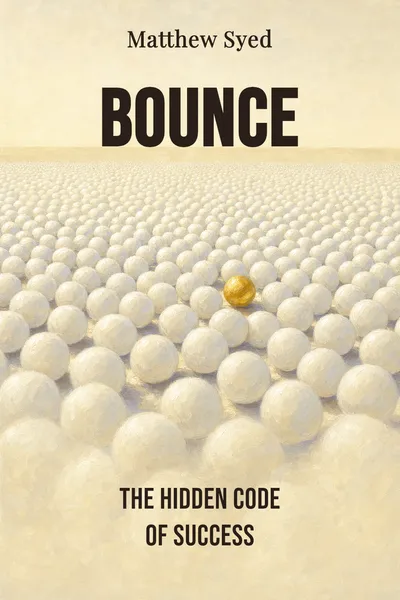
Bounce
The hidden code of success
Description
In the early 1980s, a street in the London suburb of Reading produced an unusual number of Britain's best table-tennis players. Matthew Syed grew up on that street, went on to become the country's number-one player for the better part of a decade, and competed at two Olympics. For years the tidy explanation was talent — the Syed brothers, and the neighbours down the road, simply had it. Then Syed looked closer at what he and his rivals actually shared, and the talent story fell apart.
They all had the same coach, a table-tennis obsessive named Peter Charters who ran the local club. They all had keys to that club, which meant thousands of hours of practice most children never get. They all had a table at home, older siblings to lose to, and a town that happened to be a national hub for the sport. Take any of those away, Syed argues, and the champions of Silverdale Road simply do not appear. What looked like a genetic cluster was a set of circumstances hiding in plain sight.
That reversal is the engine of Bounce, Syed's 2010 book on where excellence really comes from. Drawing on cognitive science, sports psychology and a career spent inside elite competition, he takes on one of our most comfortable beliefs — that the great are born, not made — and asks what we lose by clinging to it. The answer runs well past sport, into classrooms, boardrooms and the way we judge one another.
The question we’re asking : If the best in the world are not simply born that way, what actually separates them from the rest of us?What we’ll see : How a champion's own life becomes the evidence that dismantles our favourite explanation for success.
Table of contents
01 Chapter 1 — The table-tennis champion who wasn't a prodigy
Syed opens with himself, because his own biography is the cleanest experiment he has. In 1995 he was ranked as Britain's top table-tennis player, and the obvious reading was that he had been born with faster reflexes and sharper hand-eye coordination than his peers. He spends the first chapters carefully taking that reading apart. The trouble starts when he lists the things that were true of him and equally true of the other top players clustered around one ordinary suburban street.
There was Peter Charters, a teacher with a near-religious devotion to the sport who turned the local club into a machine for producing players. There was Omega Club, to which Syed and a handful of others held a key — meaning that while other children practised for an hour a week, these ones practised whenever they liked, often late into the night. There was an older brother, Andrew, to play against at home, and a table in the garage. None of this shows up when you simply admire a finished champion. All of it shows up when you ask how the champion was built.

02 Chapter 2 — Ten thousand hours, and the myth of the natural
The engine underneath Bounce is the research on expertise associated with the psychologist K. Anders Ericsson, whose studies of violinists, chess players and athletes suggested that world-class performance follows years of a particular kind of work. Ericsson's figure, popularised as roughly ten thousand hours, is less a magic number than a rough marker of scale: elite performers have almost always logged an enormous amount of practice, far more than the merely good. Syed borrows the framework and stress-tests it against his own world.
The crucial refinement is that not all practice counts equally. Ericsson's term is purposeful, or deliberate, practice — work aimed squarely at what you cannot yet do, with immediate feedback and constant correction, sustained at the edge of your ability where it is uncomfortable. Playing a match you can win teaches little. Drilling the shot you keep missing, again and again, until it stops being a weakness, teaches a great deal. Most people who play a sport for years never improve much precisely because they repeat what they already know.
03 Chapter 3 — What happens when the mind goes blank
If practice builds excellence, Bounce spends a memorable stretch on the moment excellence collapses. Syed knows it intimately. At the 2000 Sydney Olympics, at the height of his powers, he froze — a comprehensive, humiliating failure at exactly the moment he had spent his life preparing for. The chapter on choking is one of the book's most vivid, because the author is describing a wound rather than a theory.
The mechanism, drawn from performance psychology, is a strange reversal of the practice story. Expertise works by pushing skills into automatic, unconscious control; the expert does not think about each movement any more than we think about walking. Choking happens when anxiety drags that automated skill back under conscious supervision. The performer starts monitoring what should run by itself, and the monitoring jams the machinery. It is called reinvestment, or paralysis by analysis, and the cruelty is that it strikes the skilled hardest, because they have the most automation to disrupt.
04 Chapter 4 — The stories we tell about winners and losers
Step back from the practice hours and the frozen limbs, and Syed is really writing about belief — specifically, what happens to a society when it decides that ability is fixed at birth. Here he leans on the psychologist Carol Dweck's distinction between two mindsets. Those with a fixed mindset see talent as a static quantity, so effort feels like an admission of not having it; failure becomes a verdict on who they are. Those with a growth mindset see ability as something built, so effort is the point and setbacks are information. The two beliefs produce very different lives from identical starting material.
The stakes rise once you notice who receives which story. Praise a child for being clever and you nudge them toward the fixed view, where every future challenge threatens the label. Praise a child for working hard and you point them at the process they can actually control. Multiply that across schools, workplaces and whole cultures, and the myth of the natural stops being a harmless flattery. It becomes a filter that decides, in advance, who is encouraged to keep trying and who is quietly written off.
05 Conclusion
The book ends more or less where it began, on that ordinary suburban street, but the meaning has changed. The champions of Silverdale Road were never proof that talent runs in postcodes; they were proof that a coach, a key to a club and thousands of hours will do things we habitually credit to genes. Syed's whole case is that we look at outcomes — the medal, the perfect performance — and read backward into a gift, when the honest reading runs forward through the conditions that made the outcome possible.
Related books