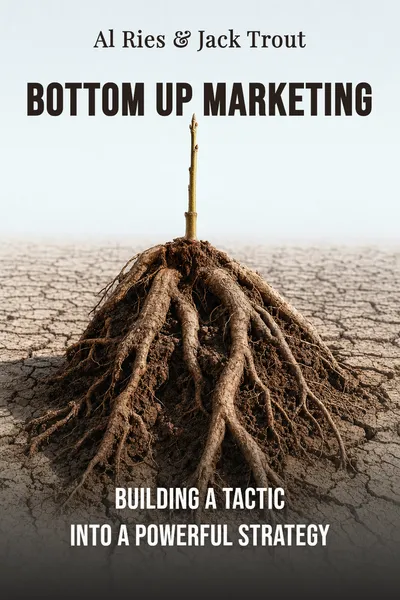
Bottom up marketing
Building a tactic into a powerful strategy
Description
Traditional marketing often follows a top-down approach, with senior management setting the strategy and middle managers implementing tactics.
However, the most successful companies have historically adopted a bottom-up approach, starting with tactics that offer a competitive advantage and then integrating these into the overall marketing strategy.
Bottom-up marketing emphasizes the importance of understanding the marketplace and finding inspiration at the point where customers interact with the product or service, leading to the development of an effective marketing strategy.
Table of contents
01 Understanding bottom up marketing
The most successful and lucrative business strategies are intricately crafted from a deep understanding and active engagement with the business's operational tactics. It is the tactics that guide a company towards the most effective strategy, not the other way around.
In the realm of business, marketing essentially embodies the strategy. It represents the ideological battleground in the minds of potential consumers. Winning this battle means securing another client or customer for your company; losing means that potential business goes to a competitor.
A tactic is a unique idea or a competitive mental angle that sets your product apart from all others in the market. It is the perceived benefit that convinces a customer that your product offers a superior solution compared to alternatives. For instance, the U.S. pizza chain Domino’s guarantees free home delivery of pizza within 30 minutes of placing an order. This home delivery promise is Domino’s tactic to boost sales. Similarly, Federal Express promises next-day delivery of packages anywhere in the United States, making dependable next-day delivery its winning tactic. In the real world, tactics are not inherently "good" or "bad"; they are either effective, generating sales, or ineffective, where a different tactic could potentially achieve more sales.
A business strategy is a comprehensive marketing direction. It is a plan developed and executed by a company to systematically organize all marketing activities with the goal of maximizing sales. Essentially, the strategy is the overarching plan that incorporates all the individual tactics a company may employ to achieve its objectives. For example, Christopher Columbus's strategy to find a shortcut to India by sailing west from Europe, instead of east, was unrealistic, but his tactic led to the discovery of a new continent. Similarly, Jack O’Neill, a dedicated surfer, developed a wet suit to combat the cold, which became the flagship product of a multimillion-dollar company. A strategy outlines the company's long-term goals, while a tactic details the steps to achieve these goals. Strategies evolve over time; for instance, a sale is a common retail tactic, but a store that runs sales every day becomes known as a discount store, illustrating a strategic positioning based on a specific tactic. Tactics are based on communication, whereas strategies are founded on products, services, or the company itself.

02 Developing bottom up marketing strategies
Embarking on a journey to the front lines of your company's marketplace is the most pivotal step in crafting a marketing strategy that resonates. It's about discovering a unique mental vantage point that makes your product or service stand out in the competitive landscape. The CEO, who typically has the final say on the marketing direction, is often the most disconnected from the actual market dynamics. To bridge this gap, it's imperative for the CEO to invest time in visiting the customer interface firsthand to witness the reactions of potential customers. This direct engagement cannot be outsourced effectively, as middle managers tend to filter information, presenting what they believe senior management wants to hear. Such visits should be seen as a vital investment in the company's future, not just a routine check.
When a CEO steps into the marketplace, the goal should be to gather insights rather than seek validation for preconceived notions. The true battleground for a product or service lies within the prospect's mind, making it essential to understand their thoughts and perceptions objectively. Notable figures like T.K. Quinn, Al Ries, Jack Trout, General Secretary Gorbachev, Harry Truman, and Richard Nuestadt have all emphasized the importance of firsthand experience and the continuous pursuit of knowledge, even when one believes they know it all.
Keeping an eye on consumer trends involves distinguishing between ephemeral fads and enduring shifts in consumer behavior. While sensational media headlines may suggest rapid lifestyle changes, the reality is that fundamental habits evolve slowly. Businesses that align with long-term trends rather than fleeting fads stand to gain significantly. Differentiating between a fad and a trend can be challenging, but generally, fads explode in popularity quickly, whereas trends build momentum over time. Marketing plans should be grounded in reality, and companies should focus on creating the future by introducing products that tap into existing customer bases rather than waiting for consumer behavior to change. There's also potential in going against the grain, as doing the opposite of everyone else can sometimes lead to remarkable success. Narrowing your focus to identify a tactical angle is about finding a competitive edge in the prospect's mind. Marketing is less about the products themselves and more about the battle of ideas. Bottom-up marketers leverage existing perceptions to their advantage, rather than attempting to reshape them. A simple, focused concept is more potent than a complex, diffuse one. Specialization allows a company to be perceived as an expert and potentially become the default choice in a category. An effective tactic is one that fills a void in the market, acknowledges consumer choice, and offers a strong benefit that can be the centerpiece of marketing efforts. It should also be difficult for competitors to replicate, as seen in the case of Avis's "We try harder" campaign.
Related books