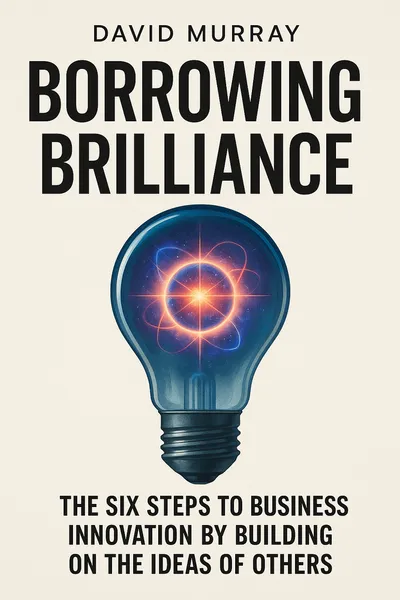
Borrowing brilliance
Recombining the old into new
Description
Creativity emerges through a structured six-step process, beginning with identifying the problem at hand.
Inspiration is then drawn from similar challenges, and these ideas are fused together.
This blend is nurtured until it forms a coherent solution, which is then refined by highlighting its strengths and mitigating its weaknesses.
Through this method, new concepts are born from the synthesis of existing ones.
History's great minds, like Newton and Shakespeare, also engaged in this practice of intellectual borrowing, proving that innovation often involves reassembling known elements in novel ways.
Thus, true creativity lies in the art of skillfully sourcing and assembling these pieces.
Table of contents
01 Problem identification
Creative ideas are the bedrock of problem-solving, and the way a problem is defined significantly influences the type of solution that emerges. As David Murray puts it, "A problem is the foundation of a creative idea." Therefore, the first step in generating a creative idea is to thoroughly study the problem at hand. However, this process is often challenged by two factors. Firstly, our innate tendency to act immediately often hinders us from understanding the problem in depth. Secondly, we often focus so much on solving the problem that we overlook its context within a larger system, leading to a lack of understanding of its scope. This narrow focus can generate more problems in the future. Therefore, it's crucial to define the problem neither too broadly nor too narrowly to foster innovative thinking. Just like every construction project begins with a task, the conception of an innovative idea also starts with constructing a solid foundation on which the new idea will stand.

02 Idea sourcing
To solve a problem, one effective approach is to gather solutions that have already been used in comparable situations. These solutions could come from various sources such as your competitors, your industry, or even from the arts, sciences, or other industries. The idea is to use these existing solutions as building blocks to construct your own unique solution. Start by examining how other companies in your industry have addressed similar problems. The goal is not to copy their solutions, but to borrow elements from them and combine these with elements from other solutions to create a fresh, hybrid solution. Next, look at other industries. There might be concepts and ideas that have proven successful there that you can adapt to your specific needs. This method of borrowing and improving upon ideas from other industries has been successfully employed across various domains.
03 Idea integration
Creativity is fundamentally about forging new and unique connections. The key to structuring and defining your innovative idea is to find or establish an appropriate metaphor. In the second step of the creative process, you gather a multitude of fresh ideas as the building blocks for your creative concept. This involves merging these ideas into novel hybrids that have never existed before. However, this isn't about randomly combining two ideas and hoping for the best. You need a metaphor as an underlying skeleton or framework. From a grammatical standpoint, metaphors and analogies differ significantly. A metaphor implies that one thing is something entirely different, like describing a planet as an "apple in the sky". An analogy, on the other hand, likens one thing to another, such as saying a personal computer is like an "electronic calculator on steroids". In the realm of creativity, however, metaphors and analogies are identical and interchangeable. The crucial aspect is that you're expressing your new idea in terms of an existing idea or ideas, creating a new intellectual connection where none previously existed.
04 Idea maturation
To foster original ideas, allow your subconscious mind to mull over your new concept. Intentionally divert your thoughts to other subjects, enabling your subconscious to refine your idea. The paradox is that the optimal way to generate an original idea is to cease pondering your problem entirely. Set your ideas aside, stop contemplating them, and engage in different activities. This incubation period often leads to a creative breakthrough, a clear and intense idea that emerges unexpectedly. This process harnesses the power of your subconscious mind. When you consciously think about a subject, you create synaptic connections. The more you dwell on the same topic, the deeper these connections become, leading to a repetitive thought sequence. Over time, it becomes challenging to think beyond this established pattern, locking you into a specific way of thinking and making it difficult to gain a fresh perspective. This is why it's crucial to involve your subconscious mind. As David Murray puts it, "effective creative thinking is sometimes not thinking at all."
05 Solution evaluation
Analyze your solution and identify its strengths and weaknesses. Evolve your new idea further by injecting your own viewpoints, personal judgment, and intuition into it.
Great ideas never appear fully formed. The insights you garner from an “aha!” moment of creative spark still need to be stress tested and developed before they’re ready for prime time implementation.
In other words, you now need to bring your judgement to bear to take those ideas from something that sounds good in theory to something that will work in the real world.
Judgment drives the evolution of any innovation. It makes solid ideas survive and the wacky ideas fade away into obscurity. So what makes an idea survivable?
“In business, survivability is based on the importance of the problem being solved and how well the idea solves the problem relative to the other solutions. Solve a trivial problem and your idea will be trivial and die. Solve an important problem less effectively than another solution and your solution will die too. If you solve an important problem that no one else is solving, you’re guaranteed survivability.” – David Murray
This is one reason why Apple’s iPod has been such a success. It superseded Sony’s Walkman because you no longer had to buy and store clumsy CDs. You could carry your entire music library wherever you went. People who bought iPods loved them so much they told their friends and on the strength of these word-of-mouth endorsements, the iPod has become a commercial juggernaut.
The iPod is the grandchild of the Walkman in just the same way as it is the descendant of the gramophone. Good ideas evolve from one generation of products to the next with new elements getting grafted in all the time as old elements fade away. Creative business thinkers understand this evolutionary idea process very well and use it to good effect.
In the creative process, judging is not used to accept or reject an idea. Instead, you judge to enhance and evolve your ideas. When you judge a new idea, you achieve three different things:
1. You identify any weaknesses which exist – so you know what you need to do to eliminate flaws.
06 Solution refinement
The creative process is a continuous journey of refining and redefining your ideas. It's not a linear path, but rather a series of trials and errors, adjustments, and fine-tuning. The process requires a blend of creative thinking, logical reasoning, and a realistic approach to the challenges involved. It's an iterative process, not a one-time event where a brilliant idea emerges fully formed. The final step in the creative process is to revisit the previous steps, making changes and adjustments based on your judgment. This could involve altering the problem you're trying to solve or the components you're using. As your idea evolves, you'll continually eliminate flaws and enhance strengths. This is how all creative ideas come to fruition, so patience and time for incubation are essential.
The foundation of your ideas is how you define the problem you're solving. Periodically, you should reassess and ask yourself if the idea you're working on could solve a different problem or if the problem could be made more dynamic by rephrasing it. The evolution of an idea includes the evolution of the problem it's solving. There's no blueprint for creating a fresh and innovative idea. It's more like solving a jigsaw puzzle than baking a cake. You have to keep borrowing different components to see if you can come up with a more robust solution. As your idea evolves, you'll need to recombine and rethink your metaphors. This could involve simple or complex changes. The enhancement of an idea is a complex endeavor involving re-defining, re-borrowing, and re-combining. It's as much an art as it is a science. The creative process is inherently inefficient, often involving detours and dead ends. But with repetition, your conscious and subconscious minds will become more adept at thinking creatively. The more ideas you consider and reject, the greater the chances of uncovering something genuinely innovative. Failures are necessary for fine-tuning and improving your creative instincts. They are the price of progress.
Related books