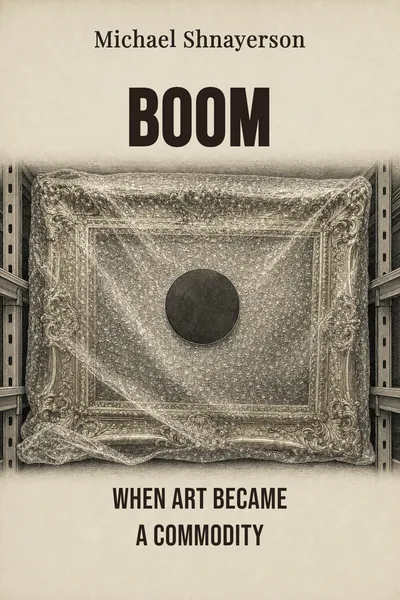
Boom
When art became a commodity
Description
On November 12, 2013, at Christie's in New York, a triptych by Francis Bacon sold for $142.4 million in under ten minutes. The buyer, on the phone through a Christie's specialist, beat out a room of underbidders for a portrait of Bacon's friend Lucian Freud. For a few weeks it was the most expensive artwork ever sold at auction. It would not hold the title long. Prices in the contemporary art world had entered a stretch where each record seemed to exist mainly to be broken by the next one, and the people bidding were rarely museums.
Michael Shnayerson, a longtime Vanity Fair writer, spent years talking to the people who built that machine — the dealers, the auctioneers, the collectors, the artists whose canvases were suddenly trading like commodities. His book Boom tells the story of how the American postwar and contemporary art market grew from a small, clubby trade into a global business measured in the tens of billions, and how a handful of dealers engineered the ascent. It is a chronicle of money, but the people are what hold it together: Leo Castelli grooming a generation, Larry Gagosian turning a gallery into an empire, artists watching their own work resold for sums they never saw a cent of.
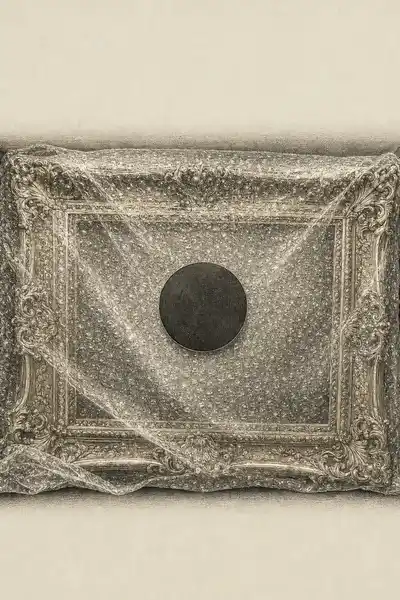
What emerges is less a celebration than a long, close look at a transformation. Somewhere across half a century, the object on the wall stopped being only an object on the wall and became something you could park capital in, flip for profit, and store in a tax-free warehouse without ever hanging it. Shnayerson watches that shift happen, dealer by dealer, sale by sale.
The question we’re asking : How did contemporary art turn from something you looked at into something you invested in — and who engineered the change?What we’ll see : The dealers who built the market, the auctions that set the prices, the machinery that keeps it spinning, and what all that money does to the art itself.
Table of contents
01Chapter 1 — The dealers who made the market
Shnayerson begins with the figure who set the template. Leo Castelli, an Italian-born dealer who opened his New York gallery in 1957, did something dealers before him had rarely done systematically: he put his artists on a stipend, promoted them like a manager promotes talent, and built the secondary reputations that turned Jasper Johns, Robert Rauschenberg and later Andy Warhol into names. Castelli understood that a market is not found, it is made — through relationships, patience, and a willingness to place work with the right collectors who would lend prestige back to the artist. He was courtly, generous, and quietly ruthless about which collectors mattered.
The generation that followed took Castelli's instincts and industrialized them. The central figure of the modern trade, in Shnayerson's telling, is Larry Gagosian, who started selling posters in Los Angeles and built the closest thing the art world has to a multinational — galleries across continents, a roster of the most bankable living and dead artists, and a talent for the secondary market that made him indispensable to anyone buying or selling at the top. Gagosian did not so much discover artists as concentrate them, luring established names away from smaller dealers with promises of reach and price.

02Chapter 2 — A painting is worth what someone will pay
If dealers built the market's foundation, the auction houses gave it its theater. Christie's and Sotheby's, Shnayerson shows, discovered that contemporary art could generate the kind of spectacle that Old Masters no longer did. A single evening sale, with its hushed room, its telephone bidders, and its auctioneer coaxing the numbers upward, became a public performance of value. The hammer price was a fact the whole world could read the next morning, and that fact then reset what every comparable work was worth.
The mechanics are more managed than the drama suggests. Shnayerson explains the guarantee — the practice by which an auction house, or a third party, promises a seller a minimum price before the sale even happens. Guarantees remove risk for the consignor and let houses compete for the best material, but they also mean the market is partly underwritten rather than freely discovered. A work that appears to have soared past its estimate may have had its floor quietly arranged in advance. The transparency is a performance layered over a private negotiation.
03Chapter 3 — The fair, the flip, the freeport
By the 2000s the market had outgrown the gallery and the saleroom, and Shnayerson follows it into the new infrastructure of the boom. Art fairs — Art Basel and its Miami Beach offshoot above all — turned buying into a global social season. Collectors flew in on private jets, dealers hung their best inventory in convention-center booths, and enormous sums changed hands in the first hours before the public was even admitted. The fair compressed a year of business into a weekend and made attendance itself a marker of status.
Then there was the flip. Shnayerson devotes close attention to the practice of buying an emerging artist's work cheaply and reselling it within months or a year for a large multiple. Speculators began treating young painters as commodities futures, bidding up so-called 'zombie formalism' and other easily traded abstraction, then dumping the work when the momentum faded — often leaving the artist's reputation wrecked in the process. Dealers fought to control who bought, precisely to keep speculators from turning their artists into churned inventory.
04Chapter 4 — What the price tag does to the art
Step back from the dealers and the record hammer prices, and the deeper story Shnayerson tells is a conversion. Over half a century, a painting stopped being primarily something to look at and became primarily something to own — an asset class alongside real estate and equities, valued by the same logic and traded by many of the same people. Boom is, at bottom, the chronicle of that reclassification, and of what gets lost when it happens.
The pressure on artists is where the cost shows most clearly. When a young painter's canvases start flipping at auction for sums that dwarf the gallery price, the market begins to want more of exactly that thing, and it wants it fast. Shnayerson describes artists who become, in effect, brands obliged to supply a product, their studios turned into workshops of assistants producing recognizable inventory. Some thrive on it; others find that the very success that enriches their collectors quietly narrows what they are allowed to make. The market rewards a signature and punishes a change of direction.
05Conclusion
The Bacon triptych that broke the record in 2013 was itself soon overtaken — by a Modigliani, then a da Vinci, then others, each hammer price a fresh headline. Shnayerson's book is a portrait of the world that produces those headlines, assembled from years of conversations with the dealers, collectors, auctioneers and artists who live inside it. What he documents is not a scandal but a transformation, carried out mostly in the open by people who mostly believed in what they were building.
Related books