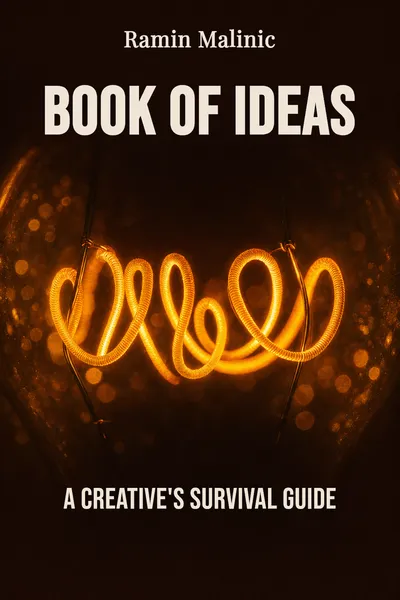
Book of Ideas
A creative's survival guide
Description
Sometime around 2016, a creative director and designer named Ramin Malinic sat down to gather the things he wished someone had told him earlier. Not a philosophy of design, not a grand theory of creativity — just the accumulated notes of a working professional who had spent years inside studios, agencies and freelance chaos, learning what actually holds a creative life together. The result was Book of Ideas, a short, illustrated volume that reads less like a manual than like a friend leaning across a café table to hand over everything he figured out the hard way.
What makes the book unusual is how ordinary its concerns are. It talks about inspiration, yes, but it also talks about managing an inbox, saying no to bad clients, getting out of bed on the mornings when the work feels pointless. It moves from beating creative block to the awkward business of self-promotion without ever changing register. The creative industry, in Malinic's telling, is strange and endlessly fascinating, but it also runs on unglamorous discipline — and most of the advice young creatives get skips straight past that part.
So the book sits in a peculiar spot: too practical to be inspirational, too personal to be a textbook. It is a survival guide written by someone who survived, illustrated with the portfolio work that proves he did. And that raises a simple question about the whole genre of creative advice — whether the thing that keeps a career alive is talent at all, or something far more mundane and far harder to sustain.
The question we’re asking : What does a working creative director actually pass on when he stops talking about talent and starts talking about survival?What we’ll see : How a small book of practical notes reframes inspiration, fear and self-promotion as the daily habits of a creative life.
Table of contents
01 Chapter 1 — A studio manual with no rules
Book of Ideas doesn't open with a manifesto, and that absence is the point. Malinic is a designer and creative director, not a guru, and the book carries the texture of someone who has spent his working hours in real studios rather than on a stage. It is built from short entries — a page here, a spread there — each one a single observation dropped without ceremony. The effect is closer to flipping through a colleague's notebook than to reading a structured argument, and it invites the same kind of reading: dip in, take what's useful, leave the rest.
The topics refuse to sort themselves into a hierarchy. Inspiration sits next to inbox control. Facing your fears shares space with the mechanics of self-promotion. Finding happiness in the work appears not as a lofty destination but as a maintenance problem, something you have to keep doing rather than something you arrive at. Malinic treats the small logistical truths of a creative career — how you handle email, how you protect your time, how you decide which projects to chase — with the same seriousness he gives to the big questions about meaning and originality.

02 Chapter 2 — Fear, block, and the empty page
The most honest sections of the book are the ones about fear. Malinic doesn't pretend that experience makes the anxiety go away; he treats it as a permanent condition of creative work, something every project reactivates. The empty page, the blank canvas, the brief you don't yet know how to crack — these produce the same dread whether it's your first job or your fiftieth. What changes, in his account, is not the feeling but the relationship to it. The professional isn't fearless. The professional has simply learned to start anyway.
Creative block gets similar treatment. Rather than framing it as a mysterious visitation to be waited out, Malinic tends to treat it as a practical problem with practical exits. Change the input. Step away and let the mind wander, since the ideas rarely arrive while you're staring them down — they turn up in the shower, on a walk, in the gap between tasks. Lower the stakes of the first attempt so that producing something bad becomes permitted, because bad is a place you can work from and blankness is not. The advice is unromantic on purpose.
03 Chapter 3 — Getting the work seen
For a book so concerned with the interior life of the maker, Book of Ideas spends a surprising amount of energy on the outer one — on the unglamorous, often uncomfortable business of getting the work in front of people. Malinic is direct about a truth many creatives resist: the work does not promote itself, and quality alone does not guarantee that anyone will ever see it. Someone has to do the showing, and if you won't do it for your own work, it's unreasonable to expect anyone else to.
The discomfort is the whole subject. Self-promotion feels, to a lot of creative people, like bragging, or like an admission that the work can't stand on its own. Malinic reframes it as something closer to a service: if you've made something good, letting the right people know it exists is part of finishing the job, not a betrayal of it. He's not selling the loud, performative version of self-marketing either. The tone throughout is measured — show the work, tell people what you do, make it easy to find and easy to hire you, and let consistency do the rest.
04 Chapter 4 — The long game of a creative life
Read all the way through, Book of Ideas turns out to be arguing something larger than any single entry admits. It is arguing that creative careers are not built on talent, or on breaks, or on the rare perfect project — they're built on self-management, sustained over years. Almost every piece of advice in the book, whatever its ostensible subject, comes back to the same underlying skill: the ability to keep yourself working, seen, and reasonably sane through a professional life that offers very little external structure to lean on.
This is a genuinely unglamorous claim, and Malinic makes it without apology. The creative industry mythologises the flash of inspiration, the wunderkind, the overnight success. What his notes describe instead is a slower and more democratic reality. The people who last are not necessarily the most gifted; they're the ones who learned to protect their attention, handle their fear, show their work and get back up after rejection often enough that the years accumulate into a body of work. The talent gets you started. The habits keep you in the room.
05 Conclusion
The book closes the way it opens, without a grand finish. There is no final revelation, because Malinic never promised one — only the accumulated notes of someone who kept working long enough to have something to pass on. Set beside the portfolio pieces that run through the pages, the advice reads as a report from inside a career that survived its own doubts: the fear that never fully left, the blocks that always cleared eventually, the self-promotion that always felt awkward and always had to be done anyway.
Related books