
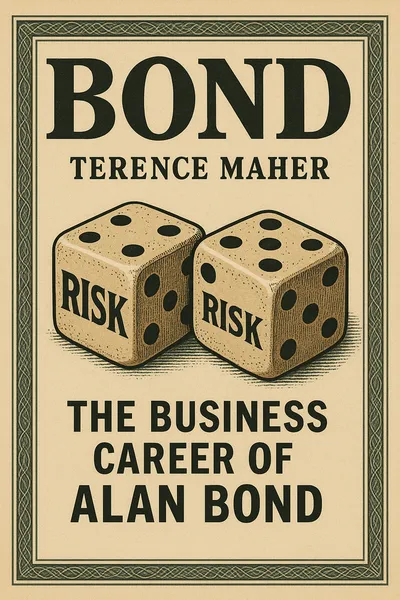
Bond
The business career of alan bond
Description
Alan Bond was born in London in 1938 and moved to Australia as a child. He left school early and started several businesses, becoming a millionaire property developer by age 21.
Bond expanded into stocks, breweries, media and other industries, financing growth by borrowing heavily. His 1983 America's Cup yacht victory brought fame and more loans, allowing a major acquisition spree.
However, by the late 1980s Bond Corporation was crippled by huge debts and losses, though Bond tried to continue his daring deals. Ultimately his overleveraged empire collapsed, but his career remains legendary for its ambitious risks and repeated comebacks against the odds.
Table of contents
01Early days in england
Alan Bond was born on April 22nd, 1938 in Ealing, London, to Kathleen and Frank Bond. His father, of Welsh descent, worked as a painter and decorator in London before enlisting as a physical training instructor in the Royal Air Force during the Second World War.
After being badly wounded, Frank was advised to move for health reasons, leading the family to migrate to Australia in 1950 under the assisted passage immigration program. Settling in Fremantle, a working-class port town, Frank's health improved in the warmer climate, and he started a signwriting business.

02Immigrating to australia
Alan Bond, a defiant and ambitious child, emigrated from England to Australia, starting school as a sixth grader. His academic record was poor, reflecting his lack of interest in formal education. However, he compensated with charm, adaptability, and self-assurance.
At 13, he moved to Fremantle Boys High School, where he continued to clash with authority. Outside school, he began making money, his first job being selling newspapers at the Fremantle wharves. He soon started his own supply chain, recruiting other kids to sell for him.
03Dropping out of school
Born in England in 1938, Alan Bond moved to Fremantle, Western Australia at age 12. Leaving school at 15, he became a signwriting apprentice, supplementing his income with after-hours work. Unlike many, Alan saw work as an opportunity to make money by tackling problems others avoided. He arranged non-union unskilled labor for difficult jobs, even organizing unofficial night shifts or overtime crews.
04Getting married young
Alan Bond's entrepreneurial journey began with Nu-Signs Pty. Ltd. in 1959, where he revolutionized real estate advertising by renting out signs to agents, a cost-effective alternative to purchasing. His bold business moves included painting Fremantle's waterfront cranes over a weekend, causing a stir among local union workers.
Bond's risk-taking continued with a daring paint job on a forty-meter stack and a massive project renovating railway stations from Broome to Perth. His ventures into property development started with a shopping complex in Fremantle, followed by transforming an old petrol station into a commercial hub, often using his father-in-law's name without prior consent.
05Launching his first business
Alan Bond was an ambitious entrepreneur who started with sign writing before founding Bond Corporation. He initially set up in his mother's furniture shop in Fremantle, then moved to a lavish office, believing in the image of success. With seed money, Bond aggressively pursued real estate and various ventures, adhering to a philosophy of keeping money in motion.
He gained construction experience through airport runway contracts and developed property, including townhouses and rural land enhanced with aerial fertilizer. Bond's work ethic was encapsulated by his belief that hard work leads to success, and he lived a James Bond-esque lifestyle with sports cars and speedboats.
06Becoming a millionaire
In the mid- to late-1960s, Western Australia experienced a mining boom as large deposits of minerals like gold and iron ore were found. This attracted entrepreneurs, including Alan Bond, who capitalized on the economic growth. Bond bought properties in Perth's central business district, notably acquiring a building for $350,000, which was considered exorbitant at the time. He leveraged a contract clause for vacant possession to lease the property back to the previous owner at a high rate, covering his holding costs for two years.
07Expanding his property empire
By the age of 30, Alan Bond had become a prominent figure in Perth society, living in a mansion and owning a yacht. As chairman and managing director of Bond Corporation Pty. Ltd., he was known for his confidence and for delegating the details of his ventures to his executive team while he pursued new opportunities.
Bond's focus shifted from property to the stock market, where he saw greater capital returns, as evidenced by the meteoric rise of Poseidon NL shares. His initial stock market endeavors were thwarted by Bernie Prindville, who blocked his attempts to gain controlling stakes in companies. Learning from these experiences, Bond executed a reverse takeover of W. Drabble Ltd. to gain a listed company presence.
08Taking on the establishment
Alan Bond was an Australian businessman known for his vast financial empire spanning real estate, mining, media, and more, which ultimately collapsed in 1992 with $1.8 billion in debts. Starting in the 1950s, Bond's early ventures included the Yanchep Sun City development near Perth, financed through high debt levels.
In the 1970s, to counter potential market downturns, he sought control of cash-rich companies, diversifying into various sectors and acquiring significant stakes in businesses like Robe River. His strategic moves included selling a 50% interest in Yanchep Sun City to a Japanese corporation for $23 million, significantly reducing his debts.
09Wheeling and dealing shares
Bond returned to Australia during a severe economic depression and began negotiations with financiers to restructure his substantial business debts. Personal guarantees for nearly $50 million of loans meant he assumed full liability. The negotiations were complex and public, leading to Bond's hospitalization in January 1975. Despite this, his management team remained optimistic, particularly about the America's Cup campaign, viewing the economic downturn as a time to prepare for future opportunities.
BondCorp shares plummeted from 56 cents to 9 cents, and the Cup challenge, costing $2 million, strained finances further. Western Australia Premier Charles Court, a close friend, encouraged major creditors to continue supporting Bond, hinting at future government business incentives. Bond's earlier visits to American parent companies and connections with billionaires like Perry Bass and Baron Marcel Bich also bolstered his position.
10Surviving hard times
Alan Bond, known for his aggressive and determined nature, formed a significant business relationship with American yachtsman Ted Turner during the 1977 America's Cup challenge. Despite their similarities and connections to influential American banking circles through Texan Perry Bass, Bond Corporation faced financial difficulties in 1978, with $48.5 million in debt and $8.2 million in losses.
However, being named Australian of the Year boosted Bond's reputation, leading to the sale of the Yanchep development and reducing corporate debt by over $32 million. Despite previous financial struggles, Bond continued to expand, focusing on energy investments like Endeavour Resources and the Santos natural gas project, which saw a significant increase in value following a major oil discovery.
11Chasing the america's cup dream
Alan Bond's corporate team targeted Swan Brewery Company Limited in the early 1980s, seeing it as a stable investment amidst a takeover threat from Robert Holmes a Court. Bond initially acquired a 20% stake and then made a personal offer of $120 million for the remaining shares, bypassing corporate acquisition regulations. By October 1981, he gained control, but this increased Bond Corporation's debts to $260 million, a concerning figure against annual profits of less than $10 million.
12Winning the cup and going on a takeover binge
After his America's Cup triumph in 1983, Alan Bond embarked on a $5 billion acquisition spree, turning BondCorp into a global conglomerate. His success in the regatta earned him widespread admiration, leading to an almost unquestioned belief in his business acumen. This popularity provided Bond with virtually unlimited credit, allowing him to expand into brewing, media, and other sectors.
Shortly after his win, Bond announced ambitious plans, including listing Swan Breweries on the American stock exchange and making significant European and Australian acquisitions. However, BondCorp's financials showed a lack of consistent earnings and a growing debt, casting doubt on its ability to service interest payments. Bond's preference for debt over equity financing was influenced by his ownership of half of the company's shares.
13The empire crumbles
Alan Bond, an Australian businessman, built a diverse empire spanning media, mining, and brewing. Starting as a signwriter, he ventured into property development in the 1960s, buying properties, revaluing them, and selling at inflated prices to associated companies, booking large paper profits. By the late 1970s, the Bond Corporation was formed, diversifying into various sectors and making extravagant purchases, including a Van Gogh painting for a record $54 million.