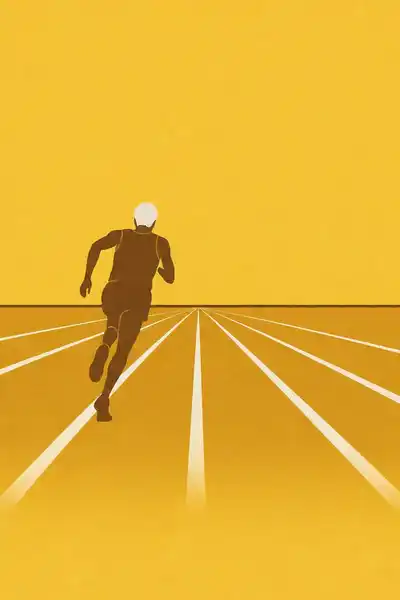
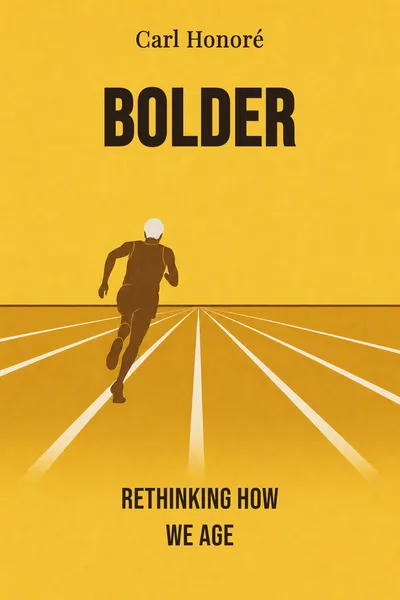
Bolder
Rethinking how we age
Description
In 2014, a Canadian journalist named Carl Honoré signed up for an amateur ice-hockey tournament and, filling out the entry form, hesitated over the box marked "age category." He was in his forties, fit, competitive, and quietly horrified to find himself lumped in with the "old-timers." The tournament went fine. What lingered was the flinch. Honoré, who a decade earlier had written In Praise of Slow — the book that turned the global backlash against hurry into a movement — noticed he had internalised something he claimed not to believe: that getting older was mostly a story of decline, and that the decline had already started.
So he did what he does. He travelled, interviewed, read the research, and pulled at the thread until a bigger pattern came loose. What he found was that most of what we assume about ageing — that the brain calcifies, that creativity is a young person's game, that happiness curves downward, that we become who we are and then slowly lose it — is either exaggerated, misdated, or flatly wrong. And that the assuming itself does measurable harm.
The result was Bolder, published in 2018. It arrives at a strange moment. For the first time in history, most of us can expect to grow genuinely old, and whole societies are greying at once — and yet the culture treats age as something to delay, disguise, or apologise for. Honoré's wager is that this is the next great shift in how we live, comparable to the slow movement he helped name, and that we are catching it just as it turns.
The question we’re asking : What if nearly everything we've been told about growing older is a story we inherited rather than a fact we checked?What we’ll see : How a personal flinch opens onto the science, the history and the quiet politics of a life that now runs decades longer than the one our assumptions were built for.
Table of contents
01 Chapter 1 — The number that stopped meaning much
Honoré starts with the thing we cling to hardest: the number. We treat chronological age as a reliable readout — so many years lived, so much capacity left — when in practice it predicts remarkably little about a given person. Two people at sixty can be separated by twenty or thirty years of biological function. Some seventy-year-olds run marathons; some fifty-year-olds are already fading. The calendar counts, but it doesn't explain, and Honoré's early chapters are a sustained argument that we've mistaken the ruler for the thing being measured.
Part of the confusion is historical. The idea that life splits neatly into rising, plateau and decline is younger than it feels. For most of human history, so few people reached old age that there was no cultural script for it beyond the vague and the venerable. Mass longevity is essentially a twentieth-century invention. A child born in a wealthy country in 1900 could expect to live into their late forties; today, well past eighty. We have added, in effect, a whole extra adult lifetime — and then kept using a map drawn before that territory existed.

02 Chapter 2 — Where the fear was manufactured
If the dread isn't warranted by the facts, where did it come from? Honoré's answer is that a good deal of it was, in a literal sense, sold to us. The modern horror of ageing is not an eternal human feeling but a fairly recent construction, and he traces its manufacture with a reporter's eye for who profited.
The word "ageism" itself is young — coined by the American gerontologist Robert Butler around 1969, to name a prejudice that, unlike racism or sexism, was still perfectly respectable to voice. Butler's insight was that we discriminate against a group we are all, if we're lucky, going to join. Honoré builds on this to show how the twentieth century gradually reframed old age from a stage of authority into a problem to be treated. The rise of youth as the culture's default reference point, the postwar cult of the new, the marketing machinery that needs us anxious about our bodies — all of it converged to make wrinkles a failure rather than a fact.
03 Chapter 3 — What older brains actually do
The most stubborn fear is cognitive: the sense that the mind itself is a depreciating asset, sharp early and blurred late. Honoré spends much of the book dismantling this, and the demolition is where Bolder is most persuasive, because the science has moved faster than the folklore.
Yes, some things slow. Processing speed and short-term memory tend to dip; the name that won't come, the reason for walking into the room. But the older brain trades that speed for other capacities, and the trade is often a good one. Vocabulary and accumulated knowledge keep growing. Pattern recognition — the ability to see the shape of a problem quickly, drawn from decades of stored cases — sharpens. Psychologists distinguish fluid intelligence, the raw quick processing that peaks young, from crystallised intelligence, the deep reservoir of understanding that can keep rising into old age. We privilege the first because it's easy to test. The second is closer to what we mean by wisdom.
04 Chapter 4 — The politics of a longer life
Step back from Honoré's own reporting and the personal question opens onto a structural one. This isn't only about how an individual feels about turning fifty; it's about what happens when entire populations do it together. The demographic shift underway is one of the largest in human history — the number of people over sixty is climbing past a billion worldwide, and in many countries the old will soon outnumber the young. A culture built around youth is about to be run by, and for, people it taught to fear the mirror.
That collision exposes ageism as what Honoré, following Butler, calls the last acceptable prejudice. We have learned to police the language we use about race and gender; we still make cards mourning fortieth birthdays and speak of "senior moments" without a flicker of guilt. The prejudice is peculiar because it's aimed at our own future selves, which makes it both irrational and oddly self-defeating: every joke about the decrepit old is a message left for the person you will become.
05 Conclusion
Honoré ends more or less where he began, but the flinch is gone. The man who winced at the "old-timers" box comes out the far side of his reporting arguing not for graceful acceptance of decline but for something more assertive: bolder ambitions, later starts, refused apologies. Age, on his account, is less a countdown than a long unfolding, and most of the fear attached to it is inherited rather than earned. The number on the form tells you how many times the earth has gone round the sun since you arrived. It tells you strikingly little about what you can still do.
Related books