
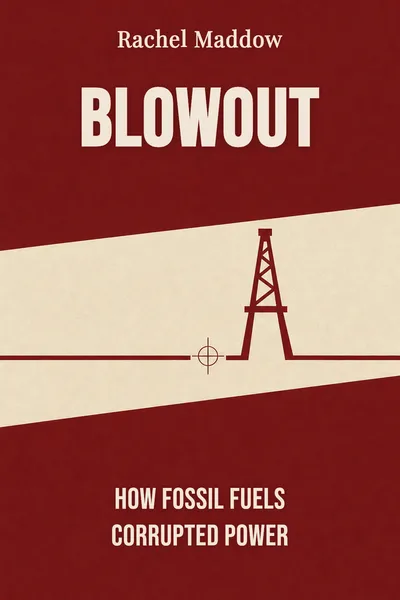
Blowout
How fossil fuels corrupted power
Description
In January 2018, a chain of small earthquakes rattled the ground around a town in northern Oklahoma. That in itself was strange — Oklahoma had never been earthquake country. Yet by the mid-2010s the state was shaking more than California, hundreds of tremors a year, some strong enough to crack walls and knock groceries off shelves. The cause was not a fault line stirring after centuries. It was wastewater, billions of gallons of it, pumped deep underground by an oil and gas industry that had drilled its way into a boom and left the state to absorb the tremors. This is the image Rachel Maddow uses to open her account of what fossil fuel wealth does to the places and people who host it.
Maddow, best known as a broadcaster, spent years reporting the book she called Blowout, published in 2019. Her argument is bigger than one shaking state. She traces a single industry — oil and gas — across continents and decades, from the wildcatters of Oklahoma to the boardrooms of ExxonMobil to the inner circle of the Kremlin. Everywhere the money flows, she finds the same pattern: institutions bend, watchdogs go quiet, and the public interest quietly loses.
What makes the book more than a catalogue of scandals is the claim underneath it. Maddow does not treat corruption as a bug that better regulation could fix. She treats it as something closer to a design feature of the business itself — a structural tendency of an industry sitting on more money and more geopolitical leverage than almost any government can withstand.
The question we’re asking : What is it about oil and gas specifically that lets it hollow out the institutions meant to keep it in check?What we’ll see : How Maddow follows the money from a shaking American state to an authoritarian petrostate, and why she calls the whole industry ungovernable.
Table of contents
01Chapter 1 — The industry that was built to be ungovernable
Maddow starts from a deceptively simple observation: oil and gas is not like other businesses. Most industries make things people choose to buy, compete on price and quality, and can be reasoned with by regulators because they need a stable, predictable environment to plan around. Oil and gas is different. The product comes out of the ground, it is worth staggering sums, and the companies that pull it up sit on cash reserves that dwarf the budgets of the governments trying to oversee them. That asymmetry, she argues, is where the trouble begins.
She reaches back to the origin story to make the point stick. The business was rowdy from the start — the boom-and-bust chaos of early American drilling, the fortunes made overnight, the towns that sprang up and emptied out. John D. Rockefeller's Standard Oil grew so dominant that the government eventually broke it up in 1911, and even that landmark antitrust action only scattered the pieces into companies that would regroup into the giants we know today. The lesson Maddow draws is that the industry has always been too big, too rich, and too essential to be treated like a normal market participant.

02Chapter 2 — Oklahoma shakes, and nobody is home
The earthquakes make Oklahoma Maddow's clearest domestic case, because the harm is so literal. As drillers exploited the fracking boom, they generated enormous volumes of toxic wastewater, which they disposed of by injecting it into deep wells. Scientists linked that injection to the surge in seismic activity. A state with barely any recorded quakes before 2009 was suddenly one of the most seismically active places in the country, with a spike of hundreds of tremors a year at the peak. People felt their houses move.
The revealing part, for Maddow, is what did not happen next. Rather than the swift, aggressive response you might expect when the ground literally starts shaking, Oklahoma's regulators moved slowly and cautiously, reluctant to point at the industry that dominated the state's economy and politics. Officials hedged, studied, and delayed while the tremors continued. The industry was not just a big employer; it was woven into the machinery of state government itself, which made confronting it feel less like enforcement and more like biting the hand that fed everyone.
03Chapter 3 — Putin's country runs on one product
Russia is the dark heart of Maddow's argument, and she treats it as the pattern's endpoint rather than an exception. The country's economy leans heavily on oil and gas exports; energy revenues underwrite the state budget and, by extension, the power of the people who control the state. Vladimir Putin's rule, she argues, is inseparable from that fact. A regime funded by hydrocarbons does not need a broad, productive economy or the consent it would have to earn. It needs the pipelines to keep flowing.
This dependence, she shows, comes with a built-in vulnerability that Putin has never solved: Russia has the reserves but has often lacked the advanced technology to extract the hardest deposits. That gap explains the courtship between Russian energy interests and Western oil giants. Maddow gives extended attention to the deal ExxonMobil struck with the Russian state company Rosneft under CEO Rex Tillerson — an enormous Arctic drilling partnership that promised to unlock reserves Russia could not reach alone. Tillerson was even awarded Russia's Order of Friendship.
04Chapter 4 — The dead hand on the wheel
Step back from the individual scandals and Maddow's larger claim comes into focus. She is not arguing that oil executives are unusually wicked people, or that a few bad regulators let the side down. She is arguing that the industry, by its structure, reliably corrodes whatever institutions surround it — and that this happens across wildly different political systems, from Oklahoma's statehouse to Equatorial Guinea's dictatorship to the Kremlin, precisely because the mechanism is not personal but structural. The money is simply too large, too concentrated, and too essential for ordinary accountability to hold.
The resource-curse logic sits underneath the whole book. When a nation's wealth comes out of the ground rather than out of the labor and consent of its people, rulers stop needing the people. They do not have to build broad prosperity, tolerate dissent, or maintain the institutions that a productive economy requires. They only have to control the resource. Maddow's contribution is to show the same dynamic operating not just in obvious petrostates but inside the democracies that like to think themselves immune — a difference of degree, she suggests, rather than of kind.
05Conclusion
The book ends more or less where it began, on unsteady ground. Oklahoma is still absorbing the aftershocks of its boom, Russia is still running its politics on the price of a barrel, and the giant companies that connect those worlds are still sitting on more money than most of the governments meant to oversee them. Maddow's throughline holds it all together: follow the fossil fuel wealth far enough, in almost any country, and you arrive at an institution that has quietly stopped doing its job.