

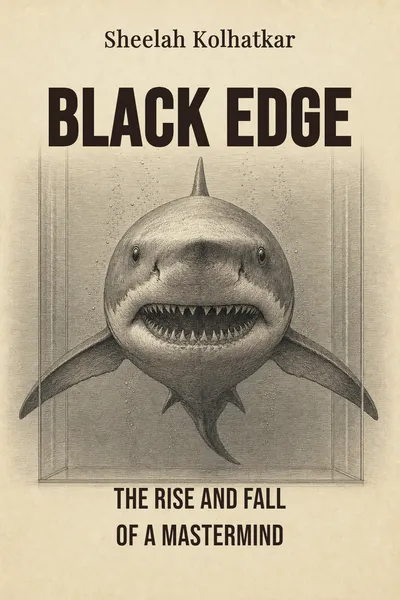
Black Edge
The rise and fall of a mastermind
Description
For most of the 2000s, the most feared trader on Wall Street ran his operation from a converted warehouse in Stamford, Connecticut, on a trading floor kept cold enough that people wore coats indoors. Steven Cohen liked it that way — the chill, he thought, kept everyone sharp. From that room, SAC Capital moved billions and posted returns that the rest of the industry could only stare at: roughly 30 percent a year, net of the famous fees, for the better part of two decades. Cohen himself became one of the richest men in America, buying Picassos and a bronze shark suspended in formaldehyde, the kind of art that announces a certain relationship to risk.
Numbers like that don't just happen. Everyone in finance understood this, which is why the same question trailed SAC for years: how? In Black Edge, the journalist Sheelah Kolhatkar reconstructs the answer the government spent nearly a decade trying to prove. Inside SAC, she reports, traders spoke of three kinds of information. White edge was public and worthless. Gray edge was ambiguous, the analyst's judgment call. And black edge was the good stuff — the kind you weren't supposed to have, the kind that made a trade a sure thing before the news broke.
What follows is not a simple story of a crook getting caught. It is the story of a man who built something large enough, and structured enough, that the law could reach almost everyone inside it except him. The FBI, the SEC and a young US Attorney named Preet Bharara threw everything they had at Stamford. What came back is stranger and more unsettling than a clean conviction.
The question we’re asking : How does the most successful trader of his generation end up surrounded by convictions without ever being convicted himself?What we’ll see : A portrait of SAC Capital from the inside — the appetite for information, the trades that arrived pre-loaded, and a prosecution that climbed all the way up and then stalled.
Table of contents
01Chapter 1 — The edge that money could buy
Steven Cohen grew up in Great Neck, on Long Island, one of eight children in a middle-class house where money was tight and attention was scarce. He was good at poker and better at reading a room, and by the early 1990s he had turned $25 million of his own money into the seed of SAC Capital Advisors — the initials his own. What he built there was less a fund than an engine. Dozens, then hundreds of portfolio managers ran their own books, each expected to feed Cohen his best ideas, each competing for capital and for the boss's favor.
The model ran on a single, ravenous input: information. SAC paid Wall Street's banks enormous commissions, and in return it wanted to be first — first calls, first color, first read on a company before the crowd caught up. Kolhatkar shows how that appetite shaped the whole culture of the firm. A manager who brought Cohen a merely good idea was replaceable. A manager who brought conviction — a trade he was willing to bet his job on — got money and got noticed. The traders who lasted learned to speak in certainties, because uncertainty didn't pay and it didn't survive.

02Chapter 2 — The trades that came with a whisper
The case that came closest to Cohen ran through a drug. In 2008, two pharmaceutical companies, Elan and Wyeth, were testing an Alzheimer's treatment called bapineuzumab, and the market hung on the results. A doctor named Sidney Gilman, an eminent neurologist chairing the trial's safety committee, had been recruited as a paid consultant through an expert-network firm — one of the middlemen that, for a fee, connected investors to insiders. Gilman came to see one particular SAC portfolio manager, Mathew Martoma, less as a client than as a kind of surrogate son. The two spoke often, and the professional relationship blurred, over months, into something warmer and more dangerous.
Kolhatkar lays out what the government alleged with almost clinical care. In July 2008, Gilman received the confidential, disappointing trial data and, over a series of contacts, passed it to Martoma. SAC had built an enormous position in Elan and Wyeth — hundreds of millions of dollars, urged on by Martoma's own conviction. Then, within days, it quietly reversed course. The firm sold out and went short, and when the bad news broke publicly the position was said to have swung by roughly $275 million in profits and avoided losses. Prosecutors would call it the most lucrative insider-trading scheme they had ever charged.
03Chapter 3 — The case that stopped at the door
The pursuit of SAC was not a single raid but a long, patient siege, and Kolhatkar tells it as a procedural. On one side stood the FBI agents and the prosecutors in Preet Bharara's Manhattan office, who had made insider trading the signature crime of the post-crisis years and were winning conviction after conviction across hedge-fund Wall Street. On the other stood a firm with limitless legal budget, ferocious lawyers, and a founder who had insulated himself with layers of deniability that no subpoena had yet managed to peel back.
The government's method was to work from the bottom up. Wire taps, cooperating witnesses, traders flipped one by one — the same technique used against organized crime, now aimed at Stamford. It produced results: multiple SAC-connected traders pleaded guilty or were convicted, including, eventually, Martoma, who was found guilty in 2014 and sentenced to nine years. What it could not produce was the one thing prosecutors wanted most — a witness who would put unlawful knowledge inside Cohen's own head.
04Chapter 4 — What a firm can outrun that a person can't
The strange arithmetic of the SAC case — a firm convicted, dozens of employees prosecuted, the founder untouched by any criminal charge — is where Kolhatkar's reporting stops being a crime story and starts being a study of how power organizes itself against accountability. What she documents is not that Cohen was cleverer than his prosecutors, though he had the best defense money could assemble. It is that the modern financial firm is built, whether by design or instinct, so that knowledge and blame flow in opposite directions.
Information travels up: the trader with the edge feeds it to the man who allocates the capital, because that is how he keeps his job. Culpability, meanwhile, is engineered to stay down. The person at the top receives the signal without the sourcing, the conviction without the confession, and in a courtroom that gap is everything. Kolhatkar's SAC is not a rogue operation but a nearly perfect machine for converting other people's certainty into one man's returns while leaving no fingerprints on his own hands.
05Conclusion
Steven Cohen served no time and admitted no crime. His SEC bar expired in 2018, and he returned to managing outside money almost immediately, rebranding his operation as Point72. A year later he bought the New York Mets. The bronze shark still hung in his collection, and the fortune that SAC had built survived nearly intact. The cold trading floor lived on under a new name, and the returns kept coming.