
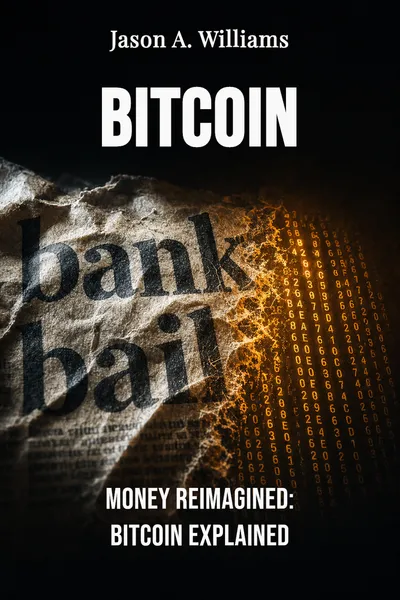
Bitcoin
Money reimagined: Bitcoin explained
Description
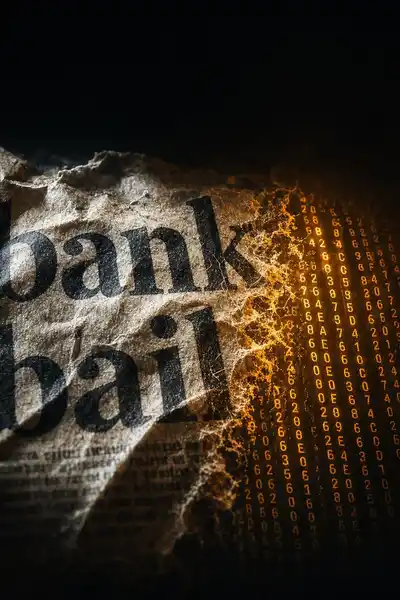
On October 31, 2008, in the middle of a financial crisis that was wiping out savings and toppling banks, an eight-page document landed on an obscure email list for cryptography enthusiasts. It was signed by someone calling themselves Satoshi Nakamoto, a name that has never been reliably attached to a real person. The paper proposed something modest in tone and enormous in ambition: a way to send money between two people over the internet without a bank, a government, or any middleman sitting in between. A few months later, in January 2009, the first Bitcoins came into existence, and the first ever recorded was reported to carry a headline from that day's paper — a quiet nod to the banks being bailed out while the whole thing launched.
Jason A. Williams came to Bitcoin the way a lot of people did — skeptical, a little confused, half-convinced it was a scam for the terminally online. His book is the account of a curious outsider who kept pulling the thread until the thing stopped looking like a fad and started looking like an idea. He writes for the person at the dinner table who nods along when Bitcoin comes up but secretly has no idea what anyone is talking about, and he refuses to make them feel stupid for asking.
What makes the story worth telling is not the price, which lurches around like a drunk on a boat. It is the claim underneath: that money itself could be rebuilt from scratch, with rules nobody can quietly change. Williams wants us to sit with that claim long enough to decide for ourselves whether it holds.
The question we’re asking : Why did a piece of software show up claiming to reinvent money, and what exactly is it trying to fix?What we’ll see : We follow Williams from the frustration that produced Bitcoin to the machinery that keeps it honest, the hard cap that defines it, and the shift in thinking it asks of us.
Table of contents
01Chapter 1 — The problem money was quietly failing to solve
Williams starts where most of us never bother to look: at the money in our own pockets. We treat it as a given, a fact of nature, when in fact it is a system somebody runs. Dollars, euros, pounds — every one of them is issued by a central bank that can print more whenever it decides the situation calls for it. Most of the time we don't notice. Then a crisis hits, the printing presses run hot, and the savings we spent years building quietly lose a slice of their value while we sleep. Nobody asks our permission. That, he argues, is the itch Bitcoin was built to scratch.
The 2008 collapse is his exhibit A. Banks had made bets they couldn't cover, the whole system wobbled, and governments responded by creating money on an unprecedented scale to keep it from falling over. Whatever one thinks of the rescue, Williams points out the strange asymmetry: the institutions that caused the mess were made whole, while ordinary people absorbed the fallout. For a certain kind of engineer watching from the sidelines, the lesson was blunt. A currency you don't control is a currency someone else can debase.

02Chapter 2 — A ledger nobody owns and everybody trusts
The flaw was deceptively simple. Digital things are easy to copy. Send someone a photo and you both have it. That's fine for photos and catastrophic for money — if a digital coin could be copied, you could spend the same one twice, or a thousand times, and the whole thing collapses into nonsense. This is the double-spend problem, and until 2008 the only known fix was a central authority keeping a master list of who owns what. Williams walks through it patiently, because everything Bitcoin does flows from solving this one puzzle without a referee.
Nakamoto's answer was the blockchain, which Williams describes less as a technology and more as a shared notebook. Instead of one bank keeping the ledger, thousands of computers around the world each keep an identical copy. Every transaction gets written into the notebook in batches called blocks, and each new block is chained to the one before it, so the whole history is locked together. Change one entry and the chain breaks visibly. There is no master copy to hack, because there is no master copy — just thousands of matching ones, all checking each other.
03Chapter 3 — Twenty-one million and not one more
If the blockchain is Bitcoin's machinery, its soul is a single number: twenty-one million. That is the total quantity of Bitcoin that will ever exist, written into the code from the beginning and, in practice, extraordinarily difficult to alter. Williams treats this as the feature that separates Bitcoin from everything that came before. Central banks can always create more of their currency. Bitcoin, by design, cannot. It is the first form of money whose supply is fixed and known in advance by anyone who cares to check.
He explains how the supply arrives on a schedule that slows over time. Roughly every four years, the reward miners receive for adding a block is cut in half — an event known as the halving. In the early years the network issued fifty coins per block; that dropped to twenty-five, then twelve and a half, and it keeps falling, so that new Bitcoin trickles out more slowly with each passing cycle until, sometime around the year 2140, the last fraction is mined. From then on, no more will ever be created. Williams likens it to a gold mine where everyone can see exactly how much gold is left and exactly when the last nugget will come out.
04Chapter 4 — Learning to think in a currency without a boss
Step back from the mechanics and Williams is really asking us to notice something we've never had to think about: how much of money is trust in an authority. When we hand over a bill, we are trusting that a government stands behind it and won't flood the market with more. When the balance in our account goes up, we trust the bank actually has it. Money, in the world we grew up in, is a chain of promises made by institutions we mostly can't see and never chose. Bitcoin's provocation is to ask what money looks like once you remove every one of those promises and replace them with math.
That's a genuinely disorienting shift, and Williams is candid that it broke his brain for a while. There is no customer service. If you lose the key to your Bitcoin, it is gone, permanently, with no one to appeal to. The freedom of having no boss is inseparable from the burden of having no safety net. He presents this not as a flaw to apologize for but as the honest price of the design. A money nobody controls is also a money nobody can rescue you from — including yourself.
05Conclusion
The story that started with an anonymous paper in the wreckage of 2008 has, in Williams's telling, never really been about getting rich. It's about a single stubborn question: does money need someone in charge? Nakamoto's answer was to build a system where the books are kept by everyone and owned by no one, where the supply is capped at twenty-one million and the rules can't be quietly rewritten. Whether that answer turns out to be revolutionary or merely clever, Williams argues, it has already done something — it proved the question was real.