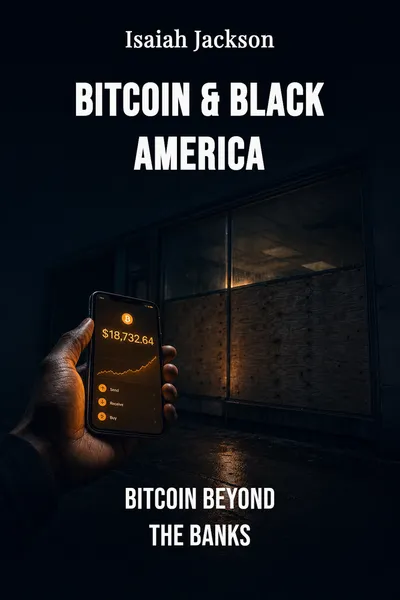
Bitcoin & Black America
Bitcoin beyond the banks
Description
In 2018, a former stockbroker and educator named Isaiah Jackson published a slim, direct book with a title that put two things together most people had never seen side by side: Bitcoin & Black America. The pairing was deliberate. Jackson had spent years watching cryptocurrency conferences fill with the same faces, the same assumptions, the same audience — and he noticed who wasn't in the room. The technology that promised money without banks, without permission, without a middleman deciding who gets an account, was being explained mostly to people who had never been turned away from a bank in the first place.
Jackson's argument starts from a fact that isn't controversial: in the United States, the relationship between Black communities and the financial system has never been neutral. Redlining, denied mortgages, predatory lending, branches that never opened in certain neighborhoods, and a chronic gap in access to credit — this is documented history, not grievance. So when a form of money arrives that doesn't need a branch, a credit score, or a loan officer's approval to move value from one person to another, the question Jackson raises is less about technology than about who has most to gain from money that answers to no gatekeeper.
The book is short on hype and long on context. It refuses to promise that Bitcoin will make anyone rich, and it refuses to treat exclusion as an accident. Instead it makes a quieter case: that a community with a specific history of being locked out of the system might have specific reasons to understand a system built to work without one.
The question we’re asking : Why does a technology that promises money without a bank land differently for a community that has been failed by banks for generations?What we’ll see : How Jackson connects a long history of financial exclusion to a new kind of money, and what he thinks that money can and cannot do.
Table of contents
01Chapter 1 — The bank that was never built for everyone
Jackson opens where the argument has to open — with the history that makes the rest of the book make sense. The American financial system, he reminds us, did not exclude Black Americans by oversight. Exclusion was designed in. In the 1930s, the federal Home Owners' Loan Corporation drew maps that graded neighborhoods for lending risk, and the neighborhoods where Black families lived were shaded red — hence redlining. Those maps shaped who could borrow to buy a home for decades, and home ownership was the single largest engine of middle-class wealth in the twentieth century. Being locked out of it wasn't a small thing. It compounded, generation after generation.
The exclusion never fully ended; it changed shape. Jackson walks through the more recent forms: check-cashing storefronts and payday lenders clustered in neighborhoods that mainstream banks avoid, charging fees that amount to a tax on not having a bank account. He points to the subprime mortgage crisis of 2008, where Black borrowers were disproportionately steered into predatory loans even when they qualified for better ones, and then lost their homes at higher rates when the market collapsed. The pattern he draws is consistent: access on worse terms, or no access at all.

02Chapter 2 — Money you hold without asking permission
Bitcoin, at its core, is money that moves between two people without a bank in the middle. Jackson explains it without the jargon that usually surrounds it. When you send someone dollars through an app, a bank verifies you, approves the transfer, and can freeze it, reverse it, or refuse it. Bitcoin replaces that trusted middleman with a shared public ledger — the blockchain — maintained by a network of computers around the world, no one of which is in charge. A transaction is recorded, confirmed by the network, and settled. There is no branch to visit and no application to be denied.
For Jackson, the operative word is permission. A bank account can be closed. A wire can be blocked. A remittance to family abroad can be delayed and skimmed by fees at both ends. Bitcoin, he argues, changes the default: value can be sent directly, across borders, at hours when banks are closed, to people who may not have accounts at all. He is careful not to oversell it — fees exist, transactions take time, and the price swings hard. But the underlying shift is real. Ownership of the money does not depend on an institution granting it.
03Chapter 3 — From skepticism to circulation
Jackson does not pretend the skepticism isn't there. He names it directly: to a community that has watched wealth-building schemes turn out to be traps, "internet money" invented by strangers can sound like the newest way to lose what little you have. He treats that caution as earned wisdom, not ignorance. His response is not to dismiss the doubt but to insist on understanding before commitment. The worst outcome, in his view, isn't skepticism — it's buying into hype without knowing how the thing works, and getting burned exactly as the skeptics predicted.
So the book becomes practical. Jackson walks through the basics a first-timer actually needs: how to set up a wallet, the difference between custodial and self-custodial storage, how to buy a small amount and learn by doing rather than by reading forever. He advocates starting small and dollar-cost averaging — buying a little on a regular schedule rather than gambling a lump sum on a price he cannot predict. He is blunt that the price will rise and fall violently, and that anyone who cannot stomach watching their holdings drop by half should not put in money they need.
04Chapter 4 — What decentralized money asks of a community
Stepping back, Jackson's book is less about Bitcoin as an investment than about Bitcoin as a form of ownership — and ownership, in his framing, is the thread running through the whole history he opened with. Every barrier he describes, from redlined maps to closed accounts to predatory loans, comes down to the same thing: someone else deciding whether value flows to you. Money that requires no permission is, in that light, not a financial gadget. It is a rare instance of a system where the gatekeeper is absent by design, and for a community that has spent generations on the wrong side of gatekeepers, that absence carries a weight it wouldn't carry for everyone.
But Jackson is honest that decentralization gives with one hand and demands with the other. When there is no bank to freeze your account, there is also no bank to call when you lose your keys or send money to the wrong address. The independence he celebrates comes with a responsibility that cannot be outsourced. Ownership without a gatekeeper means ownership without a safety net. That is not a footnote in his argument — it is the price of the freedom he is describing, and he refuses to hide it.
05Conclusion
Jackson wrote Bitcoin & Black America to close a gap he kept noticing in the room — the gap between who was being taught about permissionless money and who might most need it. He returns, at the end, to where he began: a financial system that was never built for everyone, and a community that has good reason to look for an exit. Bitcoin, in his account, is not a promise of wealth and not a cure for centuries of exclusion. It is a tool, and tools are only as useful as the understanding brought to them.
Related books