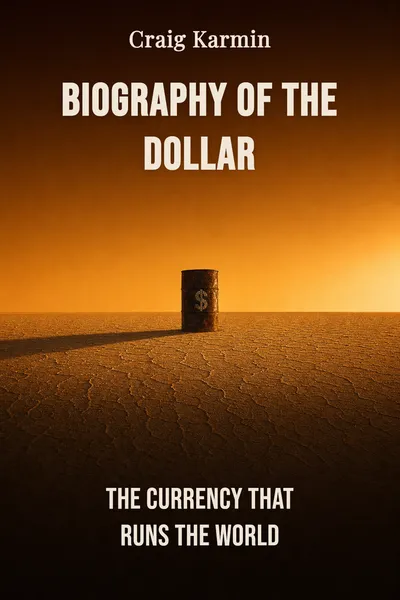
Biography of the Dollar
The currency that runs the world
Description
Somewhere in the world right now, a Korean electronics firm is closing a deal with a Brazilian buyer, and neither of them will use the won or the real. They will price the shipment, settle the invoice and think about their profit in dollars — a currency issued by a country neither of them lives in, whose central bank sits thousands of miles away in Washington. Nothing about the transaction requires an American to be present. And yet the greenback is there, sitting quietly in the middle of the exchange like a translator everyone has silently agreed to trust. Craig Karmin, a financial journalist who covered markets for the Wall Street Journal, set out to explain how a single piece of paper came to occupy that position — and why the arrangement has held for so long.
His book, Biography of the Dollar, treats the currency the way you might treat a person: it has an origin, a rise, a set of habits, a reputation it has to keep defending. For most of the twentieth century the dollar was the undisputed champion. It was not only the money of the United States but the fuel of global commerce — the currency oil is priced in, the currency governments hoard, the unit that lets a company in one hemisphere do business with a company in the other without either trusting the other's money. It became, in Karmin's telling, the superengine of the world's only superpower, accepted almost everywhere, questioned almost nowhere.
That kind of dominance looks permanent until you ask how it works. What actually keeps the world using an American currency it has no obligation to use? Where does the trust come from, and what happens to everyone else when the country behind the money runs deficits, prints freely, or simply changes its mind? Karmin's answer is less about economics than about faith — and about how much of the planet's prosperity rests on a belief that could, in principle, fade.
The question we’re asking : How did one nation's currency become the money of the whole world — and what holds that arrangement together?What we’ll see : We follow the dollar from a fragile national experiment to the reserve that governments hoard, the trust it runs on, and the anxieties of those who depend on it.
Table of contents
01Chapter 1 — The most trusted piece of paper on earth
Start with the strange fact Karmin keeps returning to. The dollar is used far beyond the borders of the country that prints it. Somewhere between half and two-thirds of all US currency in circulation has never seen America — it sits in cash boxes in Russia, under mattresses in Argentina, in the tills of shops in countries that have their own perfectly functional money and choose the greenback anyway. In moments of crisis, people who have lost faith in everything else still reach for dollars.
Why? Not because the paper is special. A hundred-dollar bill is cotton and ink like any other note. What people are actually holding, Karmin argues, is a promise — the belief that this money will hold its value tomorrow, that someone somewhere will accept it, that the institutions behind it are stable enough to bet on. The dollar's real backing stopped being gold decades ago. Its backing now is reputation, and reputation is a fragile, self-fulfilling thing: the dollar is trusted because it is trusted.

02Chapter 2 — How a young currency inherited the throne
For most of modern history the world's money was British. The pound sterling, backed by the Bank of England and the reach of an empire, was the currency that financed global trade through the nineteenth century. The dollar, by comparison, was a latecomer and something of a mess — the United States did not even have a central bank until 1913, when Congress finally created the Federal Reserve after a string of banking panics had shown how vulnerable an economy without a lender of last resort could be.
The two world wars changed everything, Karmin explains, and mostly by accident. Europe emerged from the fighting exhausted and indebted, much of it owing money to the United States, which had lent heavily and been spared the physical destruction. The economic center of gravity crossed the Atlantic. By the time the war was ending, the question was no longer whether the dollar would matter but how the new order would be arranged around it.
03Chapter 3 — The dollar leaves home
Once the dollar was the world's money, it stopped being fully America's to control. Karmin devotes some of his most vivid reporting to the way the currency lives abroad — in vaults, in reserves, in the daily calculations of governments that will never issue a cent of it but depend on it all the same. Central banks around the world hold enormous piles of dollars, mostly in the form of US Treasury bonds, because the dollar is where you park money when you want it to be safe.
That creates a peculiar relationship. When a foreign government buys American debt, it is lending money to the United States — financing American deficits and American consumption. For years the largest holders were in Asia, with Japan and then China accumulating dollar reserves on a vast scale, partly as a byproduct of selling goods to American consumers and taking payment in dollars. The exporter's dollars flow back to Washington as loans. Karmin lays out the loop plainly: America buys the world's goods, the world buys America's debt, and the dollar circulates through the middle of it all.
04Chapter 4 — The nervous kings
Step back from the mechanics and the dollar starts to look like something stranger than a currency: a global public good that no one agreed to create and no one entirely governs. Karmin's biography is really the story of how a national instrument quietly became an international one — and of how much of the world's prosperity now rests on a decision that is renewed, silently, every single day, by everyone who chooses to keep trusting the greenback rather than something else.
What makes that arrangement remarkable is how little force holds it up. There is no treaty compelling Saudi Arabia to price oil in dollars or China to stockpile Treasuries. They do it because everyone else does, and because the alternatives are worse or not yet ready. The dollar rules by consensus, not command — which is exactly what makes its position both durable and unearned by any single act. It cannot be decreed and it cannot easily be revoked; it can only be believed in, or not.
05Conclusion
Return to that Korean firm and its Brazilian buyer, settling in a money that belongs to neither of them. What looks like a small convenience is the whole system in miniature: two strangers reaching for the same trusted unit because it saves them from having to trust each other. Multiply that gesture across every port, trading desk and central bank on the planet, and you have the dollar's empire — an empire that rests, as Karmin shows, on nothing more solid and nothing more powerful than shared belief.
Related books