

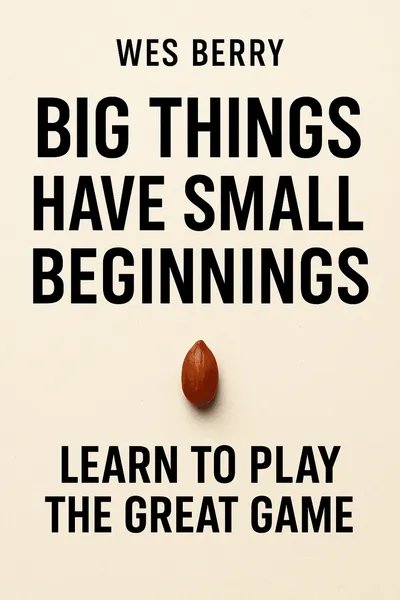
Big things have small beginnings
Learn to play the great game
Description
Every successful leader I've encountered has demonstrated a similar principle: they focus significantly on the minor details that others often overlook. This approach is crucial because managing the small aspects well tends to naturally lead to larger successes.
Therefore, it's essential to prioritize these smaller tasks, remembering that all significant achievements start from humble beginnings. Persist through challenges without giving up, as perseverance is key to winning in the long run.
Wes Berry emphasizes that success is not a matter of chance but a result of continuous effort and resilience. He highlights the importance of support from family and friends in overcoming obstacles and continuing the journey toward success.
Table of contents
01Explore the competitive landscape
To thrive in the business world, ambition is a necessity. However, the key lies in striking the right equilibrium. Excessive ambition can lead to recklessness and potentially even ruthlessness. It's crucial to aspire for improvement while concurrently comprehending your "Why". Your Why is the driving force that propels you to push forward when faced with adversity and when initial attempts don't yield the desired results. To truly commit to the grand game, identify your Why. Nothing in business is accomplished without ambition. It must be a fundamental component of your emotional constitution for you to progress, and genuine ambition necessitates struggle before achieving something of value.
In simple terms, to progress, you must be ambitious. Without ambition, you lack the personal drive and tenacity needed to advance. Hence, be receptive and maintain a positive attitude towards being ambitious. All great achievers possess this characteristic. As 17th-century philosopher Sir Francis Bacon stated, ambitious individuals, if they find the path clear for their ascent and continue to progress, are more industrious than dangerous. However, if their desires are thwarted, they become secretly discontent, viewing people and situations with a malevolent eye, and derive pleasure when things regress, which is the most detrimental trait in a servant of a prince or state. When directed appropriately, ambition serves as a catalyst for creativity and accomplishment. Ambitious individuals are industrious and active. Issues arise when ambitious individuals are denied the opportunity to follow their passions. In such cases, ambition can transform into a destructive force. You need sufficient ambition to motivate you to take reasonable risks and related actions, but not so much that you become reckless. This dynamic is also applicable in military careers. The most successful military leaders in history have been those who have the audacity to take bold risks without succumbing to senseless follies. As Sun Tzu, a Chinese general and war strategist from the 6th century BC, stated, in the midst of chaos, there is also opportunity.

02Understand the complexities of leadership
To excel in leadership, it's crucial to have a clear vision of where you're heading and to ensure you have the right team to get there. The challenge lies in initiating the right small steps that will systematically lead to your larger goals. Setting goals and targets, specifying realistic deadlines, and assembling the right people and tools are key. Time management is also vital, turning time into an ally rather than an adversary. As Jim Collins puts it, "You are a bus driver. The bus, your company, is at a standstill, and it's your job to get it going. …In fact, leaders of companies that go from good to great start not with “where” but with “who.” They start by getting the right people on the bus, the wrong people off the bus, and the right people in the right seats." It's essential to set goals for your organization's future direction. Even if you don't know the details of how you'll get there right at the outset, that can be worked out. The important thing is to clarify what your business will look like and feel like when you succeed.
Once you set your big picture goals, a cascade effect will naturally occur. As Wes Berry states, "If you don’t have goals, you’re not going to get anywhere. Goals themselves may be one of those real big things but thoroughly thinking through what those goals really are for you… well, that’s one of the most common 'small things' that way too many business people simply seem to neglect. Nothing in the great game makes any sense until the goal gets established. If you don’t know where you’re going, you’re never going to get there. It can be frighteningly easy to get side-tracked."
Goals are strategic, but they only become tangible when you set objectives and target dates. Specifying who will do what by when is a small step that can have a powerful impact on achieving your larger goals. Even if things don't go as planned, it's important to remain flexible and adjust your objectives and target dates as needed. The ultimate aim is to achieve the goal, not just to tick off a list of objectives.
03Search for the gem in the rubble
Securing the appropriate talent is vital for any enterprise. It is of utmost importance to identify those who are not only capable of taking charge of their responsibilities but also willing to enhance their capabilities within the company. Such individuals are rare and invaluable, much like finding a rare gem in an expansive mine. It is equally critical to nurture leaders of exceptional caliber at all organizational levels.
In the late 19th century, Elbert Hubbard, a philosopher and innovator, founded The Roycrofters in East Aurora, New York. His mission was to craft furniture and other items of superior quality. Over time, The Roycrofters flourished, employing a workforce of more than 500 adept artisans. Hubbard was at the forefront of various innovative business methods. He was one of the first to use trademarks and logos on his products, a practice that was frowned upon at the time. His distinctive dress sense, often donning a loose hat, flannel shirt, and cowboy boots, made him a recognizable figure in the bustling streets of New York City.
Hubbard's initial career involved selling soap for the Larkin Soap Company, where he invented a sales technique known as "The Puppy Dog Close," which involved leaving a product with potential customers to try before purchasing. This approach led to a surge in sales and helped Hubbard climb the corporate ladder. After departing from the soap business to establish The Roycrofters, Hubbard became an author and speaker on business success strategies. Despite his informal education, he was widely esteemed and attributed his knowledge to real-world experiences. During his tenure at The Roycrofters, he was responsible for editing and publishing magazines and books, as well as penning biographies of numerous historical figures. His reputation grew, and his establishment welcomed visitors from across the globe, including prominent figures like Thomas Edison and Henry Ford. The Roycrofters' complex expanded to include various facilities, from a hotel to workshops. Tragically, Hubbard's life came to an abrupt end when he and his wife perished in the sinking of the Lusitania in 1915.