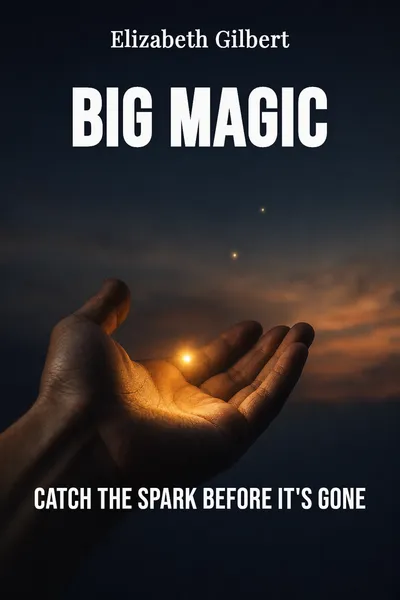
Big Magic
Catch the spark before it's gone
Description
In the early 2000s, Elizabeth Gilbert was working on a novel set in the Amazon jungle — a story about a woman who travels to South America to retrieve a man who has vanished. She researched it, made notes, fell in love with it, and then her life got busy and she put it down for a couple of years. When she came back to the manuscript, the spark was gone. The story had cooled. Around the same time, she became friends with the writer Ann Patchett, and the two struck up a long correspondence by letter. At some point Patchett mentioned she was writing a novel of her own: a woman travels to South America to retrieve a man who has vanished into the jungle. The plots, the details, even some of the emotional beats lined up. Gilbert had abandoned her version. Patchett had picked the same one up, more or less out of the air, the day they met.
Gilbert is the author of Eat, Pray, Love, the 2006 memoir that sold around ten million copies and turned her into the kind of writer strangers stop on the street. After that success, the obvious question was what she'd do with it — and the harder question, the one creators rarely say out loud, was whether the fear of not matching it would quietly strangle whatever came next. In 2015 she answered with Big Magic, a short book about creative living that takes the jungle-novel coincidence as a starting point for an unusual claim about where ideas come from and what we owe them.
What makes the book worth following is that Gilbert refuses the two scripts our culture keeps handing artists: the tortured-genius script, where great work demands great suffering, and the credentialed-permission script, where you're allowed to create only once someone qualified says you can. She proposes something looser, stranger, and a lot more livable — and she means it as practical advice, not metaphor.
The question we’re asking : If creativity isn't reserved for the gifted or the tormented, what stance toward our own ideas actually lets us make things?What we’ll see : How Gilbert reframes inspiration, fear, talent and reward into a way of working she calls big magic.
Table of contents
01 Chapter 1 — The idea that came knocking
Gilbert's account of the jungle-novel coincidence isn't offered as a spooky anecdote to enjoy and forget. She builds a whole theory of inspiration on it, and it's the most metaphysical part of the book — the part she's perfectly aware will make some readers wince. Her claim is that ideas are a kind of disembodied, energetic life form. They float around looking for a human collaborator who will agree to bring them into being. An idea will visit you, signal its interest, and wait. If you say yes and get to work, the partnership holds. If you stall, get distracted, or let it sit too long, the idea grows impatient and moves on — to someone else who will actually do the work.
That, in her telling, is what happened with the Amazon story. She had said a tentative yes, then drifted, and the idea simply went looking for a more available partner. It found Ann Patchett. Gilbert reports this without bitterness, almost with delight, because the framework lets her hold it lightly: the idea was never hers to hoard. It was on loan.

02 Chapter 2 — Fear in the passenger seat
The single biggest obstacle to creative living, in Gilbert's account, is fear — and she's refreshingly unsentimental about it. She doesn't promise to banish fear, doesn't suggest it can be conquered, doesn't frame it as a dragon to slay. Fear, she points out, is doing exactly the job evolution gave it: scanning for danger, and treating anything new and uncertain as potential danger. A brain that flags an unwritten novel as a threat is a brain working as designed. You can't argue it out of that, and trying to is a waste of energy.
So she proposes a truce. In one of the book's most quoted passages, she imagines creativity and fear taking a road trip together. Fear is allowed in the car. It's part of the family; it can't be left behind. But it doesn't get to choose the route, it doesn't get to touch the radio, and under no circumstances does it get to drive. Fear can come along and complain the entire way. It just has no operational authority over the trip.
03 Chapter 3 — The job is not to suffer for it
If fear is the first obstacle, the second is what Gilbert calls the cult of the martyr — the belief that creativity must be heavy, grave, and self-destructive to count. Against the martyr she sets the trickster: playful, light, more interested in the game than the glory, willing to make things badly rather than not at all. The martyr says the work is sacred and I must die for it. The trickster says the work is a delight and I'd like to keep playing. Gilbert is firmly on the trickster's side, and much of the book is an argument for treating your own creative life with curiosity instead of solemnity.
Her most practical and most contested idea is about money. She advises against quitting your day job to chase your art, and against demanding that your creativity pay your rent. Gilbert kept other jobs — waitressing, bartending — long after she was a published writer, precisely so she'd never have to ask her writing to support her. Her reasoning is protective: the moment you put financial pressure on your creativity, you change the relationship. You start resenting the work for not earning, and you start making choices to please a market rather than to follow the idea. Letting the art stay unburdened by the rent, she suggests, keeps it free.
04 Chapter 4 — A different deal with the work
Step back from the road trips and the visiting ideas, and Big Magic is making a larger argument about why human beings bother to make things at all. Gilbert's wager is that creativity is not a profession reserved for the talented few but a basic feature of being human — a birthright, in her word. We are a species that decorates, sings, tells stories, builds things slightly fancier than they need to be. To create is not to audition for the title of artist. It's to do the thing our kind has always done.
That reframing quietly dismantles a question most of us treat as the gatekeeper: am I good enough? Gilbert thinks the question is malformed. Good enough for what, and according to whom? If the point of making something is to enrich your own life rather than to win a place in the canon, then talent stops being the entry requirement. You don't need permission, a degree, or a reviewer's blessing. You need curiosity and a willingness to follow it, which she frames as a far more reliable engine than passion — passion burns out, curiosity keeps tugging.
05 Conclusion
The jungle novel that slipped from Gilbert to Patchett is, in the end, the whole book in miniature. An idea arrived, was held loosely, drifted, and found another willing pair of hands — and nobody was robbed, because nobody owned it in the first place. That's the deal Gilbert is proposing across two hundred pages: treat inspiration as a visitor rather than a possession, keep fear in the car but out of the driver's seat, refuse the romance of suffering, and stop asking the work to justify itself in money or applause.
Related books