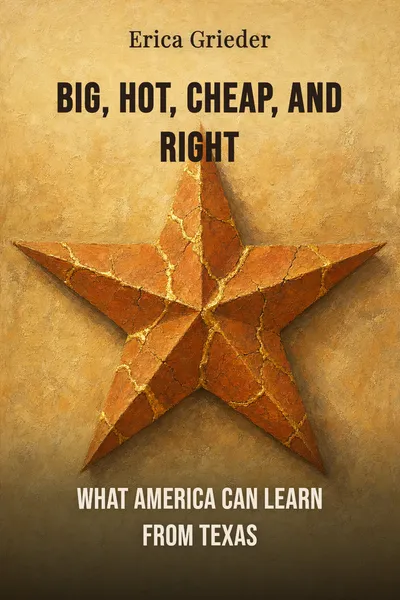
Big, Hot, Cheap, and Right
What America can learn from Texas
Description
Texas is the state Americans argue about without needing to visit. Say the name at a dinner in Brooklyn or Berkeley and the picture assembles itself: oil rigs, megachurches, an execution chamber running at a pace no other state comes close to matching, and a governor who once floated the idea of secession. It is the place where evangelicals sit comfortably in the halls of power, where millions live below the poverty line, and where the swagger tends to arrive before the person. For a certain kind of outsider, Texas is less a place than a warning.
Erica Grieder, a journalist who grew up there and later covered the state for The Economist and Texas Monthly, wrote a book to complicate that picture. Its title borrows a line the late lieutenant governor Bob Bullock liked to use about Texas — big, hot, cheap, and right — and turns it into an argument. Between roughly 2000 and 2010, while the rest of the country stalled, Texas added jobs and people at a rate that embarrassed richer, prouder states. California, its natural rival, was hemorrhaging both. The numbers were awkward enough that they demanded an explanation.
Grieder's wager is that the explanation is not luck, not just oil, and not simply the willingness to be crude about it. There is a governing model underneath the bravado — one with real costs Texans have chosen to tolerate — and dismissing the whole thing as a redneck caricature means missing what actually works. That is the uncomfortable proposition a Texan set out to defend to a skeptical national audience.
The question we’re asking : If Texas offends so many Americans, why does its economy keep outpacing theirs — and what, if anything, is worth borrowing?What we’ll see : A working model with sharp edges, the bargain its residents have accepted, and why the fight over Texas is rarely about Texas.
Table of contents
01 Chapter 1 — The state everyone loves to dislike
Grieder opens by conceding the case against her home state, because pretending it away would fatally weaken the argument. Texas leads the nation in executions by a wide margin — its death row is the busiest in the country, and it has been for decades. Its uninsured rate is the worst in the union. Large shares of its population live in poverty, its public schools are chronically underfunded per pupil, and its politics carry a religiosity that unsettles people who prefer a firmer wall between pulpit and statehouse. None of this is invented by hostile coastal editors. It is on the ledger.
There is also the matter of tone. Texas has a habit of announcing itself. The bumper-sticker patriotism, the outsized flags, the periodic musing about going it alone as a republic — the state performs its identity in a way that invites mockery, and often seems to enjoy the mockery it invites. Rick Perry, governor for most of the period Grieder examines, made a national brand out of hunting, prayer, and picking fights with Washington. To a skeptic, the whole package reads as bluster dressed up as governance.

02 Chapter 2 — A model built on low taxes and light regulation
Strip away the culture-war noise and Grieder finds a fairly coherent governing philosophy, one she traces back to the state's founding conditions and its long stretch as a frontier. The core of it is minimalism. Texas has no state income tax and does not want one — the prohibition is close to sacred. Government is kept lean, spending per capita runs low, and regulation is designed to get out of the way of anyone trying to build, hire, or drill. The legislature meets for only about 140 days every two years, which limits how much mischief, or governing, it can do either way.
This is not, she argues, mere ideology. It grew out of a place that was poor for most of its history, distrustful of distant authority, and shaped by decades of frontier self-reliance where the state simply wasn't there to help. The result is a low-cost environment that businesses read as a signal: come here and we will tax you lightly and leave you mostly alone. Combined with cheap land, cheap housing, and a large, growing labor force, the pitch worked. Toyota, among others, moved operations south. The energy sector anchored the whole thing, but Grieder is careful to note that Texas diversified well beyond oil into technology, medicine, and shipping.
03 Chapter 3 — The trade-offs Texans decided to live with
The honest version of the Texas model, Grieder insists, is a ledger with a debit column. Cheap government means services are thin. The uninsured rate is the highest in the country partly because the state declined to expand its safety net when given the chance. Schools operate on tight budgets. Poverty is widespread, and the low-wage economy that helps keep costs down also keeps a lot of people poor. When California progressives look at Texas and see a place that neglects its vulnerable, they are seeing something real.
Her argument is not that these costs are illusory but that they are chosen, and that the choosing is itself a legitimate act of self-government. Texans have, over and over, voted for lower taxes and less state over more services and more state. Grieder treats this as a genuine preference rather than a con perpetrated on a duped electorate. A society can rationally decide to accept more risk and less cushion in exchange for growth, mobility, and cheap living — even if a coastal observer would make the opposite bargain in a heartbeat.
04 Chapter 4 — What the Texas quarrel is really about
Step back from the tax tables and the execution counts, and Grieder's book is describing something larger than one state's balance sheet. It is describing how Americans use Texas as a screen onto which to project a fight about what the country should be. For conservatives, Texas is proof that the low-tax, light-touch model delivers; for progressives, it is proof that such a model abandons the weak. Both sides reach for the same state and find exactly the confirmation they arrived looking for. The place stops being a place and becomes an argument with a flag on it.
That projection is convenient for everyone except anyone hoping to learn something. If Texas is simply the enemy's homeland, its housing policy and job growth can be waved away as tainted by association. If it is a promised land, its poverty and thin schools can be dismissed as the price of freedom. In both cases the actual mechanics — why homes stay affordable, why the workforce keeps growing, what a lean government does well and badly — go unexamined. The caricature does the thinking so no one has to.
05 Conclusion
Grieder ends more or less where the numbers pushed her: with a state that outgrew its rivals during a lost decade, that houses its people cheaply and employs them readily, and that pays for this with a thin safety net and a politics many Americans find hard to stomach. The line she borrows — big, hot, cheap, and right — is a boast, but she means the last word seriously. On the questions of taxes, regulation, and getting out of the way of ordinary people trying to build a life, she thinks Texas has been more right than its detractors will admit.
Related books