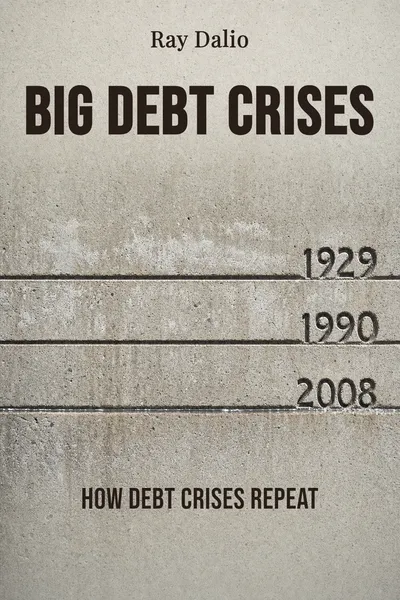
Big Debt Crises
How debt crises repeat
Description
In the years after the 2008 crash, Ray Dalio did something most people running a hedge fund don't have time to do: he sat down and studied forty-eight debt crises in detail, going back a century and across continents. Dalio runs Bridgewater Associates, one of the largest investment firms in the world, and he had a professional reason to do this. His firm had seen the 2008 crisis coming, more or less, because it had built a rough model of how these things unfold. "Big Debt Crises," published in 2018, is his attempt to write that model down.
The claim at the center of the book is almost provocatively simple. Debt crises, Dalio argues, are not freak accidents or moral failures unique to their moment. They are mechanical. They follow a sequence — credit builds, a bubble inflates, the bubble bursts, the economy contracts, and then, through a familiar set of moves, things stabilize and recover. Weimar Germany in the 1920s, the United States in 1929, Japan in the 1990s, and the whole world in 2008 look, from a distance, like the same play performed by different casts.
That is a strong thing to say. If crises really do rhyme this closely, then the panic each generation feels — the sense that this time the ground has genuinely opened up — is partly a failure of memory. Dalio's wager is that the pattern is legible enough to be taught, and that once we can see the machine working, the events stop feeling like fate and start feeling like weather: dangerous, recurring, and, up to a point, forecastable.
The question we’re asking : If debt crises keep repeating the same sequence, why do they keep catching everyone off guard?What we’ll see : How one investor turned a century of financial wreckage into a working template — and what it costs to treat catastrophe as mechanism.
Table of contents
01Chapter 1 — The machine has parts that fit together
Dalio's starting move is to treat the economy as a machine rather than a mood. Prices, growth, unemployment, interest rates — these feel like the weather of daily life, unpredictable and emotional. But underneath, he argues, sits a small number of moving parts that behave in consistent ways, and debt is the part that matters most. Credit is simply spending power created out of a promise to repay later. When someone borrows and spends, that spending becomes someone else's income, which supports more borrowing. The loop is generative, and for a while it feels like pure growth.
The trouble is built into the definition. Debt is a promise, and a promise has to be honored with future money. Every dollar borrowed today is a dollar of spending pulled forward and a dollar of obligation pushed into the future. As long as incomes rise fast enough to service the debts, the machine hums. Dalio's point is that this arrangement contains its own limit: borrowing can grow faster than income for a long time, but not forever, because eventually the cost of servicing the debt eats into the spending that made the whole thing work.

02Chapter 2 — The long cycle nobody wants to admit is running
Dalio's answer is the long-term debt cycle, and its most uncomfortable feature is its length. It can run for decades — long enough that almost nobody who lived through the last one is still in charge when the next peak arrives. In the early stages, debt grows in line with incomes and finances real, productive activity: factories, houses, businesses that generate the returns to pay the loans back. This is healthy. Borrowing is doing what borrowing is supposed to do.
The shift is gradual and easy to miss. Over time, debt starts growing faster than income, and more of the new borrowing goes toward buying assets rather than building them. Prices rise, which makes the borrowers look richer, which justifies more lending against those higher prices. Dalio calls the top of this a bubble, and he insists it is recognizable in advance — not by the mood of optimism, which is misleading, but by the numbers. Debt-service costs are climbing relative to incomes; new buyers are borrowing heavily on the assumption that prices only go up; lenders are stretching their standards.
03Chapter 3 — Four levers and the timing of the pull
Once a debt crisis breaks, Dalio argues, policymakers have essentially four tools, and the art lies entirely in how they mix and sequence them. The first is austerity — spending less, paying debts down. It sounds responsible, and it is the instinctive first move, but on its own it is brutal: cutting spending shrinks incomes, which makes the debts even harder to service. Austerity alone deepens the hole. The second is default and restructuring — letting some debts be written down, or renegotiated, so that borrowers are relieved of obligations they were never going to meet. This is painful and politically ugly, but it removes debt from the system in a way austerity cannot.
The third and fourth levers push the other direction. Governments can redistribute wealth, typically through higher taxes on those who still have money, and central banks can print money to buy assets and ease the shortage of credit. Printing is the lever that frightens people, because it conjures the ghost of hyperinflation. But Dalio's data leads to a counterintuitive conclusion: printing is not inherently inflationary if it merely offsets the collapse of credit that is happening at the same time. The money created replaces money that has vanished. The danger comes from overdoing it.
04Chapter 4 — 1929, 2008, and the same story in different clothes
The deeper wager of "Big Debt Crises" is not about any single crash but about how we read economic history at all. We tend to narrate crises as morality tales — greedy bankers, reckless borrowers, negligent regulators — with villains and lessons. Dalio's template quietly refuses that frame. In his account, 1929 and 2008 are not separate scandals with separate culprits; they are two instances of the same mechanical sequence, and the people involved are less authors of the disaster than participants swept along by a cycle larger than any of them. This is a demystifying move, and it changes what the past is for.
Treating crises as recurring mechanism rather than singular catastrophe has real consequences. It means the goal is not to assign blame after the fact but to recognize the pattern while it is running. Dalio points out that the United States in the early 2010s handled its deleveraging comparatively well — aggressive money-printing paired with tolerable restructuring — while Europe, more committed to austerity, suffered longer. The difference was not that one region had better people. It was that one pulled the levers in a better sequence, because it read the machine more accurately.
05Conclusion
Dalio began with a practical problem — his firm needed to see crises coming — and ended with something closer to a theory of history. The template that emerged treats the great debt crises as turns of a single, knowable cycle: credit builds beyond what incomes can support, the bubble breaks, and recovery depends on mixing austerity, default, redistribution, and money-printing in the right proportion at the right time. Weimar, 1929, Japan, 2008 — different casts, same script.
Related books