

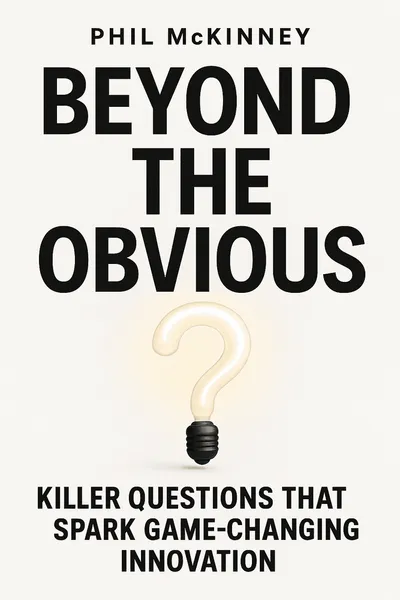
Beyond the obvious
Questions that unlock growth
Description
Innovation requires transcending the "obvious" by challenging your own assumptions and revisiting fundamental questions about identity, customer service, and operational methods. To foster groundbreaking ideas, one must adopt a disciplined approach to questioning and rethinking the basics: who we are, what we offer to our customers, and why we operate as we do.
The FIRE methodology is a structured process that aids in the generation and development of innovative concepts. Phil McKinney emphasizes that innovation is not a random stroke of luck but a skill that can be honed through a systematic approach. His Killer Questions method provides a strategic framework for generating, evaluating, and implementing powerful ideas, ensuring that resources are invested wisely in the most promising innovations.
Table of contents
01Foresight
Innovation is a pivotal element in the growth and success of any organization. It involves the identification and exploitation of opportunities by posing the right questions and challenging the status quo. The process commences by pinpointing areas where innovation could exert the most significant influence on your organization. This necessitates a comprehensive examination of all business facets to ensure no potential innovation areas are overlooked.
The journey of innovation begins with asking some preliminary questions to uncover your assumptions. These questions might include understanding how your industry functions, the unwritten industry rules, customer preferences, potential changes in customer treatment, new methods of delivering your product or service, and applying changes from other industries to your product niche. Once these assumptions are clarified, you can then anticipate the impact of changes to these assumptions, potentially altering your industry position and providing a competitive edge.
Three critical questions to consider are: Who is the customer? What is the product? How does the organization function? These questions delve deeper and challenge your assumptions, often marking the first step in generating innovative and creative ideas. They are not simple yes or no questions; they require a deeper understanding and analysis of the situation.

02Imagination
Phil McKinney, an advocate for innovation, underscores the importance of critical inquiries, or "killer questions," in business. These questions are designed to challenge foundational beliefs about operations and purposes, prompting a reevaluation of the hurdles and dilemmas faced by organizations. McKinney's approach is to shift perspectives, encouraging solutions that go beyond preconceived notions of who is responsible for innovation, what it should look like, and why it is necessary.
McKinney emphasizes that groundbreaking ideas often come from the most unexpected places. It is a mistake to expect innovation to come only from certain individuals or departments. Instead, it is vital to be open to the possibility that brilliance can come from any part of an organization. Drawing from his professional experience, McKinney shares his unique method for discovering innovative ideas in overlooked areas, leading to the creation of products that meet unarticulated consumer needs.
Mastering the art of inquiry is crucial, according to McKinney, to uncover opportunities that are often overlooked. This process can transform an organization's self-perception, its offerings, and its understanding of its target audience. Such a transformation is essential for maintaining a competitive edge and challenges the conventional wisdom of relying solely on past experiences.
03Rating
The process of sifting through ideas to identify those with the potential to become valuable innovations is a critical step in the innovation pipeline. It is essential to centralize all the ideas generated in one place without any filtration, allowing each idea to stand on its own merit. This inclusive approach ensures that no potentially groundbreaking idea is overlooked due to bias or premature judgment.
The next step involves developing a ranking grid based on five factors, with each idea scored from 0 to 5. A score of 0 indicates that the idea is impractical or a no-go, while a score of 5 suggests that the idea is brilliant and should be executed immediately. This scoring system helps to objectively evaluate the potential of each idea against a set of criteria that are crucial for the success and alignment with the organization's goals and capabilities.
It is important to rank a manageable number of ideas to identify the absolute best ones worth exploring further. However, it is equally important not to discard the also-rans arbitrarily. Ideas that do not make the cut should be kept for future consideration, as their relevance or practicality may change over time. Timing can be a critical factor in the success of an idea, and what may not be feasible now could become the next big thing later.
04Execution
Implementing ideas requires a significant commitment, including dedication, financial investment, and human resources. It is indeed a gamble, but there is no point in going through the process of Financial Independence, Retire Early (FIRE) without effectively leveraging the outcomes. To mitigate risks and address the concerns of skeptics, it is advisable to adopt a gated funding system. In this system, an idea must pass through four sequential stages to gain further support and resources. These stages are designed to ensure that only the most viable ideas receive investment.
Within any organization, new ideas will naturally attract both support and opposition. The resistance often comes from various sources. Some individuals may reflexively reject new proposals, fearing an increase in their workload. Others might oppose out of envy, wishing they had been the ones to come up with the innovation. The uncertainty associated with market experimentation can deter those who prefer stability over risk. Additionally, a general weariness of constant change can lead to a lack of enthusiasm for new initiatives.