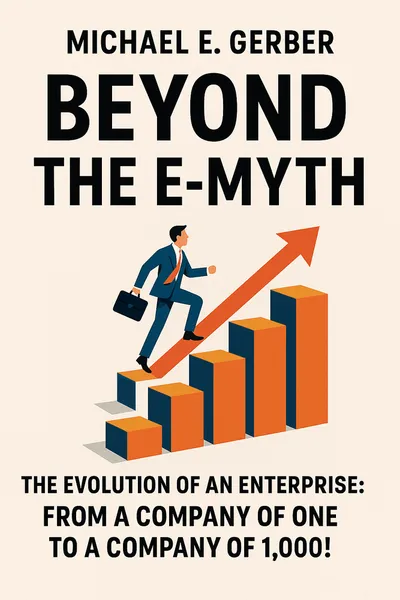
Beyond the e-myth
The evolution of an enterprise: from a company of one to a company of 1,000!
Description
The E-Myth, or Entrepreneurial Myth, suggests that many start businesses because they enjoy the work itself, but to grow, they must work on the business, not just in it. To transcend the E-Myth, one must create an enterprise that operates profitably without the founder's constant involvement.
Michael Gerber emphasizes that to evolve from a self-employed mindset to an entrepreneurial one, it's crucial to implement systems that allow the business to function independently. This shift requires thinking like an entrepreneur and establishing a clear process for designing, building, launching, and growing a company, preparing it for eventual sale.
Table of contents
01 Framework for corporate existence
Before considering the purchase of your company, it's essential to clearly articulate why your company exists and what it aims to achieve. This can be achieved by establishing your company's Dream, Vision, Purpose, and Mission. These four components form the bedrock of your business platform.
The Dream is the ultimate result your company aims to produce, addressing a problem or filling a gap for your customers. For instance, a company might aspire to revolutionize small businesses globally, equipping them with effective, low-cost systems to foster growth and competitive advantage. This dream is the grand ambition, the big picture that guides all other aspects of the business.
The Vision, on the other hand, outlines the structure your company must adopt to consistently deliver the desired result. A company might envision itself as the McDonald's of small business consulting, creating a franchise system that anyone can use to achieve success. This vision is the roadmap, the strategic plan that outlines how the company will achieve its dream.
The Purpose of your company is the specific outcome you aim to deliver for your most important customers. This is where you define what the result will look like and how it will feel. It's best to encapsulate this in a narrative that resonates emotionally with your customers. For example, a company might aim to empower small business owners to create companies as reliable and replicable as a McDonald's franchise, instilling confidence in their ability to achieve great results. This purpose is the why, the reason the company exists and the impact it aims to have on its customers.

02 Customer satisfaction mechanism
The primary responsibility of any company is to deliver the products and services purchased by its customers. This is a fundamental principle that underpins the very existence of a business. However, to position your company for a future sale, it's crucial to demonstrate more than just the ability to deliver. You need to show a smoothly functioning, efficient, and profitable delivery system. This is what potential buyers will be looking for. They want to see a business that can operate independently, without the hands-on involvement of the founder.
Interestingly, the best way to kickstart your new company, which we'll call NewCo for the sake of this discussion, is not necessarily to start with a specific product or service in mind. Instead, it's to hit the streets and engage with potential customers. Ask them about their roles, their most challenging problems, how these problems affect their business, and what solutions have worked best for them so far. This approach allows you to understand your customers, their thought processes, and their pain points. It also helps you verify if your initial assumptions about the product you want to sell align with their needs or if they are off the mark.
03 Customer procurement strategy
Acquiring new customers is a critical aspect of any business, and having a scalable client acquisition system in place is essential. The process begins with lead generation and concludes with converting that lead into a sale. The goal is to create lifetime customers who appreciate your product or service. This is often achieved by telling compelling stories, as stories are a powerful way to make experiences more meaningful.
Successful entrepreneurs like Walt Disney, Steve Jobs, Richard Branson, Howard Schultz, and Ray Kroc are not just known for the products they sell, but for the companies they built that inspired their audiences and employees. These entrepreneurs had a "Great Story" at the heart of their aspirations. To develop a great story for your client acquisition system, remember that memorable stories discuss universal and eternal ideas, respect the audience, and are authentic. The story should exemplify a universal truth you're trying to convey, just like the great entrepreneurs have done. For instance, Steve Jobs didn't just sell products, he created a company that delivered something consumers were missing. Similarly, your story should reveal truths that capture the hearts and minds of your future customers.
04 Turnkey leadership framework
The concept of a management system as the heart of a business is a powerful one. It's the core competency that every successful company must possess, and it's the foundation upon which you can build a lasting legacy. This system can be visualized as a four-legged stool, with the legs representing innovation, quantification, orchestration, and continuous improvement. It's crucial that this system is turnkey, allowing for growth, scalability, and the eventual sale of the enterprise. As an entrepreneur, you must always keep your ultimate exit strategy in mind.
The first leg of the stool, innovation, is about recognizing that the world is not static. It's about constantly seeking new and better ways to achieve results. This involves examining all your business systems for new efficiencies and encouraging everyone in your organization to make suggestions and join the search for new discoveries. Innovation is not just about creating new products or services, but also about finding new ways to do things, new ways to deliver value to your customers, and new ways to operate more efficiently and effectively.
Related books