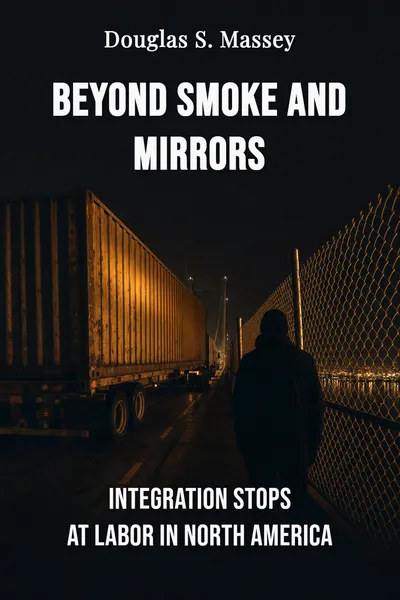
Beyond Smoke and Mirrors
Integration stops at labor in North America
Description
In January 1994, the North American Free Trade Agreement came into force, knitting the United States, Mexico and Canada into a single market for goods, capital, services and information. Tariffs fell, factories moved south, investment flowed across the Rio Grande in both directions, and the three governments celebrated a continent finally doing business as one. That same year, the United States launched Operation Gatekeeper in San Diego, pouring agents, fences and floodlights onto the busiest stretch of the Mexican border. One door was being thrown open. Another was being welded shut.
The two gestures were not contradictory by accident. They expressed a single, deliberate choice: integrate everything that moves through a market except the people. Goods could cross freely. Money could cross freely. The one factor of production that arrives with a face, a family and a future — labor — would be policed harder than ever. Douglas Massey, the sociologist who spent decades tracking Mexican migration village by village, set out to explain why a country would spend billions resisting the very flows its own economy had summoned into being.
His account, written with two longtime collaborators, reads less like a policy brief than a forensic report on a self-inflicted wound. The smoke and mirrors of the title are the rhetoric of "control" — the press conferences, the apprehension statistics, the ever-rising enforcement budgets — that obscured what was actually happening on the ground. Behind the spectacle, the numbers told a stranger story about who was crossing, why, and what the crackdown was quietly doing to them.
The question we’re asking : Why did North America integrate its markets for goods and money while militarizing its border against the workers those same markets required?What we’ll see : How a continent chose to integrate everything but labor — and what that one exception cost both countries.
Table of contents
01 Chapter 1 — The contradiction at the heart of NAFTA
Massey's starting point is simple and, once stated, hard to unsee. Migration between Mexico and the United States is not an invasion, an anomaly, or a failure of policing. It is one strand of a long historical process by which two neighboring economies have been growing into each other for more than a century. Rail lines, recruited farm labor, the bracero program that imported Mexican workers by the millions between 1942 and 1964, decades of cross-border commerce — all of it had already braided the two countries together long before anyone signed a trade deal.
NAFTA was the moment that integration acquired a name and a legal architecture. The agreement explicitly committed all three nations to lowering the barriers that slowed the movement of goods, capital, services and information across their borders. It was, in plain terms, a project to make North America function as a single economic space. The logic was that freer movement produces efficiency, growth and shared prosperity — the standard case for any common market.

02 Chapter 2 — A system that built the very flows it claimed to stop
To understand why the crackdown failed, Massey insists, we have to understand what migration actually was before the United States tried to stop it. Drawing on the Mexican Migration Project — the long-running survey he helped run, which interviewed thousands of households in migrant-sending communities — he reconstructed a portrait that bore little resemblance to the one in political speeches.
For most of the twentieth century, Mexican migration was overwhelmingly circular. Men, mostly, would cross north to work for a season or a few years, then return home to their families and communities. They came to earn, save and invest, not to settle. The flow was a current, not a flood, and it moved in both directions. Crossing was relatively cheap and low-risk, so workers could afford to go home knowing they could come back when they needed to.
03 Chapter 3 — The border that backfired
The centerpiece of the American response was the border itself. Beginning in the mid-1990s, the United States dramatically escalated enforcement: Operation Hold the Line in El Paso, Operation Gatekeeper in San Diego, and a steady climb in the Border Patrol's budget, personnel and physical infrastructure. The promise was deterrence. The reality, Massey shows, was a textbook case of a policy producing the opposite of its goal.
Sealing the busiest urban crossings did not stop people from coming. It rerouted them. Migrants who had once crossed quickly through Tijuana or Juárez were funneled into the deserts and mountains of Arizona and the remote stretches of Texas. The crossing became longer, more dangerous and far more expensive, and the death toll climbed as people pushed into terrain that killed by heat, cold and exhaustion. Enforcement did not lower the volume of migration so much as relocate and brutalize it.
04 Chapter 4 — When markets integrate but people don't
Step back from the border and a larger pattern comes into view. The Mexico–United States case is a controlled experiment in what happens when a market integrates its goods, its capital and its information while quarantining its labor. Every other factor of production was permitted to seek its most efficient location. Workers alone were ordered to stay put — and ordered, ultimately, in vain, because labor is the one factor that responds to the same incentives as capital while also being a human being with the will to act on them.
The lesson Massey draws is that selective integration is unstable. A continent cannot wire its economies together and expect the people inside them to behave as if the border were still a wall. The pressures that move money and goods move workers too, and a state that refuses to acknowledge this does not abolish the movement; it simply drives it underground, strips it of legal status, and converts a normal economic flow into a humanitarian and social crisis. The disenfranchisement of immigrants — barring them from services, from legal work, from the protections citizens take for granted — does not reduce their numbers. It corrodes the social fabric of both societies, hollowing out wages and rights on the American side and draining communities on the Mexican one.
05 Conclusion
Two doors opened on the same border in 1994, and the country that opened them insisted they had nothing to do with each other. Goods flowed; money flowed; workers were told to stay home and then hunted when they didn't. The crackdown that followed did not seal the border so much as transform the people crossing it — turning seasonal workers into permanent settlers, cheap crossings into deadly ones, and a self-regulating current into a trapped population. The statistics that announced success measured the wrong thing, and the failure they hid grew larger every year.
Related books