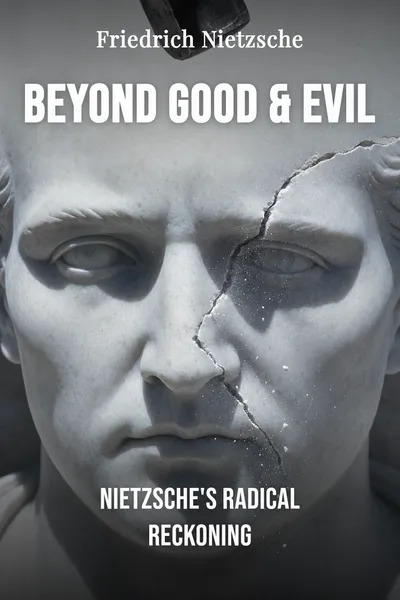
Beyond Good & Evil
Nietzsche's radical reckoning
Description
In 1886, Friedrich Nietzsche paid to publish a book that almost nobody bought. He had left his professorship at Basel years earlier, was living on a modest pension, moving between boarding houses in the Swiss Alps and the Italian coast, writing in intense bursts between bouts of illness. Beyond Good and Evil sold a few dozen copies in its first year. His publisher was unenthusiastic. The reviews, when they came, mostly missed the point. Nietzsche called the book, with characteristic lack of modesty, a way of saying the same things he had said in Thus Spoke Zarathustra — but this time in a form that could actually be argued with.
What he produced was not a treatise in the ordinary sense. It has no single sustained argument, no chapters that build one on the next toward a conclusion. Instead there are nine parts and a run of aphorisms, ranging from a single stinging line to short essays, circling philosophy, religion, morality, scholarship, nationhood, and the question of what it means to be noble. The style is deliberate. Nietzsche believed that how a philosopher writes tells you what a philosopher values, and he wrote to provoke, to seduce, and occasionally to insult the reader into thinking.
The title is the provocation in miniature. Not beyond good and bad — beyond good and evil, the pair that Nietzsche thought carried a whole hidden history. He wanted to ask where our deepest moral certainties came from, who they served, and whether we had ever really examined them at all. The book that came out of that question became one of the most influential of the nineteenth century, for reasons and misuses its author could not have foreseen.
The question we’re asking : When Nietzsche sets out to sum up his philosophy, what is he actually attacking, and what does he put in its place?What we’ll see : How a strange, aphoristic book takes apart the certainties of philosophers and moralists — and hands us a far more uncomfortable way of reading them.
Table of contents
01 Chapter 1 — The philosophers who never asked the real question
The book opens by going after the philosophers themselves, and the charge is unusually personal. Nietzsche imagines truth as a woman the philosophers have clumsily failed to win — all their solemn systems built on the assumption that truth is something obviously worth having, that the will to truth is above suspicion. His first move is to suspect it. Why do we want truth at all? Why not untruth, or uncertainty? Nobody, he says, had thought to ask.
His real target is the pretense of pure reason. When a philosopher like Kant claims to have discovered the necessary structures of thought, Nietzsche reads it differently. Behind every great philosophy, he argues, stands a confession — the involuntary memoir of its author. The system is not the disinterested result of cold logic; it is the rationalization of a prior instinct, a temperament, a ranking of what matters, dressed up afterward in the language of proof. The Stoics who told us to live according to nature were not reading nature at all. They were reading their own desire to make nature obey them.

02 Chapter 2 — The free spirit and the will to power
Against the philosopher who hides behind his system, Nietzsche sets a figure he calls the free spirit. This is not simply a rebel or a skeptic. The free spirit is someone who can hold dangerous thoughts without needing them to be comforting, who has broken with the herd not out of resentment but out of a kind of surplus strength. Free spirits are rare, and Nietzsche writes to and for the ones he hopes are coming — he addresses them almost as future readers, a scattered company he will never meet.
What such a spirit must give up is the craving for certainty, for a world that is fair and legible and on our side. Most people, Nietzsche thinks, believe things because believing them feels secure, and they mistake that feeling of security for evidence. The free spirit learns to live without the net. He can entertain the idea that his convictions are useful fictions, that even error might be a condition of life, and keep going anyway. This takes a hardness toward oneself that Nietzsche does not pretend is pleasant.
03 Chapter 3 — Morality has a history, and two names
The heart of the book is the claim that morality is not one thing handed down from the sky, but a human product with a history — and that this history has been forgotten so thoroughly that we mistake our particular morality for morality itself. Nietzsche wants to reopen the record. Before we ask which acts are good, he says, we should ask how the very ideas of good and evil were manufactured, and by whom.
His answer is that there have been, roughly, two kinds of morality, growing from opposite soils. What he calls master morality arises among the strong and self-affirming. Here "good" means noble, powerful, life-affirming — it is what the strong say of themselves — and "bad" is merely the contemptible, the common, the weak, named almost as an afterthought. The good comes first, out of abundance. Slave morality inverts everything. It arises among the powerless, the resentful, those who cannot act and so take their revenge imaginatively. For them the powerful are recast as "evil," and only then, by contrast, do the meek qualities of the oppressed — patience, humility, obedience — get renamed as "good."
04 Chapter 4 — What is noble
The final part turns to nobility, and it makes explicit what the whole book has been quietly performing. For Nietzsche, every genuine philosophy is an order of rank — a statement about which experiences, which types of person, which possibilities are higher and which are lower. A system that pretends to be neutral is simply one that has hidden its rankings. Beyond Good and Evil is unusual because it puts its own hierarchy on the table: it prizes strength over weakness, creation over comfort, distance and solitude over the warm consensus of the herd.
This is why the book cannot be read as ordinary philosophy and set aside like a solved problem. It is an act of self-disclosure that demands the same of its reader. If every philosophy is the confession of its author, then to read Nietzsche honestly is to be asked what one's own convictions confess. What does your certainty that pity is virtuous, that equality is just, that truth is worth having at any cost, reveal about the kind of creature you are and the kind you fear becoming? He does not answer for us. He makes the question inescapable.
05 Conclusion
The book Nietzsche paid to print, and that barely sold, has since become one of the most cited and most quarreled-over works of modern thought. Its aphorisms have been used to justify positions Nietzsche would have found contemptible, and mined for insights he never quite stated. Part of that fate is built into the form he chose. A book of aphorisms hands the reader fragments and refuses to assemble them; it makes complicity unavoidable, because the meaning has to be finished in the reading.
Related books